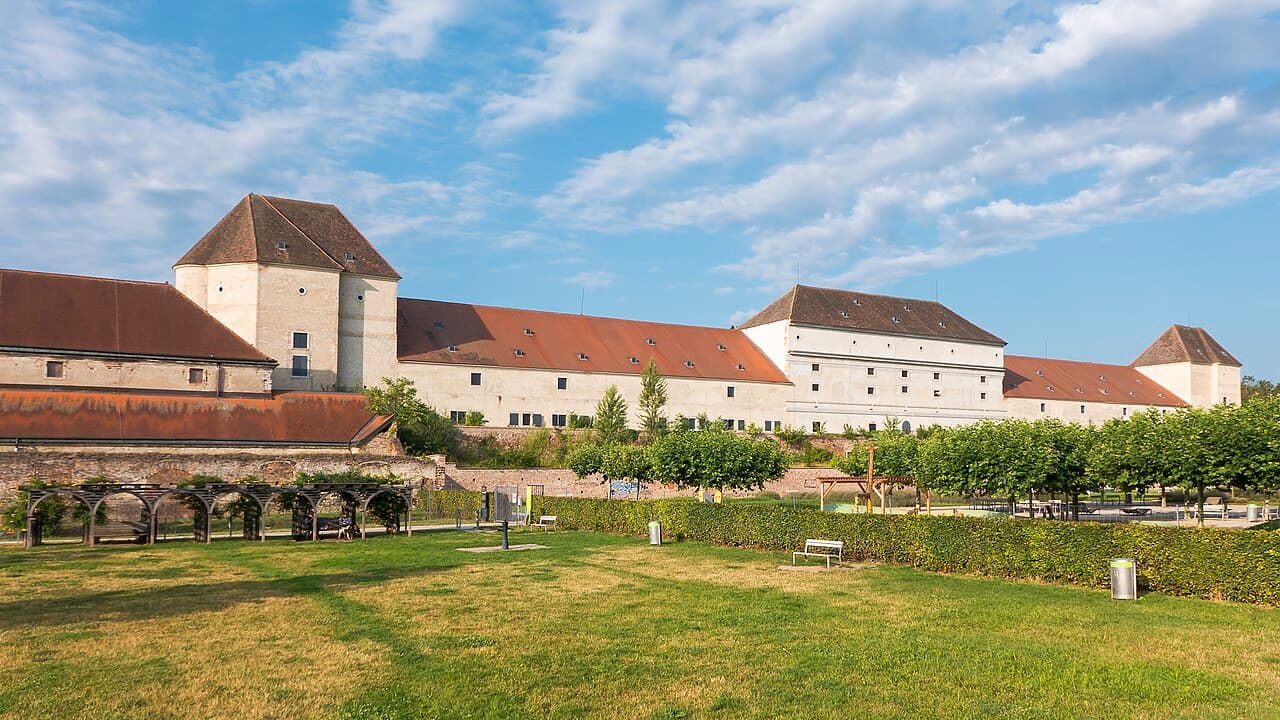
Neugebäude Palace (German: Schloss Neugebäude) is a significant Renaissance era palace complex located in the Simmering district of Vienna, Austria. Commissioned by Habsburg Emperor Maximilian II, construction began in 1569, reflecting the architectural ambitions of the late 16th century. The palace was conceived as a grand hunting and pleasure residence, embodying Mannerist architectural elements that were prevalent in Central Europe during this period.
The site holds historical importance as it is reputedly the location where Ottoman Sultan Suleiman the Magnificent pitched his tent during the 1529 Siege of Vienna. This association with a major historical event influenced the palace's design, which was modeled to reflect the grandeur and strategic significance of the site.
Architectural design and features
Neugebäude Palace was planned as a vast complex featuring a series of interconnected buildings arranged around courtyards and extensive gardens. The architecture displays characteristic Mannerist features, including ornamental façades, elaborate window frames, and a blend of classical elements with innovative spatial arrangements. The palace grounds originally included formal gardens, fountains, and hunting grounds, emphasizing its dual role as a residence and leisure estate.
Layout and structural elements
The palace complex was composed of multiple wings forming enclosed courtyards, which served both aesthetic and defensive functions. The design incorporated arcaded galleries, ornate staircases, and vaulted halls that demonstrated the craftsmanship of the period. The extensive gardens were designed in a geometric pattern, typical of Renaissance landscaping, with pathways, terraces, and water features enhancing the visual appeal.
Historical significance and decline
During the 16th and early 17th centuries, Neugebäude Palace served as a favored residence of the Habsburg court, particularly for hunting and summer retreats. However, by the late 17th century, the palace fell into disuse, largely due to changing political priorities and the shifting residence preferences of the Habsburgs. The structure gradually deteriorated, and much of it was abandoned, leading to its current state as ruins.
Despite its decline, the palace remains a protected historical monument, recognized for its architectural and cultural value. Since the 1970s, efforts have been undertaken to stabilize and preserve the ruins, ensuring that the site remains accessible for historical study and public appreciation.
Modern adaptation and current use
In the early 20th century, the palace's extensive gardens found a new purpose. In 1922, the renowned architect Clemens Holzmeister designed the Feuerhalle Simmering, Austria's first crematorium, within the walled gardens of the derelict palace. This innovative reuse integrated the historical landscape with a modern function, preserving many of the ancient trees designated as natural monuments.
Today, the site offers visitors a unique glimpse into Renaissance architecture and Habsburg history, set amidst a park-like environment that blends historical ruins with commemorative spaces. The palace's ruins and gardens are open to the public, serving as a cultural and historical landmark within Vienna.
Visiting Neugebäude Palace
Visitors to Neugebäude Palace can explore the remains of the palace structures and enjoy the surrounding gardens. The site provides interpretive signage detailing its historical context and architectural features. While the palace is in a state of ruins, it remains an evocative reminder of Vienna's Renaissance past and the Habsburg dynasty's architectural legacy.
The integration of the Feuerhalle Simmering within the palace grounds adds a layer of 20th-century history, making the site a place of both remembrance and historical continuity. The palace is accessible year-round, with no entrance fee, allowing visitors to experience a quiet, reflective environment within the bustling city.
Frequently asked questions (FAQ)
- What is the historical significance of Neugebäude Palace?
- Neugebäude Palace was built in the 16th century by Emperor Maximilian II and is linked to the 1529 Siege of Vienna, where Sultan Suleiman the Magnificent camped nearby. It exemplifies Renaissance architecture and Habsburg history.
- Can I visit the ruins of Neugebäude Palace?
- Yes, the ruins and gardens of Neugebäude Palace are open to the public year-round with no entrance fee, offering a peaceful historical site in Vienna.
- What architectural style is Neugebäude Palace built in?
- Neugebäude Palace is designed in the Renaissance style with Mannerist features, including ornamental façades and geometric garden layouts typical of the period.
- Why did Neugebäude Palace fall into ruin?
- The palace fell into disuse in the late 17th century due to changing political priorities and the Habsburgs' shifting residences, leading to gradual abandonment and decay.
- What is the Feuerhalle Simmering and how is it connected to Neugebäude Palace?
- Feuerhalle Simmering, Austria's first crematorium, was built in 1922 within the walled gardens of Neugebäude Palace, reusing the historic grounds and preserving ancient trees.

Information
Loading map...
Visitor reviews
No reviews yet. Been here? Write the first review and help other travelers!
Write the first reviewVisited this castle? Share your experience
Your review helps other travelers and adds first-hand knowledge to our encyclopedia.