Franzensburg
Franzensburg castle is a remarkable example of 19th-century historicism located in Laxenburg, Austria. Constructed between 1801 and 1836, it stands as a water castle on an artificial island within a large park, designed to evoke the grandeur and defensive character of medieval castles. Commissioned by Emperor Franz II, the castle was intended as both a stately residence and a museum to showcase the Habsburg family’s extensive art collections. Its architectural design deliberately references medieval forms, making it a significant milestone in the development of historicist architecture in Europe.
Historical context and construction
The castle was built during a time of great political upheaval in Europe, with construction interrupted by the Napoleonic Wars. The initial phase began in 1801 under the direction of the court architect Johann Ferdinand Hetzendorf von Hohenberg, who planned a complex comprising two main parts: the Ritterburg (knight’s castle) intended for residential use, and the Knappenburg, designed as a museum space. Work was halted in 1805 due to the wars but resumed after the coalition victory over Napoleon, culminating in the castle’s completion in 1836, shortly after Emperor Franz II’s death.
To control construction costs and ensure material supply, Emperor Franz II acquired a brick factory and the nearby Vösendorf castle, which served as a production and administrative center. The castle incorporates numerous medieval architectural fragments salvaged from significant historic sites, including elements from the Heiligenkreuz Monastery parish church and the Speciosa chapel of Klosterneuburg, one of the earliest Gothic buildings in the Danube region. These fragments were carefully integrated into the structure, enhancing its authenticity and historic character.
Architectural features and style
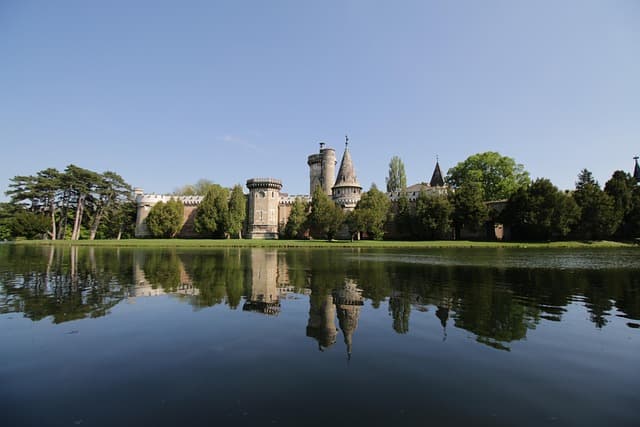
Franzensburg is a water castle situated on an artificial island surrounded by a pond within a 250-hectare English landscape garden. The castle’s layout is complex, featuring multiple multi-story buildings connected by covered passages and galleries, designed to simulate a medieval fortress. The western facade is characterized by a high battlement wall with defensive towers, emulating a genuine medieval stronghold, while the eastern side features a tall observation tower offering panoramic views of the surrounding park.
The castle’s interiors are richly decorated, reflecting the Habsburgs’ imperial stature and artistic patronage. Noteworthy rooms include the Armory Hall, with a ceiling adorned by shields bearing the coats of arms of 44 Austrian regions and provinces, symbolizing the empire’s vast reach. The Habsburg Hall houses half of the imperial statues sculpted by Paul Strudel, while the Lorraine Hall features portraits of emperors following Franz II, anchored by a portrait of the castle’s founder painted by Leopold Kupelwieser. The Luisenzimmer is distinguished by its ceiling paintings and contains intricately carved door panels dating from around 1600, originally from Rappottenstein Castle.

Photo by Pho Tomass
The park and surrounding landscape
The castle is set within an extensive English landscape garden spanning approximately 250 hectares. This park, laid out in the late 18th century, features naturalistic elements such as forests, meadows, canals, and ornamental structures including the Temple of Concord, the Knight’s Column, and a pleasure house. These elements create a harmonious environment that complements the castle’s medieval revival architecture and offers visitors a scenic and culturally rich experience.
The park remains a popular destination for tourists and locals alike, offering opportunities for guided tours of the castle, summer theater performances, and leisurely walks through the landscaped grounds.
Access and visitor experience
Access to Franzensburg has historically been by ferry, crossing the pond to reach the artificial island. This ferry service remains operational, managed by a licensed shipping company. During winter months, when the pond may freeze, a wooden bridge replaces the ferry, and there is also a permanent stone bridge on the eastern side of the pond providing year-round access.
Visitors to Franzensburg can explore its richly decorated interiors, learn about the Habsburg dynasty’s history, and enjoy the surrounding park’s natural beauty. The castle’s combination of medieval architectural motifs and 19th-century historicism offers a unique glimpse into the period’s romanticized view of the past.
Legacy and preservation
Following the dissolution of the Austro-Hungarian Empire in 1918, Franzensburg and other Habsburg properties were confiscated by the state. Since then, the castle has functioned as a public museum, preserving its art collections and architectural heritage. Restoration efforts culminated in 2003 with a significant reopening attended by Otto von Habsburg, a direct descendant of Emperor Franz II.
Today, Franzensburg stands as a well-preserved example of historicist architecture and a cultural landmark within Austria. Its integration of authentic medieval elements with 19th-century design reflects the era’s fascination with the medieval past and contributes to its enduring appeal as a tourist destination and heritage site.
Frequently asked questions (FAQ)
- How do I get to Franzensburg castle?
- Franzensburg castle is located on an artificial island accessible by a ferry service operated by a licensed company. In winter, a wooden bridge replaces the ferry, and there is also a permanent stone bridge on the eastern side of the pond for access.
- What is the historical significance of Franzensburg?
- Franzensburg was built in the early 19th century by Emperor Franz II as a historicist water castle incorporating genuine medieval architectural fragments. It symbolizes the Habsburg dynasty’s cultural heritage and the 19th-century romantic revival of medieval architecture.
- When was Franzensburg castle built?
- Construction of Franzensburg began in 1801, was interrupted by the Napoleonic Wars in 1805, and was completed in 1836 shortly after Emperor Franz II’s death.
- Can I visit the interior of Franzensburg castle?
- Yes, the castle is open daily from 10:00 to 16:00 and offers guided tours of its richly decorated interiors, including the Armory Hall, Habsburg Hall, and Lorraine Hall.
- What architectural style is Franzensburg castle?
- Franzensburg is designed in the historicist style, deliberately imitating medieval Gothic and fortress architecture, and incorporates authentic medieval building fragments from notable historic sites.
- Is there an entrance fee to visit Franzensburg?
- Yes, the entrance fee is €8 for adults and €4 for children, supporting the castle’s maintenance and museum operations.
Photo gallery

Photo by FTom


Information
Opening hours
10:00-16:00, daily
Ticket prices
€8 adult, €4 child
Current owner
State museum
Website
Visit websiteSources & official resources
Verify the information above using these authoritative references.
Loading map...
Visitor reviews
No reviews yet. Been here? Write the first review and help other travelers!
Write the first reviewVisited this castle? Share your experience
Your review helps other travelers and adds first-hand knowledge to our encyclopedia.