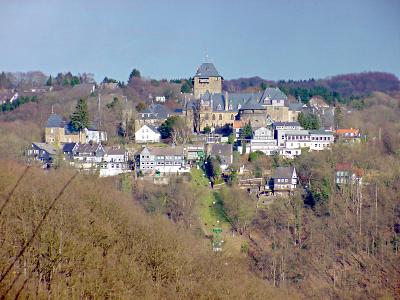
Schloss Burg
Schloss Burg, perched majestically above the Wupper River in present-day Solingen, Germany, stands as a remarkable example of a 12th-century hill castle with a rich history spanning nearly a millennium. Founded between 1133 and 1150 by Count Adolf II of Berg, the castle was established on the site of an earlier fortification, replacing the family’s former seat at Burg Berge near Altenberg. Originally called "Neuenburg," meaning "new castle," it became the ancestral stronghold of the Counts and later Dukes of Berg, playing a pivotal role in the region's medieval political and military landscape.
The castle's location on a rocky spur approximately 100 meters above the river provided a naturally defensible position, surrounded by steep cliffs on three sides. Access was carefully controlled from the east, where multiple moats and a massive multi-story shield wall measuring 17 meters across formed formidable barriers against invaders. This strategic siting exemplifies the typical characteristics of a hill castle, designed to dominate the surrounding landscape both visually and militarily.
Early history and medieval expansion
During the High Middle Ages, Schloss Burg rose in prominence under the stewardship of notable figures such as Archbishop Engelbert II of Cologne (1218–1225). He undertook significant expansions, including the construction of a large two-story hall building known as the Palas, a chapel, and enhanced fortifications. These additions transformed the castle into a center of political power and courtly life, reflecting the increasing importance of the Berg dynasty in regional affairs.
The core of the castle, the Palas, spans approximately 700 square meters and features a six-axial hall alongside a chapel wing built later in the 19th century in neo-Gothic style. The building exhibits a blend of late Gothic and Romanesque revival architectural elements, including distinctive windows, a freestanding staircase with arcades, and decorative statues and heraldic symbols that celebrate the castle's noble heritage.
The bergfried and defensive structures
The Bergfried, or keep, is a central feature of Schloss Burg, with foundations dating back to the 12th century. The reconstructed tower rises about 32 meters high and comprises six floors. It is adorned with Romanesque-style twin windows and capped by a flat hipped roof. A covered wooden bridge connects the Bergfried to the shield wall, providing both defensive strength and a commanding vantage point with panoramic views of the surrounding landscape.
The castle's eastern approach is guarded by a shield wall rebuilt between 1888 and 1902, featuring a projecting battlement walkway and an external latrine known as the Heymlich Gemach. This wall was crucial in protecting the castle from direct assault and exemplifies medieval defensive architecture adapted through later restoration efforts.
Additional defensive elements include the Diebsturm or prison tower, an octagonal structure with a vaulted medieval ground floor and two upper floors added in the 15th century, topped by an eight-sided roof. The Zwingertor outer gate features a pointed arch passage with a defensive machicolation—a stone opening through which defenders could repel attackers. Adjacent to it is the Pferdestall, a two-story half-timbered building designed by architect Gerhard August Fischer, serving historically as stables and imperial living quarters.
Historical significance and later uses
Schloss Burg witnessed significant historical events, notably after the Battle of Worringen in 1288, when Archbishop Siegfried von Westerburg was imprisoned within its walls. The castle also became linked to the dynastic union of Jülich-Cleves-Berg in 1496 through the marriage of Maria of Jülich-Berg, intertwining important noble lineages.
From the late 14th century, the castle's prominence waned as the Counts of Berg ascended to dukes and relocated their main residence to Düsseldorf. Schloss Burg transitioned into a hunting lodge and administrative center rather than a primary ducal seat.
The castle endured damage during the Thirty Years’ War, including a siege by Swedish forces in 1632 and partial demolition by imperial troops in 1648. Over subsequent centuries, it fell into disrepair and was repurposed for industrial uses such as a blanket factory and a school. By 1849, plans for demolition were considered, reflecting its decline.
Preservation and restoration efforts
Preservation efforts began earnestly in 1887 with the founding of a preservation association led by Julius Schumacher. Architect Gerhard August Fischer spearheaded a comprehensive reconstruction campaign from 1890 to 1914, reviving much of the castle’s medieval character despite interruptions caused by financial constraints and the outbreak of World War I.
A devastating fire in 1920 destroyed significant portions of the castle and its museum collection, prompting restoration work between 1922 and 1925. Post-World War II repairs included the addition of the Memorial of the German East in the castle’s Batterieturm or battery tower in 1951, commemorating displaced persons.
Archaeological excavations in 2005 uncovered original 12th-century foundations of the main hall and unearthed medieval ceramics and bones, enriching understanding of the castle’s early history and the lifestyle of its inhabitants.
Architectural features and interior spaces
Constructed primarily from local graywacke rubble stone with finer stone detailing window and door frames, Schloss Burg’s buildings showcase a harmonious blend of medieval construction techniques and revivalist styles. Most roofs are covered with slate, and some buildings incorporate decorative half-timbering.
Notable interior spaces include the Ahnensaal or ancestral hall, which features a genealogical mural celebrating the Berg family lineage. The Rittersaal or knights’ hall measures 22 by 13 meters and contains Gothic-style window niches and frescoes depicting regional history, reflecting the castle’s role as a noble residence and seat of power.
The Kemenate, a connecting chamber with wood flooring and murals illustrating courtly life, and the neo-Gothic chapel adorned with Jugendstil murals and a large wooden statue of Archangel Michael, further enrich the castle’s interior.
Castle grounds and surrounding features
The castle grounds include a historic lime tree known as the Kaiserlinde and several protected trees, contributing to the site's natural heritage. A network of paths connects Schloss Burg to the surrounding forest and nearby parks, enhancing its appeal as a cultural and recreational destination.
Access is gained through a large double gate on the southeast side, and since 1952, a cable car links the castle to the lower town, facilitating visitor access.
Museum and cultural role today
Today, Schloss Burg is a well-preserved monument owned jointly by the cities of Solingen, Remscheid, and Wuppertal. It functions as a museum, cultural venue, and memorial site. The Bergisches Museum occupies several rooms within the Palas and Bergfried, displaying medieval weapons, regional artifacts, tapestries, and furniture, including a 16th-century wooden statue of Saint Adrianus and a 13th-century ivory casket decorated with Arabesque patterns.
The castle complex hosts cultural events, artisan shops, and a restaurant located within the Palas, making it a vibrant center for heritage and tourism in the Berg region.
Nearby, the former Johanniterkirche or St. Martinus Church, dating to the late 12th century, features a Romanesque east choir and an octagonal bell tower covered with slate shingles. Its interior boasts medieval marble columns and stained glass windows depicting religious scenes and a unique stylized astronaut, adding to the site's historical richness.
Frequently asked questions (FAQ)
- How do I get to Schloss Burg?
- Schloss Burg is accessible via a cable car from the town of Solingen, which connects the lower town to the hilltop castle. Visitors can also reach the castle by car or on foot through well-marked hiking trails.
- What are the opening hours of Schloss Burg?
- The castle is typically open to visitors daily from 10:00 to 17:00, but hours may vary seasonally or for special events. It is advisable to check the official website before planning your visit.
- Is Schloss Burg wheelchair accessible?
- While the castle has some uneven terrain and historic structures that may pose challenges, efforts have been made to improve accessibility. Certain areas are wheelchair accessible, but visitors with mobility concerns should inquire in advance.
- What can I see inside Schloss Burg?
- Visitors can explore the reconstructed medieval buildings, including the Palas, Bergfried, and Diebsturm. The Bergisches Museum displays medieval weapons, tapestries, and regional artifacts, while the neo-Gothic chapel and knights’ hall showcase intricate murals and architectural details.
- When was Schloss Burg originally built?
- Schloss Burg was founded in the early 12th century, between 1133 and 1150, by Count Adolf II of Berg on the site of an older fortification.
- Can I attend cultural events at Schloss Burg?
- Yes, the castle regularly hosts cultural events, artisan markets, and exhibitions, making it a lively venue for both locals and tourists interested in medieval history and regional culture.
- Are there guided tours available at Schloss Burg?
- Guided tours are available, providing detailed insights into the castle’s history, architecture, and significance. These tours can enhance the visitor experience and are often offered in multiple languages.
Information
Sources & official resources
Verify the information above using these authoritative references.
Loading map...
Visitor reviews
No reviews yet. Been here? Write the first review and help other travelers!
Write the first reviewVisited this castle? Share your experience
Your review helps other travelers and adds first-hand knowledge to our encyclopedia.