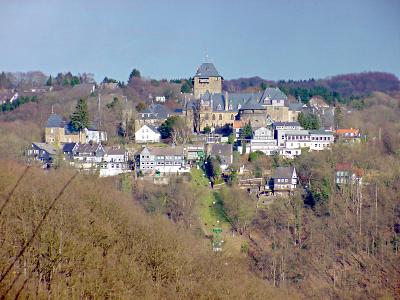
Burg Berge
Burg Berge stands as a significant medieval fortification nestled near the community of Altenberg, within the municipality of Odenthal, Germany. This hill castle traces its origins to the 11th century, marking the early power base of the noble family who became known as the Counts of Berg. The castle's elevated position on two rocky hilltops overlooking the Dhünn River exemplifies typical early medieval defensive strategies, integrating natural terrain with constructed fortifications.
The origins and historical significance of Burg Berge
The foundation of Burg Berge dates approximately to 1060, attributed to the father of Adolf von Berg, who later attained the title of count. This initial construction phase established the castle as a stronghold for the family that would adopt the name "de Berge," or "from the mountain," reflecting their connection to the castle's commanding location. By around 1080, the family had solidified their identity tied to this site, using the Latin term "de monte" in official records.
In 1133, a pivotal moment occurred when Count Adolf II and his brother Eberhard relocated their residence to the newly built Burg Neuenberge along the Wupper River. This move signaled a shift in the family's center of power away from Burg Berge, marking the beginning of its decline as a noble residence.
Transition to monastic use and eventual abandonment
The same year as the relocation, Adolf II and Eberhard founded a monastery on the grounds of the old castle, known as Kloster zum alten Berge or Monasterium Sanctae Mariae de Berge. This monastery was established to house twelve Cistercian monks from Morimond Abbey in the Brabant-Burgundy region. Initially, the monks occupied the remaining castle structures while expanding the site, including doubling the plateau through embankments on the southern slope.
However, the monastery's tenure at Burg Berge was brief. The monks soon found more favorable conditions in the nearby Dhünn valley, prompting their relocation. By 1145, the Altenberg monastery was sufficiently completed to consecrate its first church, constructed largely from materials salvaged from the dismantled fortress. Following this, Burg Berge ceased to function as either a noble residence or monastic site, leading to its gradual abandonment.
Architectural features and defensive structures
The castle's remains occupy a steep hillside, with two rocky hilltops each once supporting significant structures. The surviving ruins primarily consist of rubble stone walls with traces of mortar, showcasing the robust construction methods typical of the 11th and early 12th centuries. Historical accounts from the late 19th century describe a complex system of defenses, including multiple ditches and ramparts extending over the northern slopes. Three main ditches, measuring approximately 96, 100, and 112 paces in length, were complemented by two ramparts behind the outermost ditch, creating formidable obstacles for any attackers.
Excavations in 1981 revealed that a modern unpaved road now crosses the site of the castle's original moat, which had been destroyed during road construction. The hilltop plateau corresponds to the former courtyard area, with a natural rocky outcrop believed to have supported the main residential building. One of the most distinctive features is an artificial mound with a substantial masonry base, traditionally considered the namesake for both the Counts of Berg and the Bergisches Land region. Beneath this mound, underground walls survive despite damage from illicit digging.
Opposite the castle lies a swampy area, likely the remains of a defensive pond designed to hinder access and enhance security. These features collectively illustrate the strategic military design of the castle, integrating natural and man-made defenses.
Archaeological discoveries and cultural heritage
Archaeological investigations conducted in 1981 confirmed the castle's precise location and provided an approximate layout of its original buildings. While no large treasures were found—likely due to the early abandonment—numerous smaller artifacts were recovered. These include gaming pieces made of bone and ivory, a gilded two-part pendant possibly linked to horse harness decoration, coins, Italian ceramic tiles, and fragments of stained glass. Such finds indicate the castle's occupants were of notable status with connections extending beyond the local region.
Today, Burg Berge is a legally protected archaeological monument within Odenthal. Its ruins offer valuable insights into the early medieval fortified noble residences and the origins of one of the region's most influential noble families. The site remains an important cultural heritage landmark, reflecting the complex history of medieval fortifications, noble power, and monastic foundations in the Rhineland area.
Frequently asked questions (FAQ)
- What is the historical significance of Burg Berge?
- Burg Berge is significant as the original seat of the Counts of Berg, built in the 11th century and marking early medieval noble power in the region.
- Can visitors see the ruins of Burg Berge today?
- Yes, the ruins of Burg Berge are preserved as an archaeological monument and can be visited, although only fragments of walls and earthworks remain.
- When was Burg Berge constructed?
- Burg Berge was constructed around 1060, during the early medieval period, by the ancestors of the Counts of Berg.
- Why was the monastery at Burg Berge relocated?
- The Cistercian monks initially settled at Burg Berge but relocated to the nearby Dhünn valley due to more favorable conditions for monastic life and construction.
- What defensive features did Burg Berge have?
- The castle featured multiple ditches, ramparts, a moat, and a defensive pond, utilizing both natural terrain and constructed earthworks for protection.
Information
Website
Visit websiteSources & official resources
Verify the information above using these authoritative references.
Loading map...
Visitor reviews
No reviews yet. Been here? Write the first review and help other travelers!
Write the first reviewVisited this castle? Share your experience
Your review helps other travelers and adds first-hand knowledge to our encyclopedia.