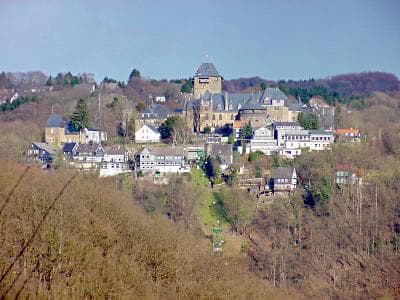
Burg Castle
Burg Castle (Schloss Burg) stands as the largest reconstructed castle in North Rhine-Westphalia, Germany, and remains a significant cultural and historical landmark. Perched on a mountain overlooking the river Wupper near the city of Solingen, this castle has a rich history closely intertwined with the rise of the Duchy of Berg.
The castle was originally constructed in the 12th century, shortly after 1133, by Count Adolf III of Berg. Its strategic location on a hill provided natural defense advantages and control over the surrounding region. Over the centuries, Burg Castle evolved from a medieval fortress into a palatial hunting residence, reflecting the changing needs and status of its owners.
Early history and medieval significance
The early history of Burg Castle is closely linked to the powerful Counts of Berg. After Count Adolf III established the castle, his descendants played prominent roles in regional and imperial affairs. Notably, Count Adolf VI of Berg participated in the Fifth Crusade and died during the siege of Damietta in Egypt in 1218. His death without male heirs led to a succession dispute resolved by his younger brother, Archbishop Engelbert I of Cologne, who assumed control of the county.
Engelbert I, also known as Count Engelbert II of Berg, was a powerful figure, serving as an advisor to Holy Roman Emperor Frederick II and guardian to the future King Henry (VII) of Germany. Between 1218 and 1225, he undertook significant construction at Burg Castle, including building the palas (main residential building). His assassination in 1225 by his nephew Friedrich von Isenberg marked a turbulent period for the castle and region.
The war of succession and the battle of worringen
The War of succession for the Duchy of Limburg profoundly influenced the castle's history. Count Adolf VIII of Berg played a key role in the decisive Battle of Worringen on June 5, 1288, which resulted in the capture of the opposing Archbishop of Cologne, Siegfried II of Westerburg, who was imprisoned at Burg Castle. This victory allowed Adolf VIII to elevate Düsseldorf to city status and control important trade routes along the Rhine River.
Architectural evolution and later history
Throughout the 13th and 14th centuries, Burg Castle remained the main residence of the Counts of Berg. Following the elevation of Count William to Duke by King Wenzel in 1380, Düsseldorf became the capital of the Duchy of Berg, while Burg Castle transitioned into a hunting castle and ceremonial venue, earning the designation "Schloss" (palatial castle).
In 1496, the castle hosted the engagement of Maria of Jülich-Berg to John of Cleves-Mark, whose marriage unified the duchies of Jülich-Cleves-Berg. Their daughter, Anne of Cleves, later became briefly married to King Henry VIII of England, linking the castle to broader European history.
The castle faced military action during the Thirty Years' War, notably a siege by Swedish forces in 1632. After the war, in 1648, Imperial troops destroyed much of the castle's fortifications, including the keep, walls, and gates. Partial reconstruction occurred around 1700, repurposing the castle for administrative functions.
Decline and restoration efforts
By 1849, Burg Castle had fallen into disrepair and was sold for scrapping, becoming a ruin. The architect Gerhard August Fischer initiated restoration plans in 1882, based on detailed studies of the castle's 16th-century appearance. Restoration work, led by a dedicated committee, spanned from 1890 to 1914, culminating with the construction of the Battery Tower.
A devastating fire in 1920 severely damaged the castle, but subsequent restoration from 1922 to 1925 revived the structure. The castle grounds feature the Engelbert monument, dedicated in 1929 to honor the castle's builder and archbishop, sculpted by Paul Wynand.
Modern significance and visitor experience
Today, Burg Castle is a well-preserved and reconstructed castle complex that serves as a major public attraction. It houses the Museum of the Bergische Land, showcasing regional history and culture. The castle church remains a popular venue for weddings, highlighting the site's ongoing cultural relevance.
The castle grounds also include memorials such as the Memorial for Deportation and the Memorial of the German Eastern Provinces, featuring historic church bells from Königsberg and Breslau. Visitors can explore commercial shops offering souvenirs and enjoy hiking trails leading to nearby forests and the village of Unterburg at the mountain's base.
A chairlift connects Unterburg with the castle, providing convenient access for tourists. The local specialty, the Burger Brezel (pretzel), is celebrated with its own monument in the village, adding to the cultural charm of the area.
Architectural features and layout
Burg Castle exemplifies high medieval architecture with later palatial enhancements. Its layout includes defensive walls, a keep, gates, and the palas. The castle's reconstruction reflects careful historical research to preserve its medieval character while accommodating modern visitor needs.
The castle's elevated position on a hill classifies it as a hill castle, utilizing natural topography for defense and commanding views. Its architectural style is primarily Gothic, with some Renaissance influences visible in later additions and restorations.
Frequently asked questions (FAQ)
- How do I get to Burg Castle?
- Burg Castle is located in Solingen, Germany, and can be easily reached by car or public transportation. If you are traveling by train, you can take a local bus from the nearest station to reach the castle grounds.
- What are the opening hours of Burg Castle?
- Burg Castle is open to visitors daily, typically from 10 AM to 6 PM. However, hours may vary during holidays, so it is advisable to check the official website before your visit.
- When was Burg Castle built?
- Burg Castle was originally constructed in the 13th century, making it a significant historical landmark in the region. It has undergone various renovations over the years, preserving its medieval architecture and charm.
- Can I take a guided tour of Burg Castle?
- Yes, guided tours are available at Burg Castle, providing an in-depth look at its history and architecture. Tours are typically conducted in both German and English, ensuring a comprehensive experience for all visitors.
- Why is Burg Castle historically significant?
- Burg Castle is significant not only for its impressive architecture but also for its role in the history of the region. It served as a strategic fortress and residence for various noble families throughout the centuries, reflecting the medieval power dynamics in Germany.
- Is it possible to host events at Burg Castle?
- Yes, Burg Castle offers facilities for hosting events such as weddings, corporate meetings, and private gatherings. The picturesque surroundings and historical ambiance make it a unique venue for special occasions.
- What are the ticket prices for visiting Burg Castle?
- Ticket prices for Burg Castle are quite reasonable, with discounts available for children, students, and seniors. Group rates may also apply, making it an affordable option for families and tours.
- What is the best time to visit Burg Castle?
- The best time to visit Burg Castle is during the spring and early autumn when the weather is pleasant and outdoor activities are plentiful. Additionally, visiting during weekdays can help you avoid larger crowds typically seen on weekends.
- Are there any nearby attractions to explore?
- Yes, in addition to Burg Castle, visitors can explore the beautiful surrounding nature trails and nearby parks. The region is also home to other historical sites and museums that highlight the rich cultural heritage of Solingen.
Photo gallery

Photo by Michael Tettinger, Solingen Original uploader was Tetti at de.wikipedia•CC BY-SA 3.0
Information
Website
Visit websiteSources & official resources
Verify the information above using these authoritative references.
Loading map...
Visitor reviews
No reviews yet. Been here? Write the first review and help other travelers!
Write the first reviewVisited this castle? Share your experience
Your review helps other travelers and adds first-hand knowledge to our encyclopedia.



