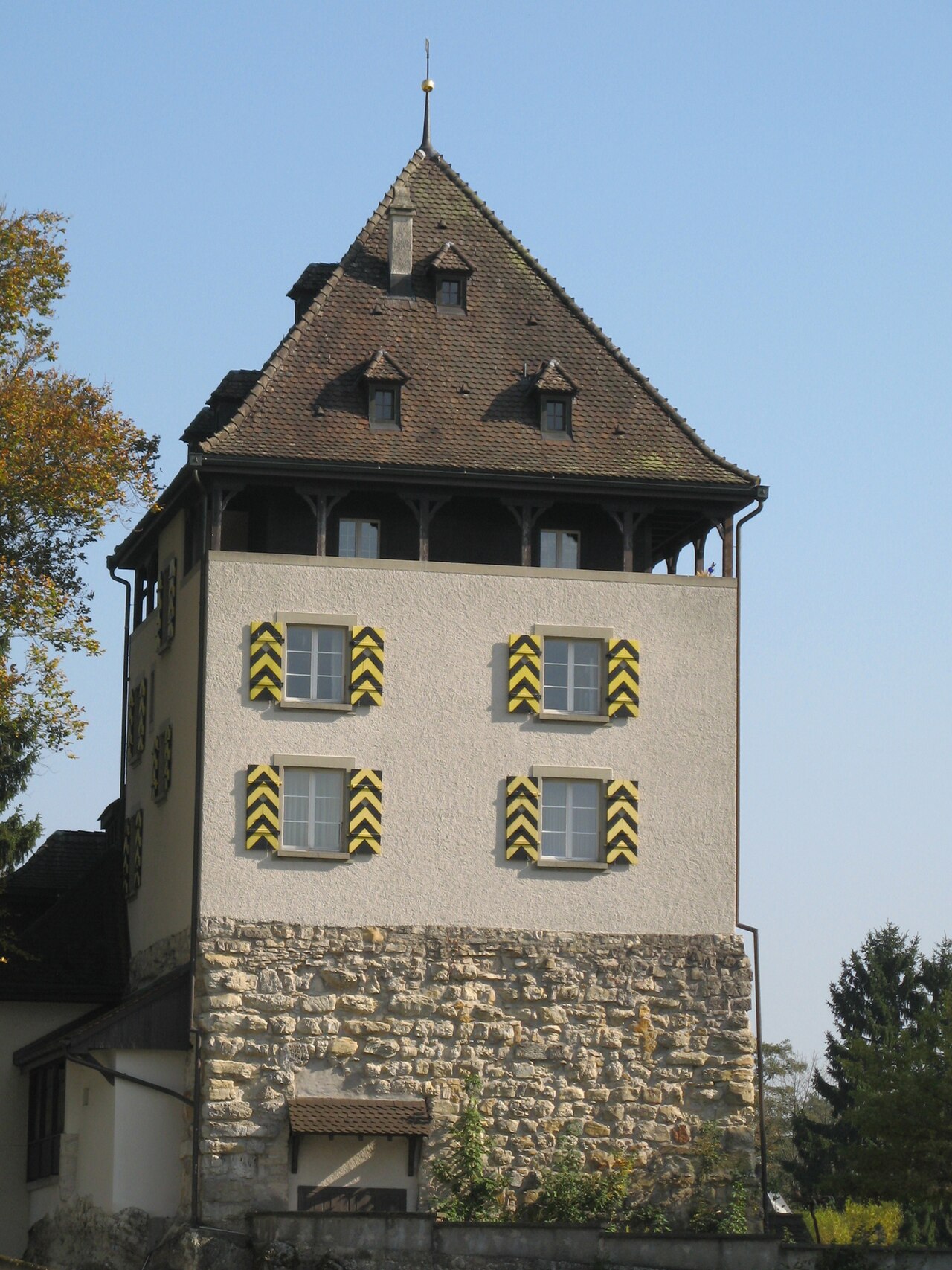
Schenkenberg Castle
Schenkenberg Castle stands as a prominent hill castle ruin perched atop a 631-meter hill in the Jura Mountains near Thalheim, Switzerland. Built in the early 13th century, it was originally constructed by the Habsburg dynasty to serve as a strategic headquarters and to protect their core holdings around the nearby town of Brugg. The castle's elevated position, rising approximately 200 meters above the Schenkenberg valley, offered commanding views and defensive advantages typical of high medieval fortifications.
The first documented mention of the castle dates to 1243, when the Lords of Schenkenberg, vassals of the Habsburgs, were granted lands surrounding the fortress. Over the centuries, ownership shifted among various Habsburg supporters, reflecting the turbulent political landscape of the region. The castle's early history is closely intertwined with the fortunes of the Habsburg family, including Albrecht von Löwenstein-Schenkenberg, son of Rudolf I of Habsburg, who was noted as lord of the castle in 1282.
Historical significance and ownership transitions
Following the Habsburg defeat at the Battle of Sempach in 1386, the family faced financial difficulties, leading to the mortgaging of Schenkenberg Castle. The Swiss Confederates conquered the surrounding region of Aargau in 1415, but the castle and its valley remained under imperial protection for a few more years. In 1417, King Sigismund placed the castle under his direct safeguard, underscoring its strategic importance.
In 1431, Margaret of Fridingen sold the castle and its associated rights to Baron Thüring of Aarburg. Later, in 1451, Thüring transferred ownership to his son-in-law Hans von Baldegg and his brother Markwart. The Baldegg family, allied with Austria, became embroiled in conflicts with the nearby city of Bern, which controlled the adjacent territory.
These tensions culminated in 1460 when Bernese forces occupied Schenkenberg Castle, expelled the Baldegg family, and established the castle as the seat of the Bernese bailiff or Landvogt. The Baldeggs made several unsuccessful attempts to reclaim the fortress, including during the Swabian War of 1499. The last of the Baldegg line, Hans von Baldegg, died around 1510 from the plague.
Strategic location and military architecture
Situated near Bern's northeastern border adjacent to Further Austria (Vorderösterreich), Schenkenberg Castle held significant strategic value. After Bern's takeover, the castle was fortified to strengthen its defensive capabilities, though maintenance gradually declined over time. By the early 18th century, the structure had deteriorated severely, with crumbling walls endangering occupants. Consequently, in 1720, the Bernese council abandoned the castle, relocating the bailiff's residence to nearby Wildenstein Castle in Veltheim.
Castle layout and defensive features
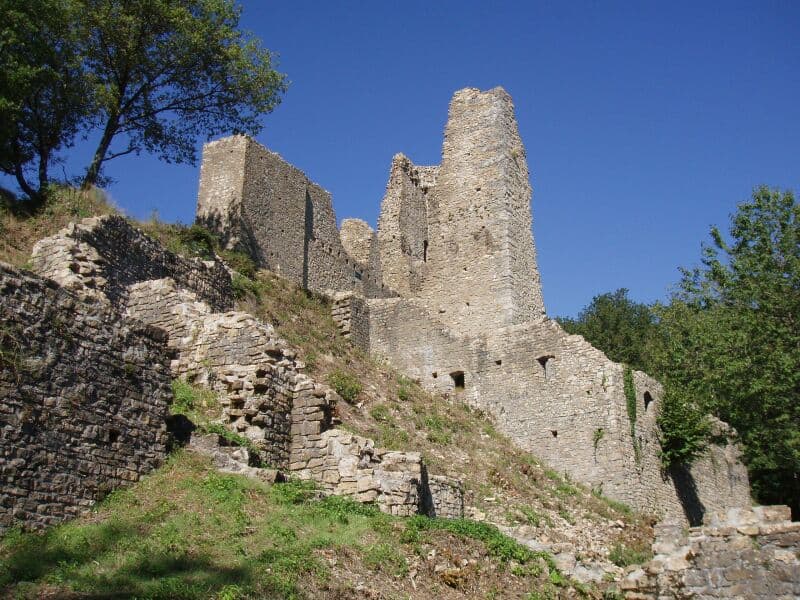
The castle complex evolved through multiple construction phases, evident from detailed architectural surveys conducted in 2003. Its core is anchored by a central bergfried or main tower, which served as a refuge and defensive stronghold. This tower, the oldest surviving element, was enlarged twice and modified to include battlements and later an artillery platform, reflecting advancements in military technology from archery to cannon warfare. Dendrochronological analysis dates the wooden beams used in the second heightening to between 1226 and 1233, confirming the castle's early 13th-century origins.
Surrounding the bergfried is the core castle (Kernburg), which includes the palas or main residential hall attached to a strong shield wall with a semi-circular tower for enhanced defense. A stair tower provided internal access between these structures. Defensive walls known as Streichwehr protected the living quarters on the eastern side.
Adjacent to the core castle lies the lower castle (Unterburg), housing economic buildings and the gate complex controlling access. This section is connected to the core castle by a staircase ascending the southern slope of the western ridge. South of the core castle and southwest of the lower castle is the castle garden area, featuring the Geissturm (Goat Tower) at the southeastern corner, the lowest point in the complex. The Geissturm, constructed around 1500 and later heightened, includes a high entrance opening onto the battlement walkway, signifying its continued military use into the early modern period.
The western boundary of the site is marked by the powder tower (Pulverturm), historically used for storing gunpowder and ammunition. An additional defensive outwork, the Vorwerk, lies east of the main tower, separated by a deep neck ditch, enhancing the castle's fortifications.
Decline, abandonment, and preservation efforts
Following its abandonment in the early 18th century, Schenkenberg Castle fell into ruin. Local farmers quarried stone from the site, accelerating its deterioration. After the political restructuring of Switzerland in 1798, the castle became property of the newly formed Canton of Aargau. In 1837, the castle was purchased by a mysterious figure known only as "Herr von Schenkenberg," who soon vanished from records.
A severe storm in 1917 caused the collapse of the east wall, prompting authorities to declare the castle ownerless and auction it in 1918. It was acquired for a symbolic sum by the Aargau Historical Preservation Society, which undertook extensive conservation and repair work. Today, Schenkenberg Castle is recognized as a nationally significant cultural monument, attracting visitors interested in its rich history and impressive medieval architecture.
The castle's ruins offer a tangible glimpse into the high medieval period of Swiss history, showcasing the evolution of fortification techniques and the shifting political dynamics between the Habsburgs, Bern, and the Swiss Confederacy. Its surviving structures, including the bergfried, palas, and various defensive walls and towers, stand as enduring symbols of the region's heritage and the complex history of territorial control in the Aargau region.
Frequently asked questions (FAQ)
- How do I get to Schenkenberg Castle in Thalheim?
- Schenkenberg Castle is accessible by local roads from Thalheim, Switzerland. Visitors can reach the site by car or public transport to Thalheim and then walk up the hill to the castle ruins.
- What is the historical significance of Schenkenberg Castle?
- Schenkenberg Castle was built in the early 13th century by the Habsburgs to protect their holdings near Brugg. It played a key role in regional conflicts and changed hands between the Habsburgs, Bern, and local noble families.
- Can I explore the ruins of Schenkenberg Castle?
- Yes, the ruins of Schenkenberg Castle are open to the public. Visitors can explore the remains of the bergfried, palas, and defensive walls, offering insight into medieval fortification architecture.
- When was Schenkenberg Castle abandoned?
- The castle was abandoned in the early 18th century due to its dilapidated condition. The Bernese bailiff moved to Wildenstein Castle in 1720, after which Schenkenberg fell into ruin.
- Is there an admission fee to visit Schenkenberg Castle?
- There is no admission fee to visit the ruins of Schenkenberg Castle, making it freely accessible to the public for exploration and sightseeing.
Photo gallery

Information
Sources & official resources
Verify the information above using these authoritative references.
Loading map...
Visitor reviews
No reviews yet. Been here? Write the first review and help other travelers!
Write the first reviewVisited this castle? Share your experience
Your review helps other travelers and adds first-hand knowledge to our encyclopedia.