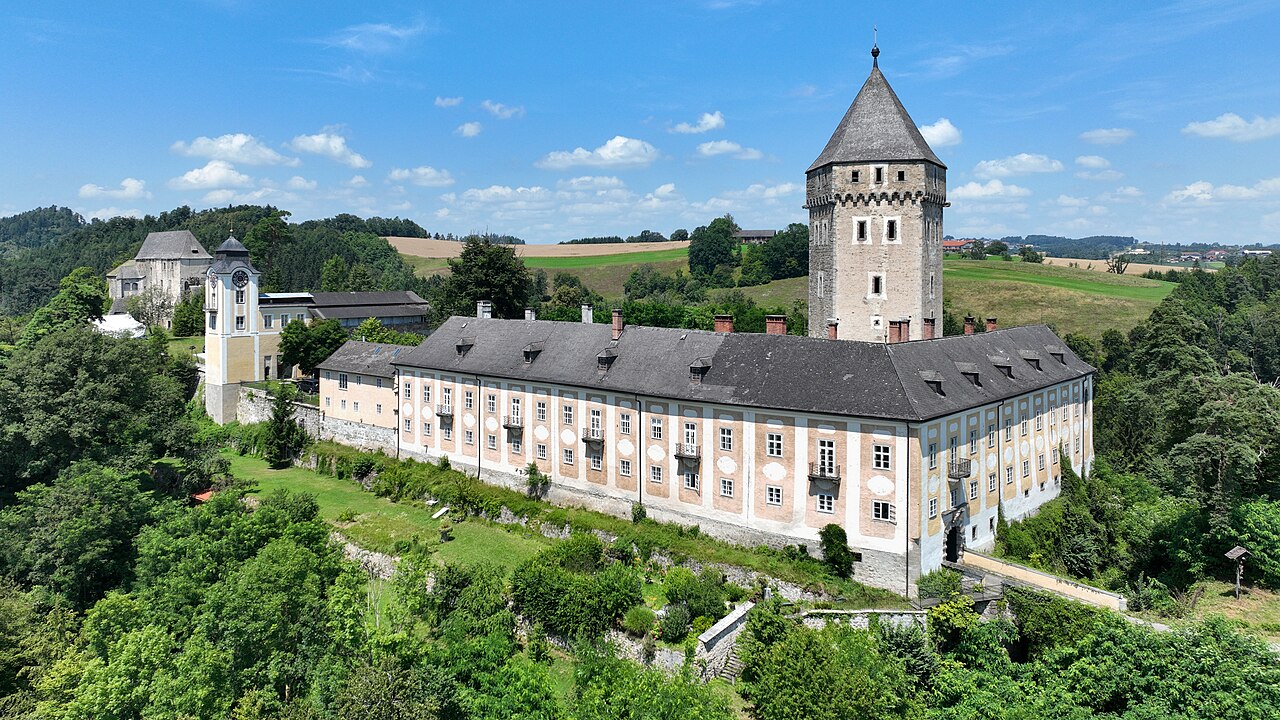
Schaunberg Castle
Schaunberg Castle, also known locally as Burg Schaunberg, is a prominent medieval hill castle ruin located on a forested ridge southwest of Hartkirchen in the province of Upper Austria. This historic site offers visitors a glimpse into the turbulent history of the region and the architectural evolution of castles from the High Medieval period onward.
Early history and strategic importance
The castle was originally constructed around 1150 by the noble Schaunberg family, who rose to prominence through their control of toll rights on the Danube River at Aschach-an-der-Donau, granted by Frederick I Barbarossa, the Holy Roman Emperor. This strategic position allowed the Schaunbergs to exert considerable influence over river trade and regional politics.
Built as a hill castle, Schaunberg Castle's location on a ridge provided natural defensive advantages, supplemented by robust fortifications typical of the period. The castle's design included a mighty keep standing approximately 32 meters high, surrounded by a ring wall that enclosed various residential and service buildings within the courtyard.
Medieval conflicts and sieges
The castle played a significant role in regional power struggles during the late 14th century. In 1380, Albert II, Duke of Austria, ordered his vassal Reinprecht II von Wallsee to attack the possessions of Heinrich von Schaunberg. Reinprecht successfully captured several Schaunberg castles along the Danube but was unable to take Schaunberg Castle itself despite a prolonged siege lasting several months. This resilience underscores the castle's strong defensive capabilities.
Eventually, Heinrich von Schaunberg sought support from the House of Habsburg but was compelled to swear an oath in 1390 to end the conflict known as the Schaunberg Feud. The castle's endurance during this period highlights its strategic and military significance in the region.
Notable historical events
One of the castle's most notable historical episodes was in 1402 when it was used to imprison Wenceslaus IV of Bohemia by order of Sigismund of Luxembourg. This event places Schaunberg Castle within the broader context of Central European medieval politics and royal intrigues.
Renaissance transition and decline
By the early 16th century, the Schaunberg family abandoned the castle in favor of the more comfortable Eferding Castle. From this point, Schaunberg Castle was primarily used by servants and gradually lost its status as a noble residence. Following the extinction of the Schaunberg family line in 1559, ownership passed to the Starhemberg family, who remain the current owners of the castle ruins.
The castle's decline accelerated during the 19th century due to neglect and lack of maintenance. In 1825, a significant structural failure occurred when half of the keep collapsed, causing damage to adjacent buildings and the surrounding ring wall. This event marked the beginning of the castle's transformation into a ruin.
Modern preservation and visitor experience
Efforts to consolidate and preserve the ruins began in earnest in the latter half of the 20th century. Despite these measures, parts of the ring wall succumbed to collapse during the harsh winter of 2002/2003, illustrating the ongoing challenges of preserving medieval stone structures exposed to natural elements.
Today, Schaunberg Castle is accessible to the public during daylight hours, offering visitors the opportunity to explore its substantial ruins. The site features the impressive keep, which visitors can climb, as well as subterranean rooms that reveal the castle's complex internal layout. The castle's ruinous state provides a tangible connection to its medieval past and the architectural styles that evolved over centuries.
Architectural features and style
Schaunberg Castle's architecture reflects its origins in the High Medieval period, with later modifications during the Renaissance. The dominant feature is the massive keep, which served both defensive and residential functions. The surrounding ring wall enclosed a courtyard with ancillary buildings, including living quarters and storage areas. The castle's design emphasizes fortification with thick walls, narrow windows for archery defense, and elevated position for surveillance over the surrounding landscape.
The castle's transition in the 16th century to a less militarized residence at Eferding Castle reflects broader shifts in castle architecture, moving from fortress-like structures to more comfortable noble residences. Schaunberg Castle's abandonment underscores this architectural and social evolution.
Frequently asked questions (FAQ)
- How do I get to Schaunberg Castle?
- Schaunberg Castle is located in Austria, easily accessible by car or public transport. If you're traveling by car, take the A1 motorway and follow the signs to the castle. The nearest train station is in the town of Linz, from where you can take a bus or taxi to reach the castle.
- What is the historical significance of Schaunberg Castle?
- Schaunberg Castle dates back to the 12th century and played a crucial role in the region's defense during the Middle Ages. It served as a noble residence and a strategic military stronghold. Today, it stands as a testament to the architectural and historical heritage of Austria.
- When was Schaunberg Castle built?
- Schaunberg Castle was constructed in the early 12th century, specifically around 1120. It was established by the noble family of Schaunberg, who were influential in the region during the medieval period. The castle has undergone various renovations over the centuries but retains its historical charm.
- Can I visit Schaunberg Castle year-round?
- Yes, Schaunberg Castle is open to visitors year-round, but it's best to check specific opening hours before planning your visit. The castle may have limited accessibility during winter months due to weather conditions. Spring and summer are particularly pleasant times to explore the castle and its surroundings.
- Why is Schaunberg Castle a popular tourist attraction?
- Schaunberg Castle is popular for its stunning views of the surrounding countryside and its rich history. Visitors are drawn to its picturesque ruins and the chance to learn about medieval architecture and life. The castle also hosts occasional events, making it a vibrant cultural site.
- Is it possible to access all areas of Schaunberg Castle?
- While some parts of Schaunberg Castle are accessible to visitors, certain areas may be restricted due to safety concerns. The main ruins and lookout points are open, allowing visitors to explore the castle's history. It's advisable to follow designated paths and guidelines during your visit.
- What are the ticket prices for visiting Schaunberg Castle?
- Admission to Schaunberg Castle is typically very affordable, often around 5 euros for adults, with reduced rates for children and families. Special rates may apply for group visits or guided tours. Be sure to check the official website for the most current pricing and any special events.
- What are the opening hours of Schaunberg Castle?
- Schaunberg Castle generally opens at 9 AM and closes at 6 PM during the peak tourist season, which is from April to October. In the off-season, hours may vary, so it is recommended to verify the schedule before your visit. Guided tours may also have specific time slots.
- What nearby attractions can I visit while in the area?
- While visiting Schaunberg Castle, you can explore the charming town of Linz, which offers museums, parks, and vibrant cultural experiences. Additionally, consider visiting the beautiful Pöstlingberg pilgrimage church or taking a stroll along the Danube River. The surrounding countryside provides ample opportunities for hiking and enjoying nature.
Loading map...
Visitor reviews
No reviews yet. Been here? Write the first review and help other travelers!
Write the first reviewVisited this castle? Share your experience
Your review helps other travelers and adds first-hand knowledge to our encyclopedia.