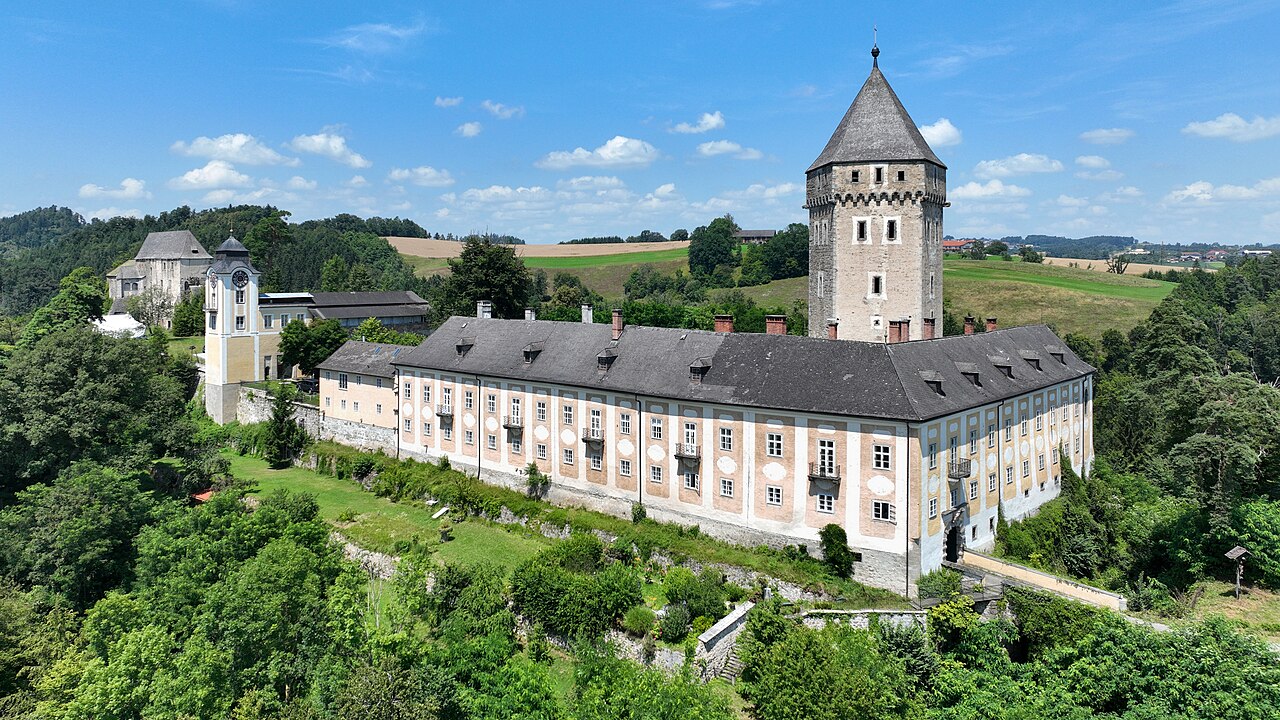
Oberwallsee Castle

Oberwallsee Castle: medieval hill castle in Upper Austria
Bad Mühllacken, Austria
Late Medieval (14th–15th c.)
Ruins

Oberwallsee Castle, known locally as Burg Oberwallsee, is a medieval hill castle situated on an elevated site overlooking the village of Bad Mühllacken in the province of Upper Austria. This castle stands as a significant example of medieval fortification and noble residence in the region, with origins tracing back to the late 14th century.

Founding and early history

The castle was founded in 1364 when Eberhard von Wallsee, a local governor, received permission from the Lord of Freudenstein to erect a fortress on this strategic hilltop. Construction was completed around 1386, and the castle was named "Oberwallsee" to distinguish it from another family seat named "Niederwallsee" located in Lower Austria. The von Wallsee family was an influential noble lineage, and establishing Oberwallsee Castle reinforced their territorial presence in Upper Austria.

Ownership transitions and architectural evolution

In 1483, the castle passed through marriage to the Count of Schaunberg. The Schaunberg family appointed a warden to oversee the castle's defense and administration. Following the extinction of the Schaunberg line in 1559, Oberwallsee Castle became subject to a lengthy legal dispute. Eventually, it was claimed by Ferdinand I, Holy Roman Emperor, who granted the castle as a fief to Hans Hofmann, Baron of Grünpichl and Strechau.

Hans Hofmann's descendants sold the fief to their steward, Schmidtauer, in 1584. The steward and his son undertook significant renovations, transforming the medieval fortress into a more comfortable residential castle. This transition reflected broader architectural trends of the period, where defensive structures were adapted for noble habitation with increased emphasis on domestic comfort.

Impact of the thirty years' war and later ownership

During the Thirty Years' War in 1620, Ferdinand II, Holy Roman Emperor, confiscated the possessions of the Hofmann family and nullified the earlier sale to the Schmidtauers. The castle was then granted to Johann Ulrich von Eggenberg, Duke of Krumau. The Eggenbergs reinstated a warden to maintain the castle, underscoring its continued strategic and administrative importance.

Upon the extinction of the Eggenberg family in 1717, ownership transferred to Count Gundaker Thomas Starhemberg. Since the Starhemberg family primarily resided at Eschelberg Castle, Oberwallsee Castle was neglected and gradually fell into decay. By this time, only a farmstead in the outer ward remained operational, marking the castle's decline as a noble residence.

Modern era and current status

In 1931, the ruined castle was sold by Prince Ernst Rüdiger Camillo von Starhemberg to private owners. Since then, it has passed through several hands. Today, Oberwallsee Castle remains private property. A private residence occupies buildings in the outer ward, but the castle ruins themselves are in a fragile state and at risk of collapse. Due to safety concerns and private ownership, the site is not open to public visitation.

Architectural features and significance

Although now a ruin, Oberwallsee Castle originally featured typical medieval hill castle characteristics, including defensive walls, a fortified gate, and residential quarters adapted over time. The castle's position on a hill provided strategic oversight of the surrounding landscape, a common feature for fortifications intended to control local territory and trade routes.

The transformation in the late 16th century from a purely defensive structure to a residential castle reflects the broader shift in castle architecture during the Renaissance period, where comfort and status became as important as military utility. The castle's decline in the 18th century illustrates the changing political and social landscape, where many such fortifications lost their original purpose.

Visiting and preservation

Due to its current private ownership and the precarious condition of the ruins, Oberwallsee Castle is not accessible to visitors. Preservation efforts have been limited, and the structure remains vulnerable to further deterioration. Despite this, the castle remains an important cultural landmark in Upper Austria, representing centuries of regional history and architectural evolution.

Frequently asked questions (FAQ)

How do I get to Oberwallsee Castle?
Oberwallsee Castle is located in Bad Mühllacken, Austria, and can be accessed by car or public transportation. If you are driving, follow the local road signs leading to the castle. For public transport, check local bus schedules that connect to nearby towns.
What is the historical significance of Oberwallsee Castle?
Oberwallsee Castle dates back to the 12th century and is an important example of medieval architecture in Austria. It has witnessed various historical events and has been a significant residence for local nobility. Its preservation allows visitors to explore the rich history of the region.
When was Oberwallsee Castle built?
Construction of Oberwallsee Castle began in the early 12th century, making it one of the oldest castles in the area. Over the centuries, it has undergone various renovations and expansions, reflecting different architectural styles. This long history adds to the castle's charm and intrigue.
Can I visit Oberwallsee Castle?
Yes, Oberwallsee Castle is open to the public for visits. Guests can explore its grounds and learn about its history through guided tours. It is advisable to check the official website for any special events or restrictions before your visit.
Why is Oberwallsee Castle considered an architectural gem?
Oberwallsee Castle showcases a blend of Romanesque and Gothic architectural styles, which highlight its historical evolution. Its fortified walls, towers, and intricate details make it a captivating site for architecture enthusiasts. The preservation of its original features contributes to its status as an architectural gem.
Is it possible to host events at Oberwallsee Castle?
Yes, Oberwallsee Castle offers facilities for hosting various events, including weddings and corporate gatherings. The picturesque setting and historical ambiance make it a unique venue. Interested parties should contact the castle management for detailed information on rentals and services.
What are the opening hours for Oberwallsee Castle?
Oberwallsee Castle is typically open to visitors from April to October, with hours varying by season. During peak months, the castle may have extended hours to accommodate more visitors. It's best to check the official website for the most current opening times and any seasonal variations.
Are there any nearby attractions to visit?
Yes, Bad Mühllacken and its surrounding areas offer several attractions, including scenic hiking trails and local museums. Visitors can also enjoy nearby castles and historical sites that reflect Austria's rich cultural heritage. Plan a full day of exploration to make the most of your visit.
What are the ticket prices for visiting Oberwallsee Castle?
Ticket prices for Oberwallsee Castle vary, with discounts available for children, seniors, and groups. Adults can typically expect a modest entry fee, while children may enter for free or at a reduced rate. Be sure to check the official website for the most up-to-date pricing information.

Information

Hill Castle

Loading map...

Visitor reviews

No reviews yet. Been here? Write the first review and help other travelers!

Write the first review

Visited this castle? Share your experience

Your review helps other travelers and adds first-hand knowledge to our encyclopedia.

Write a review

(5/5)

0/2000 characters

Your review will be visible after admin approval

Nearby castles

4.6 km

Eschelberg Castle

Eschelberg, Austria

Eschelberg Castle, located in Eschelberg, Austria, is a notable example of a Renaissance castle with a rich architectural history dating back to the early 13th century. The first documented mention of the castle was in 1209, indicating its medieval origins. While the current structure predominantly reflects the 16th-century Renaissance style, it incorporates remnants of an earlier medieval fortress, particularly visible on its southern side. Historical background and early origins The site of Eschelberg Castle has been significant since the High Medieval period, serving as a defensive stronghold and noble residence. The earliest records from 1209 suggest a medieval castle existed here, likely constructed to oversee and protect the surrounding territory. Over the centuries, the castle underwent numerous modifications, reflecting changes in architectural styles and defensive needs. Renaissance transformation in the 16th century During the 16th century, the castle was extensively rebuilt and expanded in the Renaissance style. This transformation introduced characteristic features such as symmetrical layouts, ornamental façades, and larger windows compared to the earlier medieval fortifications. The Renaissance period emphasized comfort and aesthetics alongside defense, and Eschelberg Castle's reconstruction reflects this shift. Architectural features The castle's design includes a central courtyard typical of Renaissance residences, surrounded by robust walls and towers that retain some medieval defensive elements. The southern side of the castle preserves remains of the older medieval structure, offering a visible contrast between the two periods. These remnants include parts of the original curtain walls and possibly a defensive tower, which highlight the castle's evolution over time. Current use and preservation Today, Eschelberg Castle serves primarily as a venue for events and weddings, capitalizing on its historic ambiance and picturesque setting. The castle's preservation allows visitors to appreciate its architectural heritage, while its adaptive reuse supports its maintenance and public engagement. Although not a fully restored museum, the castle remains an important cultural landmark in the region. Location and regional significance Situated in the town of Eschelberg within Austria, the castle is part of the broader historical landscape of Upper Austria, a region known for its numerous castles and historic sites. Eschelberg Castle contributes to the cultural tourism of the area, attracting visitors interested in Renaissance architecture and medieval history. Visitor information and accessibility While primarily used for private functions, the castle occasionally opens for public tours and cultural events, providing insights into its architectural and historical significance. Visitors are encouraged to check local listings for event schedules and visiting hours. The castle's setting offers a unique experience of Renaissance architecture blended with medieval heritage.

Renaissance (15th–17th c.)
Details
6.7 km

Schaunberg Castle

Burgruine Schaunberg, Austria

Schaunberg Castle, also known locally as Burg Schaunberg, is a prominent medieval hill castle ruin located on a forested ridge southwest of Hartkirchen in the province of Upper Austria. This historic site offers visitors a glimpse into the turbulent history of the region and the architectural evolution of castles from the High Medieval period onward. Early history and strategic importance The castle was originally constructed around 1150 by the noble Schaunberg family, who rose to prominence through their control of toll rights on the Danube River at Aschach-an-der-Donau, granted by Frederick I Barbarossa, the Holy Roman Emperor. This strategic position allowed the Schaunbergs to exert considerable influence over river trade and regional politics. Built as a hill castle, Schaunberg Castle's location on a ridge provided natural defensive advantages, supplemented by robust fortifications typical of the period. The castle's design included a mighty keep standing approximately 32 meters high, surrounded by a ring wall that enclosed various residential and service buildings within the courtyard. Medieval conflicts and sieges The castle played a significant role in regional power struggles during the late 14th century. In 1380, Albert II, Duke of Austria, ordered his vassal Reinprecht II von Wallsee to attack the possessions of Heinrich von Schaunberg. Reinprecht successfully captured several Schaunberg castles along the Danube but was unable to take Schaunberg Castle itself despite a prolonged siege lasting several months. This resilience underscores the castle's strong defensive capabilities. Eventually, Heinrich von Schaunberg sought support from the House of Habsburg but was compelled to swear an oath in 1390 to end the conflict known as the Schaunberg Feud. The castle's endurance during this period highlights its strategic and military significance in the region. Notable historical events One of the castle's most notable historical episodes was in 1402 when it was used to imprison Wenceslaus IV of Bohemia by order of Sigismund of Luxembourg. This event places Schaunberg Castle within the broader context of Central European medieval politics and royal intrigues. Renaissance transition and decline By the early 16th century, the Schaunberg family abandoned the castle in favor of the more comfortable Eferding Castle. From this point, Schaunberg Castle was primarily used by servants and gradually lost its status as a noble residence. Following the extinction of the Schaunberg family line in 1559, ownership passed to the Starhemberg family, who remain the current owners of the castle ruins. The castle's decline accelerated during the 19th century due to neglect and lack of maintenance. In 1825, a significant structural failure occurred when half of the keep collapsed, causing damage to adjacent buildings and the surrounding ring wall. This event marked the beginning of the castle's transformation into a ruin. Modern preservation and visitor experience Efforts to consolidate and preserve the ruins began in earnest in the latter half of the 20th century. Despite these measures, parts of the ring wall succumbed to collapse during the harsh winter of 2002/2003, illustrating the ongoing challenges of preserving medieval stone structures exposed to natural elements. Today, Schaunberg Castle is accessible to the public during daylight hours, offering visitors the opportunity to explore its substantial ruins. The site features the impressive keep, which visitors can climb, as well as subterranean rooms that reveal the castle's complex internal layout. The castle's ruinous state provides a tangible connection to its medieval past and the architectural styles that evolved over centuries. Architectural features and style Schaunberg Castle's architecture reflects its origins in the High Medieval period, with later modifications during the Renaissance. The dominant feature is the massive keep, which served both defensive and residential functions. The surrounding ring wall enclosed a courtyard with ancillary buildings, including living quarters and storage areas. The castle's design emphasizes fortification with thick walls, narrow windows for archery defense, and elevated position for surveillance over the surrounding landscape. The castle's transition in the 16th century to a less militarized residence at Eferding Castle reflects broader shifts in castle architecture, moving from fortress-like structures to more comfortable noble residences. Schaunberg Castle's abandonment underscores this architectural and social evolution.

Renaissance (15th–17th c.)
Details
7.8 km
Neuhaus Castle — Austria castle

Neuhaus Castle

Neuhaus an der Donau, Austria

Neuhaus Castle, located in Neuhaus an der Donau, Upper Austria, is a significant example of a high medieval hill castle with origins tracing back to the 13th century. The castle's strategic position above the Danube River allowed it to control river traffic, a vital aspect of medieval commerce and defense. This control was enforced notably through a chain tower situated below the castle, from which a heavy chain could be stretched across the river to block passing ships, a defensive mechanism used in several medieval fortifications along important waterways. Early history and construction The earliest construction phase of Neuhaus Castle likely dates to the 13th century, possibly erected on the foundations of an earlier fortified house from the 12th century. This initial structure formed the basis for the castle's development through the centuries. The castle's distinctive pentagonal tower was added in the 14th century, enhancing its defensive capabilities and architectural complexity. This tower is a notable feature, rising to approximately 32 metres, which makes it one of the tallest medieval tower houses in the region of Styria. Ownership and architectural evolution Neuhaus Castle was originally constructed by the House of Stubenberg in the mid-14th century. Historical records from 1375 mention a figure known as 'Hans from Neuhaus,' indicating the castle's established role in the local nobility's domain. Over time, ownership passed to the Drachsler family and subsequently to the counts of Wurmbrand. The counts undertook significant fortification efforts, particularly in response to the threat posed by the advancing Ottoman Turks during the late medieval period. These enhancements were part of a broader trend of castle modernization to withstand evolving military technologies and siege tactics. 16th-century rebuilding During the 16th century, Neuhaus Castle underwent substantial reconstruction. This period saw the adaptation of the castle's defenses and residential quarters to Renaissance military and architectural standards. The renovations included strengthening walls and updating living spaces to reflect contemporary tastes and functional needs, marking a transition from purely military fortress to a noble residence with defensive features. Military significance and sieges Neuhaus Castle's strategic location made it a focal point in regional conflicts. Documented sieges occurred in 1381, 1386, and 1389, reflecting the turbulent political landscape of medieval Austria. The castle's defenses, including its thick walls and elevated position, were tested during these assaults. The ability to control river traffic on the Danube added to its military importance, as controlling trade routes was crucial for economic and strategic dominance. Decline and restoration efforts Around 1800, Neuhaus Castle suffered near-total destruction due to a lightning strike, which led to a fire that devastated much of the structure. Following this event, the castle entered a prolonged period of decay lasting approximately two centuries. Despite this, the castle's extraordinarily thick walls preserved enough of the original structure to allow for modern restoration efforts. Modern revitalization In recent decades, significant restoration work has been undertaken to stabilize and reconstruct key parts of Neuhaus Castle. The medieval tower house has been nearly fully restored, preserving its status as one of the oldest and tallest high-rise medieval buildings in the region. Additionally, two adjoining buildings are undergoing reconstruction to revive the castle's historical footprint. These efforts aim to conserve the castle's architectural heritage and promote its cultural significance in Upper Austria. Architectural features and style Neuhaus Castle exemplifies the high medieval hill castle typology, characterized by its elevated position and robust defensive structures. The castle's pentagonal tower is a unique architectural element, contributing both to its defensive strategy and its silhouette against the landscape. The castle's walls are notably thick, a feature that has contributed to its partial survival despite centuries of neglect and damage. The castle's architectural style reflects the transitions from medieval fortification principles to Renaissance adaptations, visible in the modifications made during the 16th century. While primarily functional in design, the castle also incorporates elements of noble residence aesthetics, balancing defense with habitation. Location and surroundings Situated at an altitude of approximately 420 metres above sea level, Neuhaus Castle overlooks the Danube River in the town of Neuhaus an der Donau. The location provided commanding views of the river valley and surrounding terrain, essential for early warning and defense. The castle's proximity to the Danube made it a critical point for controlling one of Europe's major waterways, influencing trade and military movements for centuries. Cultural and historical significance Neuhaus Castle remains an important cultural monument in Upper Austria, reflecting the region's medieval history and architectural evolution. Its restoration contributes to the preservation of Austria's heritage and offers insights into feudal life, military architecture, and the socio-political dynamics of the Middle Ages. The castle attracts visitors interested in history, architecture, and the scenic beauty of the Danube valley.

High Medieval (11th–13th c.)
Details