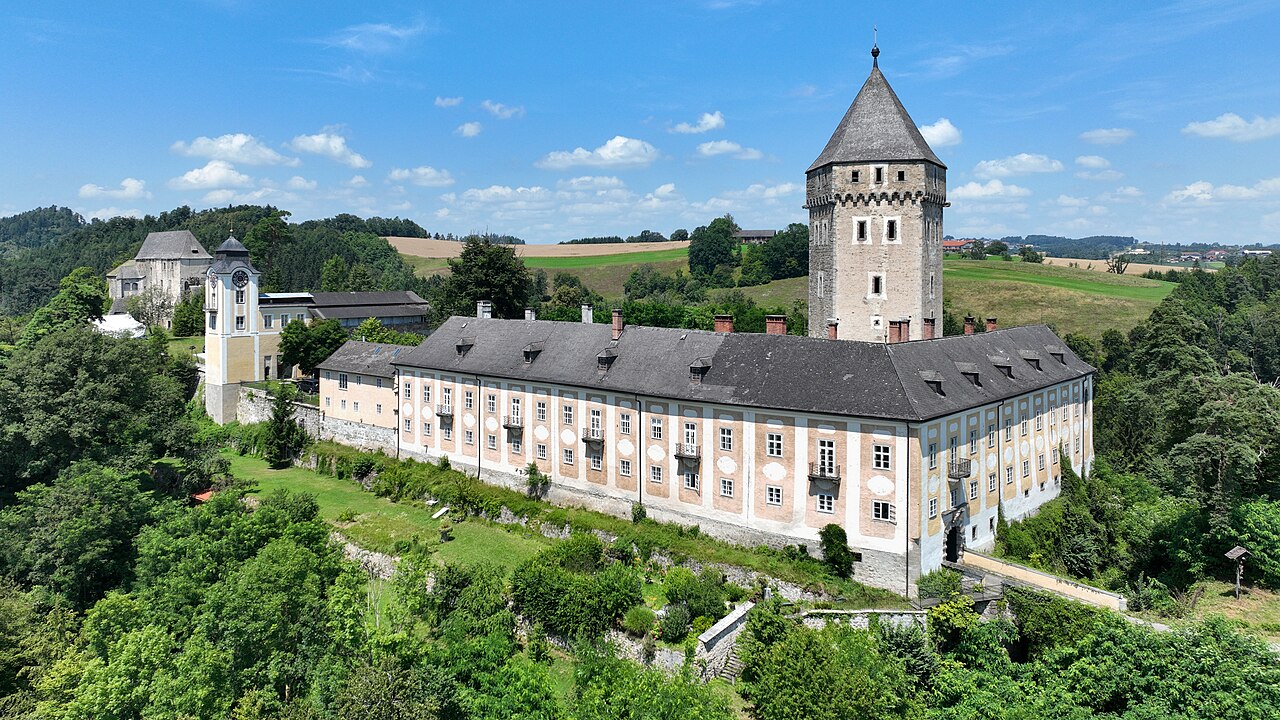
Burgruine Stauf
Burgruine Stauf stands as a remarkable example of a medieval hill castle in Austria, steeped in history and architectural significance. Located in Haibach ob der Donau, this fortress was originally constructed in the early 12th century, likely by Wernhard de Stove, an ancestor of the influential Counts of Schaunberg. Its strategic placement on a rocky hilltop at an elevation of 531 meters allowed it to dominate the surrounding landscape and control vital routes along the Danube River’s right bank.
Throughout its history, Burgruine Stauf served as the primary residence and power base for the Schaunberg family, who played a significant role in regional politics and conflicts during the High and Late Middle Ages. The castle’s architecture reflects its evolution from a fortified noble residence to an administrative center, with adaptations made over centuries to meet military and domestic needs.
Historical significance and ownership
The castle’s documented history begins in the 12th century, with the Schaunberg family maintaining control for several centuries. From at least 1337 until 1841, the castle functioned as an administrative seat managed by appointed stewards known as Pfleger. This long tenure highlights the castle’s sustained importance in local governance.
Burgruine Stauf was a focal point during the Schaunberger Feud (1380-1390), a conflict involving the Schaunberg family and the ruling Habsburg dynasty. During this period, the castle endured a significant siege by forces led by Duke Albrecht III of Austria in 1380-81. Despite initial resistance, the castle fell to Austrian forces by 1385 or 1386. Subsequently, the Habsburgs administered the property but restored it to the Schaunberg family as a hereditary lease in 1383, underscoring its political and strategic value.
Following the death of the last Schaunberg in 1559, the castle became embroiled in inheritance disputes and passed to the Liechtenstein family in 1572. By this time, a devastating fire in 1570 had rendered the castle uninhabitable. The Liechtensteins chose not to restore the fortress, opting instead to construct a new residence in nearby Aschach an der Donau.
Ownership changed hands multiple times thereafter, with notable possession by the Jörger family, prominent Protestants involved in uprisings against Emperor Ferdinand II. Their estates were confiscated in 1620 due to their opposition. In 1622, the castle was acquired by Karl von Harrach, whose family retained the estate into the 20th century.
Architectural features and layout
Core castle and bergfried tower
The ruins occupy a rocky plateau approximately 12.5 by 25 meters, featuring a classic hill castle layout with a core castle and an adjacent outer bailey to the east. The construction primarily utilizes local gneiss rubble and fieldstones, with granite reserved for door and window frames, reflecting a pragmatic and robust building approach.
At the heart of the castle stands a distinctive six-sided bergfried tower rising about 21.67 meters, although it no longer reaches its original height. This tower, a hallmark of medieval fortifications, comprises four floors. The two lower levels are windowless vaulted chambers with walls up to five meters thick on the northern side, designed to withstand sieges. The upper floors contain large window niches with built-in benches, indicating their use for residential or lookout purposes. The bergfried’s original entrance was positioned high above ground level, enhancing its defensive capabilities. Today, an observation platform near the top offers expansive views over the Danube valley and the city of Linz on clear days.
Palas and residential quarters
Adjacent to the bergfried is the palas, a three-story residential building measuring approximately 9 by 18 meters. Its design includes spacious windows on the upper floors for light and ventilation, complemented by battlements on the southern and western exterior walls, underscoring its dual residential and defensive function. A preserved garderobe (medieval latrine) remains intact, providing insight into daily life within the castle.
Outer bailey and defensive structures
The outer bailey covers an area of about 20 by 45 meters, enclosed by a protective ring wall with surviving sections reaching up to nine meters in height. The northern gate features a striking Gothic portal approximately 3 meters wide and 6 meters tall, topped by a pointed gable arch reminiscent of gates at Burg Hardegg. Flanking the entrance are two narrow pointed-arch windows, likely part of the gatekeeper’s chamber.
Access from the outer bailey to the core castle is via a steep stairway of 49 steps. The core castle is secured by a 15-meter-high eastern wall featuring a murder hole above the doorway for defensive purposes. A similar murder hole exists in the western wall. Remnants of an eastern gatehouse once controlled access to the bailey.
Additional defensive features include a ditch about six meters deep on the southeastern side and a small sally port in the southern bailey wall, possibly leading to a wooden bridge over the ditch. The castle’s position on a narrow ridge and the nearby small plateau to the northwest likely served as an outwork, providing forward defense.
Preservation and cultural impact
After centuries of decline following a fire in 1570 and changing ownership, Burgruine Stauf fell into ruin. Preservation efforts began in the early 20th century under Count Alfred Harrach. Post-World War II, local heritage organizations and the Dreihann-Holenia family took stewardship of the site. Major conservation work between 1968 and 1977 stabilized the ruins and added a roof to the main tower. Since 1989, a dedicated association has continued preservation activities, ensuring the castle’s architectural and historical legacy endures.
The castle’s evocative ruins have inspired poets such as Richard Billinger and Herbert Emmerstorfer, who found artistic muse in its dramatic setting and storied past. Today, Burgruine Stauf remains a significant cultural landmark, offering visitors a tangible connection to Austria’s medieval heritage and the turbulent history of the Schaunberg family.
Visiting burgruine stauf
Visitors to Burgruine Stauf can explore the well-preserved ruins, including the bergfried tower with its observation platform that provides panoramic views over the Danube valley. The site’s location on a hilltop ridge makes it accessible via hiking trails, offering an immersive experience in medieval architecture and history.
The castle’s layout, defensive structures, and residential quarters provide a comprehensive glimpse into the life of a noble family during the Middle Ages. Interpretive signage and guided tours may be available, enhancing understanding of the castle’s historical context and architectural features.
Frequently asked questions (FAQ)
- When was Burgruine Stauf originally built?
- Burgruine Stauf was originally constructed in the early 12th century, likely by Wernhard de Stove, an ancestor of the Counts of Schaunberg.
- What role did the castle play during the Schaunberger Feud?
- During the Schaunberger Feud (1380-1390), Burgruine Stauf was besieged by Duke Albrecht III of Austria's forces. It initially resisted but was eventually captured, highlighting its strategic importance.
- What are the main architectural features of Burgruine Stauf?
- Key features include a six-sided bergfried tower with thick walls, a three-story palas with battlements, a Gothic gate in the outer bailey, and defensive elements like murder holes and a deep ditch.
- Is Burgruine Stauf accessible to visitors?
- Yes, visitors can explore the ruins and climb the bergfried's observation platform for panoramic views of the Danube valley. The site is accessible via hiking trails.
- Who owns Burgruine Stauf today?
- The castle is maintained by local heritage organizations and a dedicated association formed in 1989, with stewardship involving families such as the Dreihann-Holenia.
Information
Website
Visit websiteSources & official resources
Verify the information above using these authoritative references.
Loading map...
Visitor reviews
No reviews yet. Been here? Write the first review and help other travelers!
Write the first reviewVisited this castle? Share your experience
Your review helps other travelers and adds first-hand knowledge to our encyclopedia.