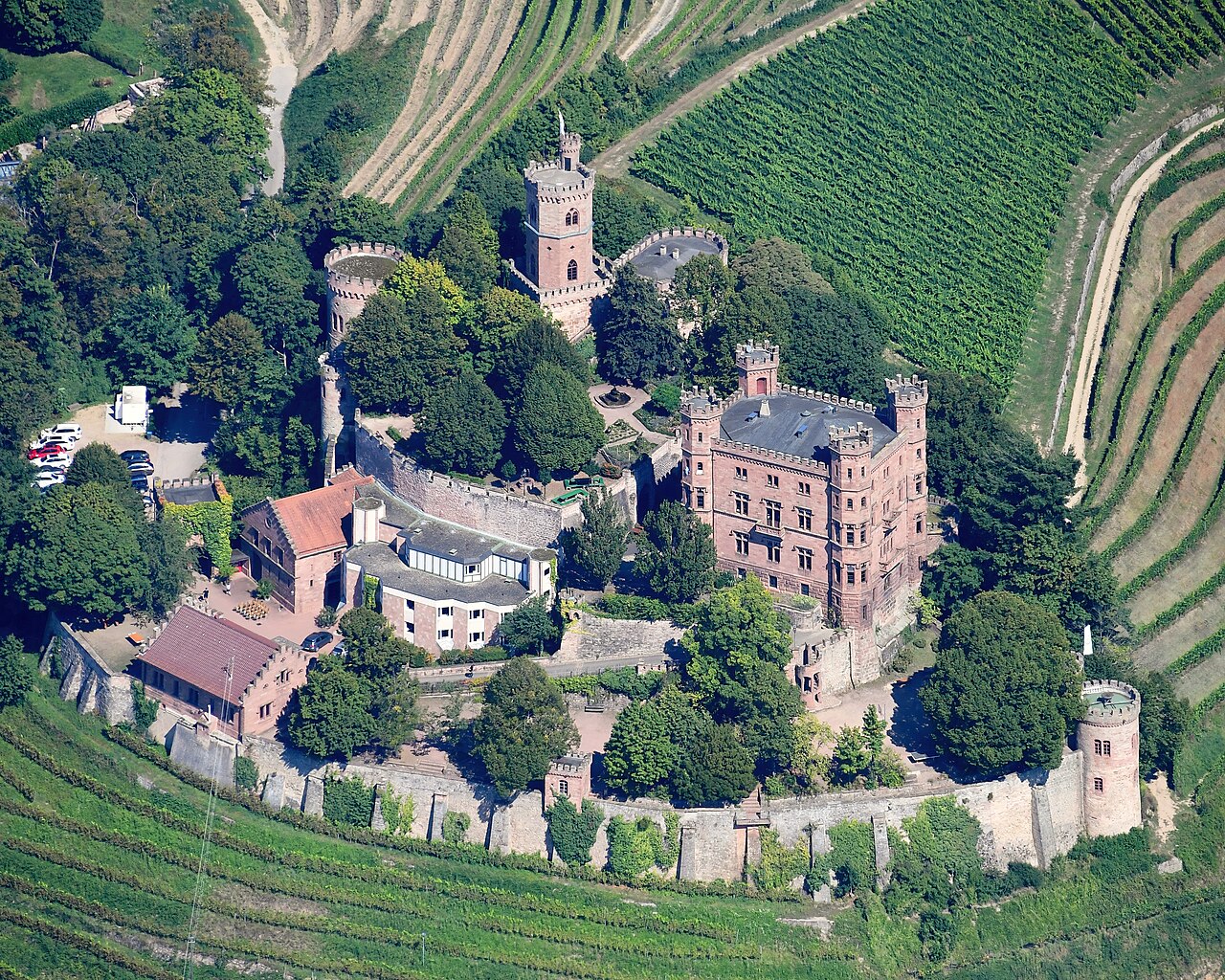
Schauenburg Castle
Schauenburg Castle stands as a prominent high medieval hilltop fortress located in Oberkirch, Germany, perched atop a 367-metre-high hill spur overlooking the scenic Rench river valley near the town of Gaisbach. Built between c. 1070 and 1090 by Duke Berthold II of Zähringen, the castle commands a strategic vantage point that was crucial for regional control during the Middle Ages. Though now a ruin, it remains a significant cultural and historical monument, attracting visitors with its evocative remains and a small museum housed in the cellar of the former castle chapel.
Historical background and ownership lineage
The origins of Schauenburg Castle trace back to the late 11th century, with its first documentary mention occurring in 1120. Its founder, Duke Berthold II of Zähringen, was a member of a powerful noble family influential in southwestern Germany. The castle initially served as a stronghold for the Zähringen dynasty, playing a role in the territorial and political struggles of the region.
Through marriage alliances, the castle passed to the Counts of Calw when Liutgard von Zähringen married Gottfried von Calw, Count-Palatine of the Rhine. After Gottfried's death in 1131, the castle was inherited by his granddaughter Uta of Eberstein, who brought it as part of her dowry to her marriage with Duke Welf VI, brother of Henry X, Duke of Bavaria. Following Uta's death, control reverted to her brother Eberhard of Eberstein, noted for founding the nearby All Saints' Abbey. The Eberstein family maintained possession for several centuries, overseeing the castle as a noble seat and administrative center.
In 1386, facing financial difficulties, Wolf von Eberstein sold half of the Eberstein possessions, including Schauenburg Castle, to Rudolf VII, Margrave of Baden-Baden. During this period, the knights of Schauenburg emerged as a distinct noble family, serving as ministeriales and burgmann under the Ebersteins, fulfilling military and administrative duties.
A notable conflict arose after the death of Ludwig Winterbach von Schauenburg, when a dispute over feudal rights led to the Feud of the lords of Schauenburg with Bernhard of Baden from 1402 to 1403. The resolution in 1404 confirmed the castle remained a Ganerbenburg, a castle jointly held by co-heirs, preserving its complex inheritance structure.
Throughout its active history, Schauenburg Castle endured multiple sieges and was captured twice, reflecting the turbulent political and military environment of the region. Its strategic importance made it a contested site in various regional conflicts.
Architectural features and castle layout
Schauenburg Castle exemplifies typical medieval hilltop fortification architecture, designed to maximize defense and control over the surrounding landscape. The castle's remains reveal a complex layout consisting of several key defensive and residential structures.
The core of the castle is enclosed by a ring-shaped ditch and fortified by an outer wall. Within this enclosure, visitors can observe the remains of at least three residential towers, two of which still stand partially intact. These towers housed the noble family and their retinue, providing both living quarters and defensive positions.
A prominent feature is the gate tower, which served as the primary entrance and a critical defensive element. The castle also includes a shield wall, a heavily reinforced barrier designed to absorb and deflect attacks, attached to which is the remains of St. Ulrich's chapel, first documented in 1275. The chapel's cellar has been preserved and now functions as a museum space, offering insights into the castle's religious and cultural history.
Surrounding the main enclosure is an outer bailey, once used for auxiliary buildings, stables, and livestock. This area is protected by a dry moat and a second shield wall, enhancing the castle's layered defenses.
Defensive structures and fortifications
The castle's defensive design reflects the military architecture of the high medieval period, with multiple layers of protection. The ramparts and shield walls provided formidable obstacles to attackers. The dry moat surrounding the outer bailey further hindered enemy advances, while the elevated hilltop position gave defenders a commanding view of the Rench valley, enabling early detection of approaching forces.
Chapel and religious significance
St. Ulrich's chapel was an integral part of the castle complex, underscoring the importance of religious practice in medieval noble life. The chapel's existence from at least 1275 highlights the castle's role not only as a military fortress but also as a center of spiritual activity. The preservation of the chapel's cellar provides a unique window into this aspect of castle life.
Decline, preservation, and modern use
Schauenburg Castle experienced significant decline after the 17th century. Traditional accounts claim it was destroyed during the Nine Years' War in 1689 by French forces under Vauban and Mélac, but records indicate the castle remained functional as a military barracks until at least 1693 and was used for grain storage in 1703. The first official description of the castle as a ruin dates to 1731.
In the 17th century, stones from Schauenburg Castle were repurposed for the construction and expansion of Gaisbach Castle by Hans Jakob Christoffel von Grimmelshausen, the noted Baroque author of Simplicius Simplicissimus. This reuse of materials further diminished the original structure.
During the 18th and 19th centuries, the castle continued to deteriorate due to stone removal and neglect until Baron Emil von Schauenburg intervened in the late 19th century to preserve the ruins and halt further demolition. Today, the castle remains a well-preserved ruin under the ownership of the Freiherren von Schauenburg family.
Visitors to Schauenburg Castle can explore the atmospheric ruins, including the towers, gate, ramparts, and chapel remains. The small museum in the chapel cellar offers historical exhibits, while a restaurant on-site provides amenities for tourists. The castle grounds are a popular destination for history enthusiasts and hikers, offering panoramic views of the Rench valley and the Black Forest region.
Recent conservation efforts
In February 2023, a section of the outer defensive wall approximately 20 meters in length collapsed, prompting the temporary closure of the site for safety reasons. Conservation efforts included debris removal and the installation of wooden supports to stabilize the remaining structures. These measures reflect ongoing commitment to preserving Schauenburg Castle as a cultural heritage site.
Frequently asked questions (FAQ)
- How do I get to Schauenburg Castle in Oberkirch?
- Schauenburg Castle is located on a hill above Gaisbach near Oberkirch. Visitors can reach it by car or on foot via marked hiking trails from Oberkirch and Gaisbach.
- What are the opening hours of Schauenburg Castle?
- The castle grounds and museum are generally open to visitors during daylight hours. The on-site restaurant has its own schedule, so it is advisable to check locally before planning your visit.
- Is there an admission fee to visit Schauenburg Castle?
- Visiting the castle ruins and the small museum in the chapel cellar is typically free of charge. The restaurant operates separately and charges for food and beverages.
- What architectural style is Schauenburg Castle built in?
- Schauenburg Castle is a high medieval hilltop castle featuring typical medieval fortification elements such as towers, shield walls, and a gate tower.
- Can I explore the chapel at Schauenburg Castle?
- Yes, the remains of St. Ulrich's chapel are accessible, and its cellar houses a small museum with historical exhibits about the castle.
Information
Sources & official resources
Verify the information above using these authoritative references.
Loading map...
Visitor reviews
No reviews yet. Been here? Write the first review and help other travelers!
Write the first reviewVisited this castle? Share your experience
Your review helps other travelers and adds first-hand knowledge to our encyclopedia.