Schauenberg Castle
Schauenberg Castle stands prominently near the municipality of Hofstetten in Switzerland, perched atop the Schauenberg hill at an elevation of approximately 892 meters above sea level. This hill castle is a remarkable historical site, showcasing layers of human activity spanning from prehistoric times through the medieval period and beyond. Its strategic location has made it a focal point for defense, habitation, and military signaling for millennia.
The hilltop's earliest known fortifications date back to the Bronze and Iron Ages, roughly between 2200 and 15 BCE. Archaeological evidence reveals a complex system of wooden palisades and ditches encircling the summit, forming a protective enclosure likely used as a refuge or settlement. These early earthworks highlight the long-standing importance of the site as a defensible position in the region.
The prehistoric and Roman heritage of Schauenberg hill
Beyond the Bronze and Iron Age fortifications, the site bears traces of activity during the Roman era (circa 15 BCE to 400 CE). A significant find—a Roman key discovered within the medieval castle precinct—attests to the continued recognition and possible utilization of the hilltop during Roman times. While no major Roman structures have been identified, this artifact suggests the site remained strategically or symbolically important through successive cultural phases.
Medieval construction and architectural evolution
Early wooden fortifications and noble residence
Circa 1200 CE, the first medieval fortification was established on the western side of the hilltop. This initial castle was primarily constructed of wood and featured a cellar hewn directly into the rock, serving as a foundation for the superstructure. Supplementary wooden buildings occupied other parts of the summit, collectively forming a modest but defensible noble residence. The site was further protected by surrounding ditches and walls, enhancing its defensive capabilities.
Transition to stone architecture and defensive enhancements
By approximately 1250 CE, the wooden structures were supplanted by a substantial stone residential tower, commonly known as a keep. This transformation marked a significant upgrade in the castle's defensive and residential stature. Key defensive features included a neck ditch cut through the bedrock, which restricted access to the keep, and a probable zwinger—an outer courtyard enclosed by a western stone wall designed to trap and expose attackers to defensive fire.
Historical ownership and events
The castle is first documented in 1260 under the name "castro Schowenberc" and is associated with the noble family of Rudolf von Schauenberg, mentioned in records dating to 1242. In 1302, the Abbey of St. Gallen granted the castle's fief to Walter von Kastell. Around 1330, control passed to Beringer von Hohenlandenberg, a figure noted in contemporary chronicles for acts of robbery and counterfeiting.
In 1344, following breaches of peace agreements by Beringer, a coalition of Austrian authorities and citizens from Winterthur and Zürich launched a military campaign that culminated in the castle's destruction. Archaeological evidence, including limited movable objects and pottery, indicates the site was largely abandoned prior to this event. The castle was never rebuilt, marking the end of its medieval occupation.
Post-medieval military use and preservation
During the Thirty Years' War in the 17th century, the strategic value of Schauenberg hill was renewed. Zürich authorities constructed a high watchtower (Hochwacht) on the summit, integrating the site into a broader network of signal towers designed to provide early warning of military threats. This watchtower leveraged the hill's natural vantage point to maintain regional security through visual communication.
Today, the castle ruins and the surrounding summit area, including a triangulation point near 894 meters elevation, are owned by the canton of Zürich. The adjacent alpine pasture lands are managed under lease agreements, preserving the natural landscape around the historic site.
Archaeological remains and layout
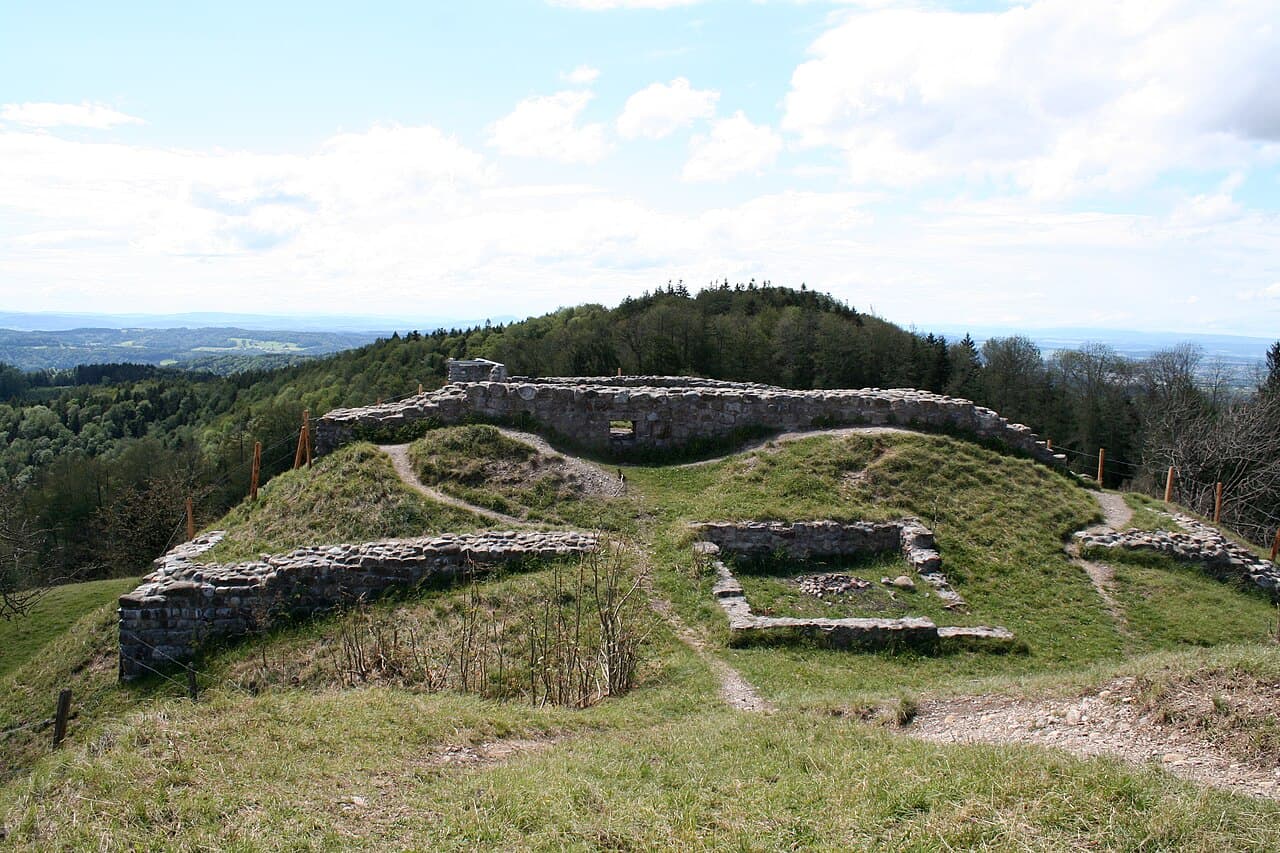
The archaeological remains at Schauenberg Castle reveal a multi-layered history. The prehistoric fortifications consist of remnants of wooden palisades and ditches, indicative of early defensive strategies. The medieval castle's footprint includes the rock-hewn cellar, the foundations of the stone keep, and surviving sections of the neck ditch and western defensive wall.
Excavations conducted between 1976 and 1979 uncovered only small quantities of pottery shards and limited artifacts, supporting the conclusion that the castle was abandoned before its 14th-century destruction. The preserved ruins provide valuable insights into medieval construction techniques and the strategic adaptations made over time.
Geographical context and strategic significance
Schauenberg hill is situated within a landscape of rolling hills, with the notable peak of Schnebelhorn approximately 17 kilometers to the southeast. The hill's elevation and commanding views made it an ideal location for monitoring movement and controlling the surrounding territory. This strategic advantage was recognized and utilized from prehistoric times through the medieval period and into early modern military planning.
The castle's ruins remain a testament to the site's enduring importance and the complex history of fortification in the region. Visitors today can explore the preserved stonework and earthworks, gaining a tangible connection to centuries of defensive architecture and local noble history.
Frequently asked questions (FAQ)
- How do I get to Schauenberg Castle?
- Schauenberg Castle is located near Hofstetten in the Canton of Zürich, Switzerland. Visitors can reach the site by local roads and hiking trails leading up to the hilltop.
- What remains can I see at Schauenberg Castle?
- Visitors can explore the ruins of the medieval stone keep, sections of the neck ditch, and remnants of early wooden fortifications, along with earthworks from prehistoric times.
- When was Schauenberg Castle destroyed?
- The castle was destroyed in 1344 following a military attack by Austrian authorities and local forces due to breaches of peace agreements by its owner.
- Is Schauenberg Castle accessible year-round?
- The castle ruins are outdoors and accessible year-round, but visitors should consider weather conditions and terrain when planning their visit.
- What is the historical significance of Schauenberg Castle?
- Schauenberg Castle illustrates a long history of fortification from prehistoric times through the medieval period, reflecting strategic military and noble residential uses.
Photo gallery

Information
Current owner
Canton of Zürich
Loading map...
Visitor reviews
No reviews yet. Been here? Write the first review and help other travelers!
Write the first reviewVisited this castle? Share your experience
Your review helps other travelers and adds first-hand knowledge to our encyclopedia.