Kyburg Castle
Kyburg Castle, located in the Canton of Zurich, Switzerland, stands as a remarkable testament to medieval fortification and noble lineage in the Swiss plateau. Perched atop a rocky spur overlooking the River Töss, this hill castle has origins dating back to the early 11th century, with its first recorded mention in 1027 under the name "Chuigeburg," which translates to "cow castle," reflecting its initial role as a refuge for livestock during times of unrest.
The castle's early history is intertwined with the powerful noble families of the region, notably the counts of Winterthur and later the House of Dillingen. Around the mid-11th century, ownership passed through marriage to the Dillingen family, who established the castle as a significant stronghold. The rise of the Kyburg family in the 12th and 13th centuries marked a period of territorial expansion and political influence, positioning them alongside the prominent Habsburgs and House of Savoy as key players in the region between the Rhine and the Alps.
Historical significance and political role
Following the extinction of the Kyburg line in 1264, the castle and its territories were inherited by Rudolf von Habsburg, who later became King of Germany. During the late 13th and early 14th centuries, Kyburg Castle held a prestigious role as the repository for the Imperial Regalia of the Holy Roman Empire, symbolizing its importance within the empire's power structure. The castle served as the administrative center of the County of Kyburg under Habsburg control.
In the 15th century, the castle and county passed to the City of Zurich, which managed it as a bailiwick. Distinguished citizens served as bailiffs, administering justice and collecting taxes from the castle until the late 18th century. The castle's administrative function ended with the political upheavals of 1798, when local peasants ransacked the fortress during the establishment of the Helvetic Republic.
Architectural evolution and features
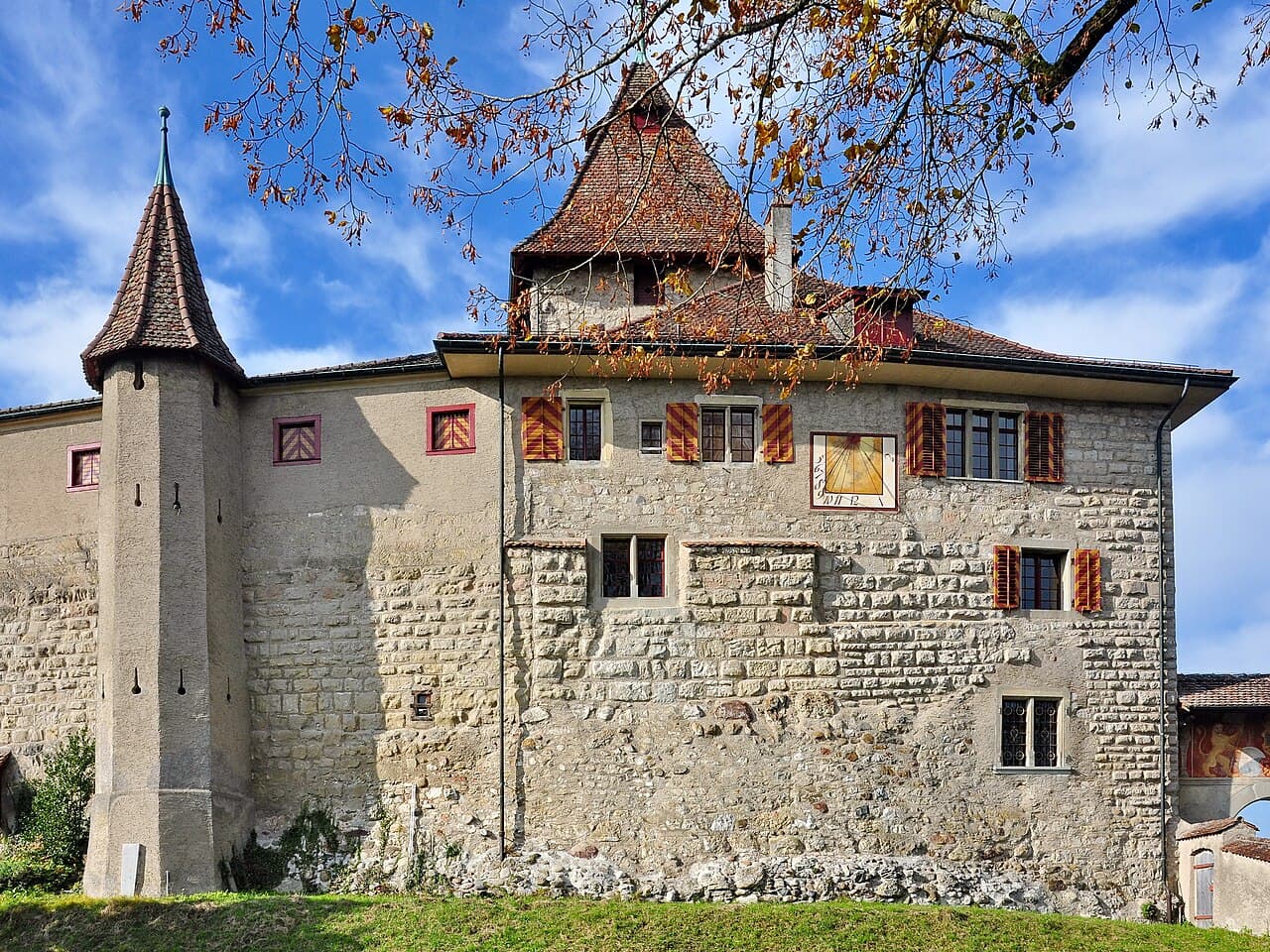
The extant structures of Kyburg Castle predominantly date from the 13th and 14th centuries, reflecting its development from an early wooden fortification to a substantial stone complex. The castle is among the largest surviving medieval castles in Switzerland, featuring a bergfried (a tall defensive tower), a palas (the main residential hall), a chapel, and multiple residential and economic buildings, all enclosed within a formidable ring wall that surrounds a spacious courtyard.
Defensive structures
Key defensive elements include a thick shield wall constructed in the 13th century between the bergfried and palas, designed to reinforce the castle's core defenses. The castle's entrance is fortified with a northern ring wall and a gate adorned with the lordly coat of arms and the Imperial eagle, symbolizing its noble and imperial affiliations. The upper bergfried was rebuilt in durable tuff stone during the 15th century, featuring a high entrance approximately 11 meters above ground level for added security.
Residential and religious buildings
The palas is notable for its impressive size, with approximately 290 square meters of living space per floor, making it one of the largest hall buildings in the German-speaking world of its time. The castle chapel, likely built around 1200, retains its original nave, choir, and side choir. It houses significant late Gothic frescoes commissioned by the city of Zurich in the 15th century, depicting religious scenes and the life of the city's patron saint, Saint Regula. These murals were concealed during the Reformation and rediscovered in the 19th century, undergoing careful restoration and conservation in the late 20th century.
Later history and preservation
After its administrative use ended in the early 19th century, the castle faced potential destruction when it was auctioned and purchased by Franz Heinrich Hirzel, who intended to dismantle it for building materials. Preservation efforts by local citizens and the acquisition by the Polish Count Alexander Sobansky in 1835 saved the castle from ruin. Sobansky and subsequent owners maintained the castle as a residence and cultural site.
In the late 19th and early 20th centuries, the castle underwent restorations inspired by medieval romanticism, with efforts to open it as a museum. The Canton of Zurich repurchased Kyburg Castle in 1917 and invested in significant renovations during the 1920s. Since 1999, the castle has been operated by the Verein Museum Schloss Kyburg society, which manages its museum exhibitions and preservation.
Notable artifacts and cultural heritage
Among the castle's unique features is the so-called "Iron Maiden", a 2.37-meter-tall wooden structure covered with iron spikes. Although displayed historically as a torture device, it is not a genuine medieval artifact but rather a symbolic piece acquired in the 19th century. The castle's courtyard has hosted various cultural events, and its well-preserved medieval architecture offers valuable insights into the evolution of castle construction and noble life in medieval Switzerland.
Today, Kyburg Castle stands as a significant cultural and historical landmark, illustrating the complex history of noble families, imperial power, and urban administration in the Swiss plateau. Its architectural grandeur and rich collection of art and artifacts continue to attract scholars, tourists, and history enthusiasts alike.
Frequently asked questions (FAQ)
- What are the opening hours of Kyburg Castle?
- Kyburg Castle is open to visitors from April to October, typically from 10 AM to 5 PM, and in the winter months, hours may vary. It is advisable to check the official website for seasonal changes and special holiday hours to avoid any disappointment.
- How do I get to Kyburg Castle?
- Kyburg Castle is conveniently located in the Canton of Zurich and can be reached by public transport from Zurich city center. Visitors can take a train to Winterthur and then a short bus ride to the castle, making it easily accessible for day trips.
- Is there an admission fee to visit Kyburg Castle?
- Yes, there is a nominal admission fee to enter Kyburg Castle, which helps in the maintenance and preservation of this historical site. Ticket prices are generally affordable, with discounts available for students and seniors.
- When was Kyburg Castle built?
- Kyburg Castle was constructed in the 11th century and has a rich history that reflects the medieval architecture of the period. Its strategic location and formidable design made it an important stronghold in the region.
- Can I take guided tours of Kyburg Castle?
- Yes, guided tours are available at Kyburg Castle, providing a deeper insight into its history, architecture, and significance. These tours are often led by knowledgeable guides who can answer questions and share intriguing stories about the castle.
- What is the historical significance of Kyburg Castle?
- Kyburg Castle played a crucial role in the political and military history of the region during the Middle Ages. It served as the residence of the Counts of Kyburg and later became an essential administrative center.
- Is Kyburg Castle accessible for visitors with disabilities?
- Kyburg Castle strives to be accessible for all visitors, with efforts made to accommodate those with mobility challenges. However, due to its historical structure, some areas may have limitations, so it's recommended to check in advance for specific accessibility options.
- What is the best time to visit Kyburg Castle?
- The best time to visit Kyburg Castle is during the spring and summer months when the weather is pleasant and the surrounding landscape is in full bloom. Additionally, various events and activities are often held during these months, enhancing the visitor experience.
- Are there any nearby attractions to visit while at Kyburg Castle?
- Yes, visitors to Kyburg Castle can explore the nearby picturesque town of Winterthur, known for its cultural institutions and beautiful parks. Additionally, the scenic hiking trails in the surrounding area provide excellent opportunities for outdoor enthusiasts.
Photo gallery

Information
Website
Visit websiteSources & official resources
Verify the information above using these authoritative references.
Loading map...
Visitor reviews
No reviews yet. Been here? Write the first review and help other travelers!
Write the first reviewVisited this castle? Share your experience
Your review helps other travelers and adds first-hand knowledge to our encyclopedia.