Schaaken Castle Ruins
Schaaken Castle, located near the village of Nekrasovo in Russia's Kaliningrad region, is a significant medieval fortress originally built by the Teutonic Order. First mentioned in 1328, the castle stands on a site with a rich history tracing back to an Old Prussian fortress known as Zoke or Shokin, recorded as early as 1258. The castle's strategic location about four kilometers inland from the Curonian Lagoon was chosen for its defensibility, with the nearby Shaaken River dammed to stabilize the marshy terrain and create firm ground for fortifications.
The origins and early construction
The earliest phase of the site featured a wooden fortress constructed by the Teutonic knights around 1261. This initial fortification was part of the Order's efforts to consolidate control over the region formerly inhabited by the Old Prussians, a Baltic people native to the area. By approximately 1270, the wooden fortress included a bishop's residence, marking Schaaken as an important religious and military center within the Order's network.
Over the following decades, the fortress expanded to include residential quarters, a chapel, and various functional buildings integrated into the defensive walls. The castle's name is believed to derive from the Old Prussian word for "grass," reflecting the natural environment of reeds and grassy marshlands surrounding the site.
Medieval architectural features and development
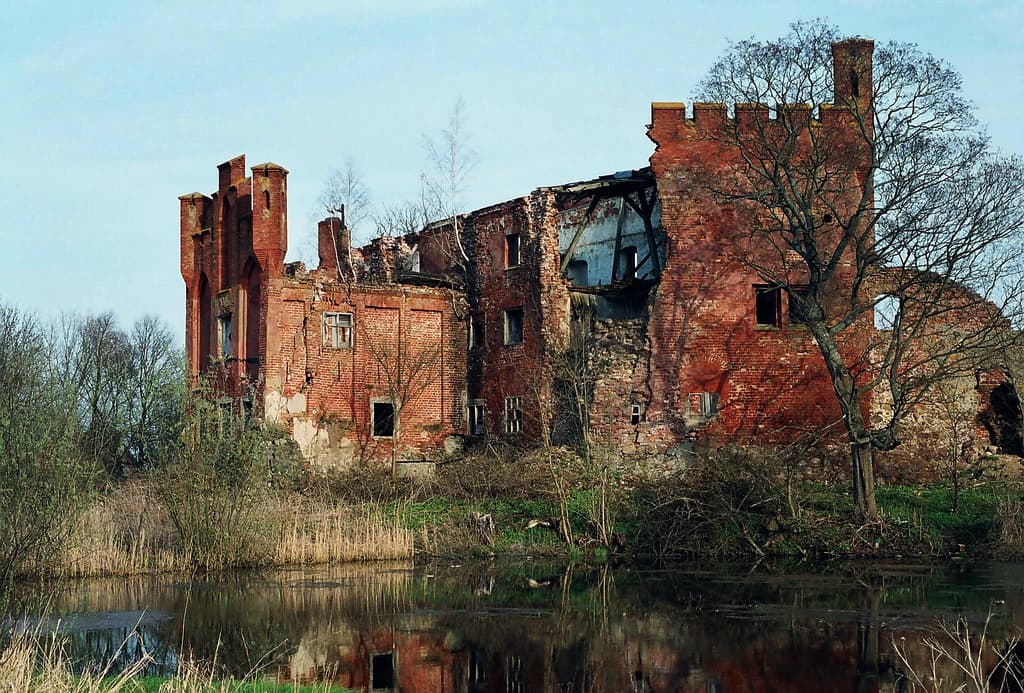
While the original fortress was primarily wooden, Schaaken Castle evolved into a complex fortified structure featuring brick defensive walls characteristic of Late Medieval architecture. The castle's design incorporated typical elements such as battlements, towers, and a gatehouse to control access. The use of brick was common in the region due to the scarcity of natural stone, and it provided durable protection against sieges and attacks.
The castle's location on artificially stabilized marshland required innovative engineering, including the damming of the Shaaken River to create a solid foundation. This adaptation demonstrates the Teutonic Order's expertise in combining natural landscape features with military architecture to secure their holdings.
Historical significance and notable events
Schaaken Castle played a notable role in regional politics and military affairs throughout the medieval and early modern periods. The castle was a key stronghold for the Teutonic Order during their campaigns in the Baltic region. Its strategic position near a harbor made it a valuable waypoint for travelers and military expeditions.
In the early 18th century, the castle gained prominence as a stopover for Russian rulers. Tsar Peter I, famed for his efforts to modernize Russia and engage with Western Europe, visited Schaaken Castle on three occasions during his "Great Embassy" between 1711 and 1717. These visits underscored the castle's continued importance as a regional hub and resting place for dignitaries traveling between Russia and Europe.
Modern history and preservation efforts
Remarkably, Schaaken Castle sustained only minor damage during World War II. After the war, from 1945 to 1947, the castle served as a shelter for orphaned German children displaced by the conflict. Subsequently, it was repurposed as a stable for a collective farm until the early 1960s. Parts of the castle were later adapted for residential use, while auxiliary buildings supported household activities.
By the 1980s, only a single family remained living in the castle's usable sections. The lack of regular maintenance led to progressive decay of much of the complex. In the early 2000s, private individuals leased the site and initiated restoration projects, including rebuilding sections of the defensive walls. During this period, the castle also hosted a museum exhibit featuring medieval instruments of torture and a children's area with exotic animals, combining historical education with family-friendly attractions.
Ownership transferred to the Russian Orthodox Church in 2011. Unfortunately, a fire in 2012 caused damage to parts of the premises. As of 2024, partial reconstruction efforts are ongoing to preserve the remaining structures and maintain the castle's cultural heritage.
Architectural remains and site features
The surviving remains of Schaaken Castle reflect its layered history from an early wooden fortress to a brick-built medieval stronghold. Key features include sections of the brick defensive walls, remnants of the residential quarters, and traces of the original chapel. The site's marshy environment and the historic damming of the Shaaken River remain notable aspects of the castle's setting.
Despite extensive degradation over the twentieth century, some parts of the castle were habitable into the late 1900s. Restoration efforts in the 2000s have helped to stabilize and partially reconstruct the defensive walls, reestablishing the castle's imposing presence in the landscape.
The castle grounds once featured a museum exhibition of medieval torture instruments, linking the site's military and judicial past to tangible artifacts. Additionally, a small menagerie of exotic animals was maintained to engage visitors, particularly children, blending educational and leisure functions within the historic site.
Legacy and cultural importance
Schaaken Castle stands as a testament to the complex history of the Baltic region, reflecting the interactions between the Old Prussian peoples, the Teutonic Order, and later Russian influences. Its architectural evolution from a wooden fortress to a brick castle illustrates the technological and strategic advancements of medieval military construction.
Today, the castle ruins are a valuable cultural and historical landmark within the Kaliningrad region, attracting visitors interested in medieval history, military architecture, and the heritage of the Teutonic Order. Ongoing preservation efforts aim to protect this unique site for future generations, ensuring that Schaaken Castle's story remains accessible and appreciated.
Frequently asked questions (FAQ)
- What is the historical significance of Schaaken Castle Ruins?
- Schaaken Castle Ruins hold a significant place in Russian history, as they are remnants of the medieval fortifications that once protected the region. Built in the 14th century, the castle reflects the architectural styles and defensive strategies of the time, showcasing its importance in the defense against invasions.
- When was Schaaken Castle built?
- Schaaken Castle was constructed in the 14th century, specifically around the year 1350. It served as a strategic fortification during the height of its use, providing a critical military stronghold for the surrounding area.
- Can I visit Schaaken Castle Ruins?
- Yes, visitors are welcome to explore the Schaaken Castle Ruins. While the site is not fully restored, it offers a fascinating glimpse into medieval architecture and history, making it an interesting destination for history enthusiasts and tourists alike.
- What are the opening hours for Schaaken Castle Ruins?
- Schaaken Castle Ruins are typically open to visitors from dawn until dusk. However, it is advisable to check local resources or visitor centers for any seasonal changes in hours or special events that may affect access.
- Is it possible to access Schaaken Castle by public transportation?
- Accessing Schaaken Castle Ruins via public transportation is possible, but options may be limited. Visitors can take local buses to Nekrasovo and then walk to the ruins, although it may be helpful to plan for a short hiking distance.
- What is the best time to visit Schaaken Castle Ruins?
- The best time to visit Schaaken Castle Ruins is during the late spring or early autumn months when the weather is mild and pleasant. These seasons provide a beautiful backdrop for exploring the ruins and enjoying the surrounding landscapes.
- Are there any nearby attractions to visit while at Schaaken Castle?
- Yes, there are several nearby attractions worth visiting, including local parks and historical sites that complement the experience at Schaaken Castle. Exploring the charming village of Nekrasovo can also enhance your visit, offering a glimpse into regional culture.
- What are the ticket prices for visiting Schaaken Castle Ruins?
- Visiting Schaaken Castle Ruins is generally free of charge, making it an accessible option for all travelers. However, visitors may want to check if there are guided tours available for a small fee for a more enriched experience.
- How do I get the most out of my visit to Schaaken Castle Ruins?
- To get the most out of your visit, consider joining a guided tour to learn about the rich history and architectural details of the ruins. Bring a camera to capture the stunning views and allow time to explore the surrounding area for a complete experience.
Photo gallery

Information
Website
Visit websiteSources & official resources
Verify the information above using these authoritative references.
Loading map...
Visitor reviews
No reviews yet. Been here? Write the first review and help other travelers!
Write the first reviewVisited this castle? Share your experience
Your review helps other travelers and adds first-hand knowledge to our encyclopedia.