Fort 5 - King Frederick Wilhelm III
Fort 5 - King Frederick Wilhelm III is a notable example of a bastioned fortress located in the Russian Federation, reflecting the military architectural trends of the 19th century. This fortification was part of a larger defensive network designed to protect strategic locations against advancing armies during a period marked by rapid evolution in artillery and siege tactics.
Historical context and strategic importance
Constructed during the 19th century, Fort 5 was named after King Frederick Wilhelm III, a monarch whose era saw significant military reforms and fortification developments across Europe. The fortress was built as part of a comprehensive system of defensive works intended to secure key territories within the Russian Empire. Its location was chosen to maximize control over important routes and to serve as a deterrent against enemy incursions.
Architectural design and features
The design of Fort 5 exemplifies the characteristics of a bastioned fortress, a style that emerged in response to the increasing power of artillery in the Early Modern period. The fortress features angular bastions projecting outward from the main walls, allowing defenders to cover adjacent walls with enfilading fire, thus eliminating blind spots. The bastions are connected by curtain walls that form a polygonal layout, optimized for defense and resilience against bombardment.
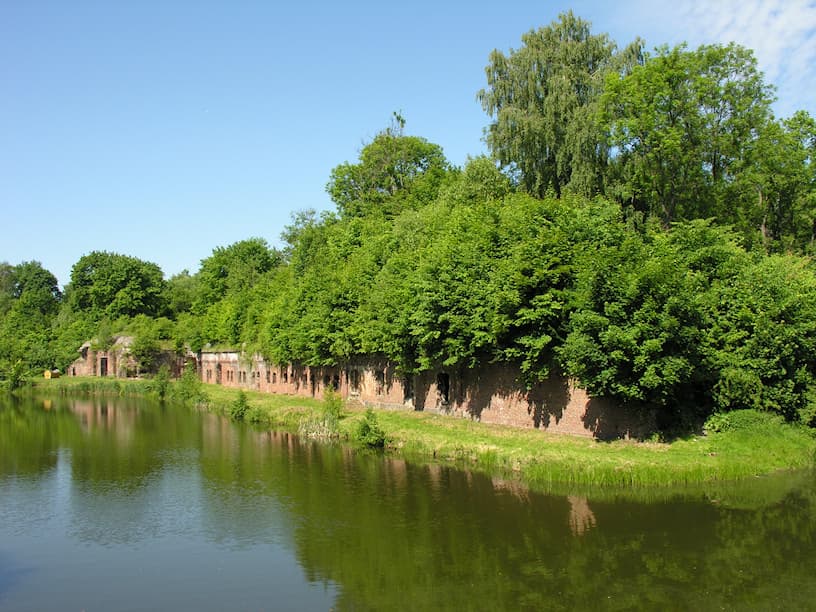
Constructed primarily from robust masonry materials, the fortress includes ditches and moats surrounding the walls to impede attackers. The entrance is typically fortified with a gatehouse and additional defensive works such as ravelins or hornworks, which serve to protect the main gate from direct assault.
Internal structures
Inside the fortress, there are various military buildings including barracks for troops, armories, and magazines for storing ammunition and supplies. The layout is designed to support a self-sustaining garrison during sieges, with provisions for water storage and food supplies.
Military significance and use
Throughout its operational history, Fort 5 played a role in regional defense strategies, particularly during periods of heightened military tension in the 19th century. Its bastioned design reflects the tactical doctrines of the time, emphasizing strong defensive positions capable of withstanding prolonged artillery attacks.
While detailed records of specific engagements involving Fort 5 are limited, its construction aligns with broader Russian efforts to modernize fortifications in response to advances in military technology and shifting geopolitical threats.
Preservation and current status
Today, Fort 5 - King Frederick Wilhelm III remains as a partially preserved example of 19th-century military architecture. The fortress's walls and bastions, though weathered, still convey the scale and defensive ingenuity of its original design. Preservation efforts focus on maintaining structural integrity and preventing further deterioration, allowing visitors and scholars to study this historic bastioned fortress.
Visiting information
Access to Fort 5 may be limited depending on its location and ownership. Visitors interested in military history and fortress architecture find it a valuable site for understanding the evolution of fortification design in the Russian context.
Frequently asked questions (FAQ)
- When was Fort 5 - King Frederick Wilhelm III built?
- Fort 5 was constructed in the 19th century as part of a network of bastioned fortresses designed to protect strategic locations in Russia.
- What architectural style characterizes Fort 5?
- Fort 5 exemplifies the bastioned fortress style, featuring angular bastions and curtain walls designed for defense against artillery.
- Is Fort 5 accessible to visitors today?
- Access to Fort 5 may vary depending on its location and ownership, but it remains a site of interest for those studying military architecture.
- What defensive features does Fort 5 include?
- The fortress includes bastions, curtain walls, moats, ditches, and fortified gatehouses to enhance its defensive capabilities.
Photo gallery

Information
Loading map...
Visitor reviews
No reviews yet. Been here? Write the first review and help other travelers!
Write the first reviewVisited this castle? Share your experience
Your review helps other travelers and adds first-hand knowledge to our encyclopedia.