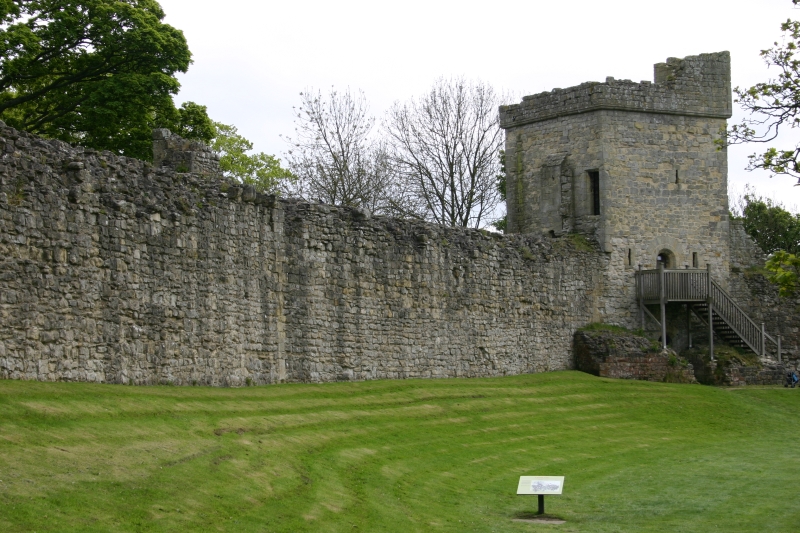
Foss Castle
Foss Castle stands as a significant example of an early Norman motte and bailey castle located in Hutton Mulgrave, England. Although today only earthworks remain, the site offers valuable insight into the military and feudal landscape of post-Conquest northern England. The castle's most prominent feature is its circular motte, a man-made mound that would have supported a wooden or stone keep, surrounded by an attached bailey enclosure where ancillary buildings and defenses were situated.
Constructed in the 1070s, shortly after the Norman Conquest of 1066, Foss Castle was built by Nigel Fossard, a Norman lord with extensive lands and multiple castles across Yorkshire. Fossard's establishment of this fortification was part of the broader Norman strategy to consolidate control over the region by erecting strongholds on elevated terrain. The castle's location on a prominent hill would have provided commanding views of the surrounding landscape, which at the time was more open and strategically important for surveillance and defense.
Anglo-Saxon heritage and early landscape
The site of Foss Castle is notable for its long-standing Anglo-Saxon connections. Prior to the Norman construction, the area was already significant, as evidenced by the nearby church containing hogback grave markers dating from the 8th to 10th centuries. These distinctive carved stones are associated with Norse-influenced Anglo-Saxon culture and indicate the presence of an established community before the castle's erection.
The earthworks of Foss Castle likely developed over several phases, adapting to evolving military needs and ownership changes. The motte itself is a classic Norman defensive feature, designed to elevate a keep and provide a strongpoint in a landscape that was transitioning from Anglo-Saxon to Norman control.
Architectural features and castle layout
Foss Castle typifies the motte and bailey design, one of the earliest forms of Norman castles introduced to England. The motte is a large, steep-sided mound constructed from earth and possibly reinforced with timber or stone structures. Its circular shape is typical, providing a defensible platform for a keep or tower that served as the lord's residence and a last line of defense.
The bailey attached to the motte would have been enclosed by a palisade and ditch, containing living quarters, workshops, stables, and storage buildings necessary for sustaining the garrison. Although now obscured by woodland, the bailey's outline can still be discerned in the terrain, marking the castle's former extent.
Historical significance and ownership
Foss Castle was established by Nigel Fossard, a prominent Norman landowner who held numerous estates and castles throughout Yorkshire. Fossard's role in the consolidation of Norman authority in the north was significant, and his castles formed a network of fortifications securing his holdings.
Following Fossard's death in 1091, the castle remained in the family for several generations. Documentary evidence from 1133 refers to the site as "Castrum de Mulgreit" or the "Castle of Mulgrave," indicating its continued importance before the later construction of Old Mulgrave Castle closer to the coast.
While detailed records of the castle's later history are scarce, Foss Castle's role as an early feudal stronghold reflects the turbulent period of Norman consolidation and the gradual transition from Anglo-Saxon to Norman rule in northern England.
Present condition and heritage value
Today, Foss Castle survives only as earthwork remains within a woodland setting. Its prominent motte and traces of the bailey provide valuable archaeological evidence of Norman military architecture and landscape adaptation. The site is an important cultural heritage asset, illustrating the early Norman strategy of using motte and bailey castles to establish control over newly conquered territories.
Visitors to the site can appreciate the scale of the motte and the castle's strategic location, although no standing structures remain. The surrounding area's Anglo-Saxon heritage, including the nearby hogback stones, enriches the historical context of Foss Castle and its significance in England's medieval history.
Archaeological insights and research
Archaeological studies of Foss Castle have focused on its earthworks and the relationship between the castle and the surrounding landscape. The multi-phase development of the site suggests adaptation to changing defensive needs and ownership. The proximity to Anglo-Saxon burial sites and artifacts highlights the continuity and transformation of the region's cultural landscape from the early medieval period through the Norman era.
Further archaeological investigation could provide additional understanding of the castle's construction techniques, the layout of the bailey, and the daily life of its inhabitants during its active use in the 11th and 12th centuries.
Frequently asked questions (FAQ)
- How do I get to Foss Castle?
- Foss Castle is located in Hutton Mulgrave, England. Visitors can reach the site by local roads leading to the village. It is advisable to check local maps and transport options as the castle is situated in a rural area surrounded by woodland.
- What remains of Foss Castle can I see today?
- Today, visitors can see the prominent earthwork remains of the motte and the outlines of the bailey. No standing structures survive, but the site offers a clear impression of the castle's original layout and defensive features.
- When was Foss Castle built and by whom?
- Foss Castle was built in the 1070s shortly after the Norman Conquest by Nigel Fossard, a Norman landowner with extensive estates in Yorkshire.
- Is Foss Castle accessible to the public?
- Foss Castle is accessible to the public, but as it is primarily an archaeological site with earthworks, there are no visitor facilities or guided tours available on site.
- What is the historical significance of Foss Castle?
- Foss Castle represents an early Norman motte and bailey fortification that played a role in consolidating Norman control in northern England. It also has connections to Anglo-Saxon heritage through nearby hogback grave markers.
Information
Website
Visit websiteSources & official resources
Verify the information above using these authoritative references.
Loading map...
Visitor reviews
No reviews yet. Been here? Write the first review and help other travelers!
Write the first reviewVisited this castle? Share your experience
Your review helps other travelers and adds first-hand knowledge to our encyclopedia.