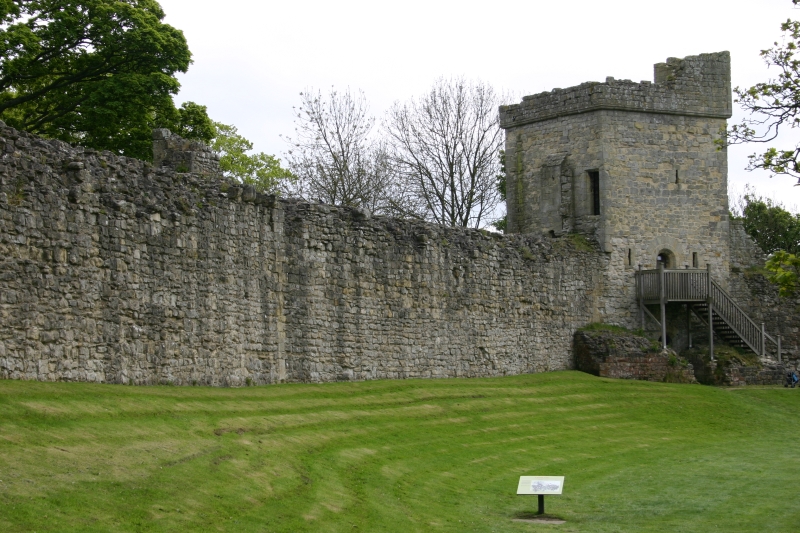
Old Mulgrave Castle
Old Mulgrave Castle stands as a significant historical and architectural site near Whitby in England. Constructed initially in the 13th century as a defensive residence, it replaced the earlier Foss Castle located in Mulgrave Woods, marking a continuity of fortification on this strategic ridge. Over centuries, this castle witnessed the passage of several noble families, including the de Mauley, Bigot, Radcliffe, and Edmund Lord Sheffield, each contributing to its layered history, although none undertook major restoration efforts, leaving the castle as a historic ruin today.
The origins and early construction
The castle's initial construction began piecemeal around 1069 on a narrow ridge between the Sandsend and East Row Becks. This location was chosen for its natural defensive advantages, with the ridge providing a commanding view and natural barriers. Early fortifications included an oval-shaped platform surrounded by a high curtain wall, protected by dry moats at either end, a drawbridge, and a prominent three-story tower-like keep. These features typify Norman military architecture, emphasizing strong defensive capabilities.
Legendary and Norman foundations
Local tradition attributes the earliest fortification on this site to Wada, a 6th-century ruler linked to mythic origins and reputed to have constructed many castles and infrastructure across Yorkshire. While this early structure is not preserved, it set a foundation for the later Norman castle built by Nigel Fossard, a Norman lord recorded in the Domesday Book of 1086. Fossard established the second Mulgrave Castle as the administrative center, or caput, of the feudal barony of Mulgrave, which by 1166 included over thirty knight’s fees, underscoring its regional significance.
Medieval ownership and architecture
The castle passed through several noble families by inheritance and marriage, including the Fossard, de Turnham, de Mauley, Bigod, and Radcliffe families. The de Mauley family, notably Peter de Mauley, the first Baron Mauley, was granted the castle in the early 13th century. Peter de Mauley is historically infamous as a henchman of King John and is believed to have been involved in the assassination of Prince Arthur of Brittany in 1203.
By 1309, the castle was already reported as being in a state of ruin, which suggests that maintenance and military relevance declined relatively early. Despite this, the castle's strategic location maintained its importance, particularly during the English Civil War in the 17th century.
Architectural features and defensive design
The Norman castle occupied an entire ridge top, utilizing the natural landscape to enhance its defenses. The main gateway faced west, flanked by two stone towers that guarded the entrance. On the eastern side, moats prevented access, augmented by a drawbridge over the western approach that could be raised to secure the castle. The curtain walls exhibited a distinctive outward bulge, a result of the uneven terrain beneath, necessitating buttresses for structural support. Some bricks were salvaged from Roman structures, reflecting medieval builders' resourcefulness.
Defensive ditches or moats encircled the castle, integrating the ridge's shape to maximize security. Although fragmentary today, these remains illustrate the castle's original formidable defenses.
Later history and decline
During the English Civil War beginning in 1642, Royalist forces seized the castle for its tactical value. However, following the Parliamentary victory, the castle was deliberately destroyed in 1647 to prevent its future military use, marking the end of its role as a fortress. Prior to this, in 1626, the castle briefly served as a semi-open-air hunting lodge, reflecting a shift from military to leisure use.
18th-century country house and estate evolution
The site saw a transformation in the 18th century with the construction of a castellated country house under Lady Catherine Darnley, an illegitimate daughter of King James II. This residence, featuring battlement-like decorative elements, marked the estate's transition into a noble country seat. In 1718, the estate passed by marriage to the Phipps family, who gained titles including Baron Mulgrave, Earl of Mulgrave, and Marquess of Normanby.
The estate also includes a summer house traditionally located on the site of a 12th-century hermitage founded by William de Percy, highlighting the site's longstanding religious connections.
In 1858, the country house was leased by Duleep Singh, the last Maharajah of Punjab, emphasizing the estate's continuing prominence. Into the 21st century, the Phipps family retained ownership, with the estate recognized as one of England's premier shooting grounds, and the country house used seasonally.
Heraldry and cultural significance
The castle's historical identity is also preserved in heraldic symbolism. The seal of Peter de Mauley, first Baron Mauley from 1296, depicts him on horseback with sword and shield. His coat of arms, described as gold with a black diagonal bend adorned with scrollwork, was prominently displayed in the castle, signifying ownership and allegiance.
Current state and archaeological remains
Today, the remains of Old Mulgrave Castle are fragmentary but significant. The ruins include the remnants of curtain walls, towers, moats, and the keep's foundations. The castle's adaptation to the ridge's uneven terrain is evident in the structural bulges and buttresses. The site offers valuable insight into Norman military architecture and medieval defensive strategies.
The extensive estate spans approximately 65 square kilometers (16,000 acres), known for its shooting grounds and noble heritage. The country house remains the central residence during shooting season, continuing the legacy of aristocratic land use tied to both defense and leisure.
Frequently asked questions (FAQ)
- What is the historical significance of Old Mulgrave Castle?
- Old Mulgrave Castle, dating back to the 12th century, is steeped in rich history and has served as a stronghold for various noble families over the centuries. Its strategic location near Whitby allowed it to play a vital role in local defense and governance, making it a significant landmark in the region's historical narrative.
- When was Old Mulgrave Castle built?
- Construction of Old Mulgrave Castle began in the late 12th century, around 1170, under the direction of the de Mulgrave family. The castle has undergone various renovations and restorations throughout the centuries, reflecting architectural styles from different periods.
- What are the opening hours for Old Mulgrave Castle?
- Old Mulgrave Castle is typically open to visitors from 10 AM to 5 PM during the summer months, with reduced hours in the winter. It’s advisable to check the official website for any seasonal variations or special events that may affect visiting hours.
- Can I access Old Mulgrave Castle with a wheelchair?
- Access to Old Mulgrave Castle can be challenging due to its historic architecture and uneven terrain. While some areas may be accessible, it is recommended to contact visitor services ahead of your visit to discuss specific accessibility needs and available accommodations.
- Is it possible to take guided tours of Old Mulgrave Castle?
- Yes, guided tours of Old Mulgrave Castle are available and provide an in-depth look at its history and architectural features. These tours are led by knowledgeable guides who can share fascinating stories and insights about the castle and its surroundings.
- When is the best time to visit Old Mulgrave Castle?
- The best time to visit Old Mulgrave Castle is during the late spring and early summer months, from May to July, when the weather is generally mild and the gardens are in full bloom. Additionally, visiting during these months may allow you to enjoy local festivals and events happening in Whitby.
- What are the ticket prices for visiting Old Mulgrave Castle?
- Ticket prices for Old Mulgrave Castle typically vary based on age and group size, with discounts often available for children, students, and seniors. It’s best to check the official website for the most current pricing and any promotional offers that may be available.
- Are there any nearby attractions to Old Mulgrave Castle?
- Yes, Old Mulgrave Castle is located near several attractions, including the picturesque town of Whitby, known for its stunning coastline and historic abbey. Additionally, visitors can explore the North York Moors National Park, which offers beautiful landscapes and walking trails just a short drive away.
Information
Loading map...
Visitor reviews
No reviews yet. Been here? Write the first review and help other travelers!
Write the first reviewVisited this castle? Share your experience
Your review helps other travelers and adds first-hand knowledge to our encyclopedia.