Šaunštejn Castle — Czech Republic castle

Šaunštejn Castle

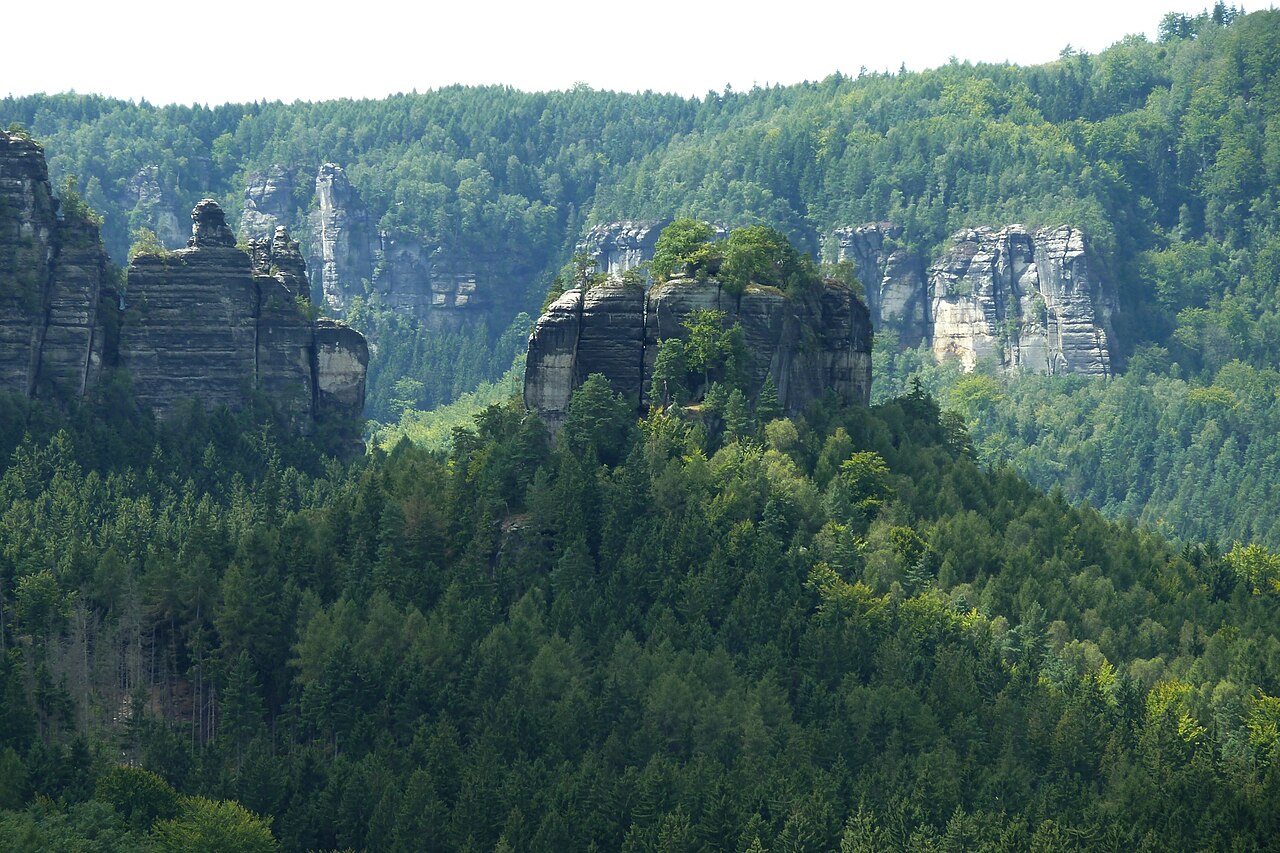
Šaunštejn Castle: medieval rock fortress in Bohemian Switzerland
Jetřichovice, Czech Republic
Late Medieval (14th–15th c.)
Ruins

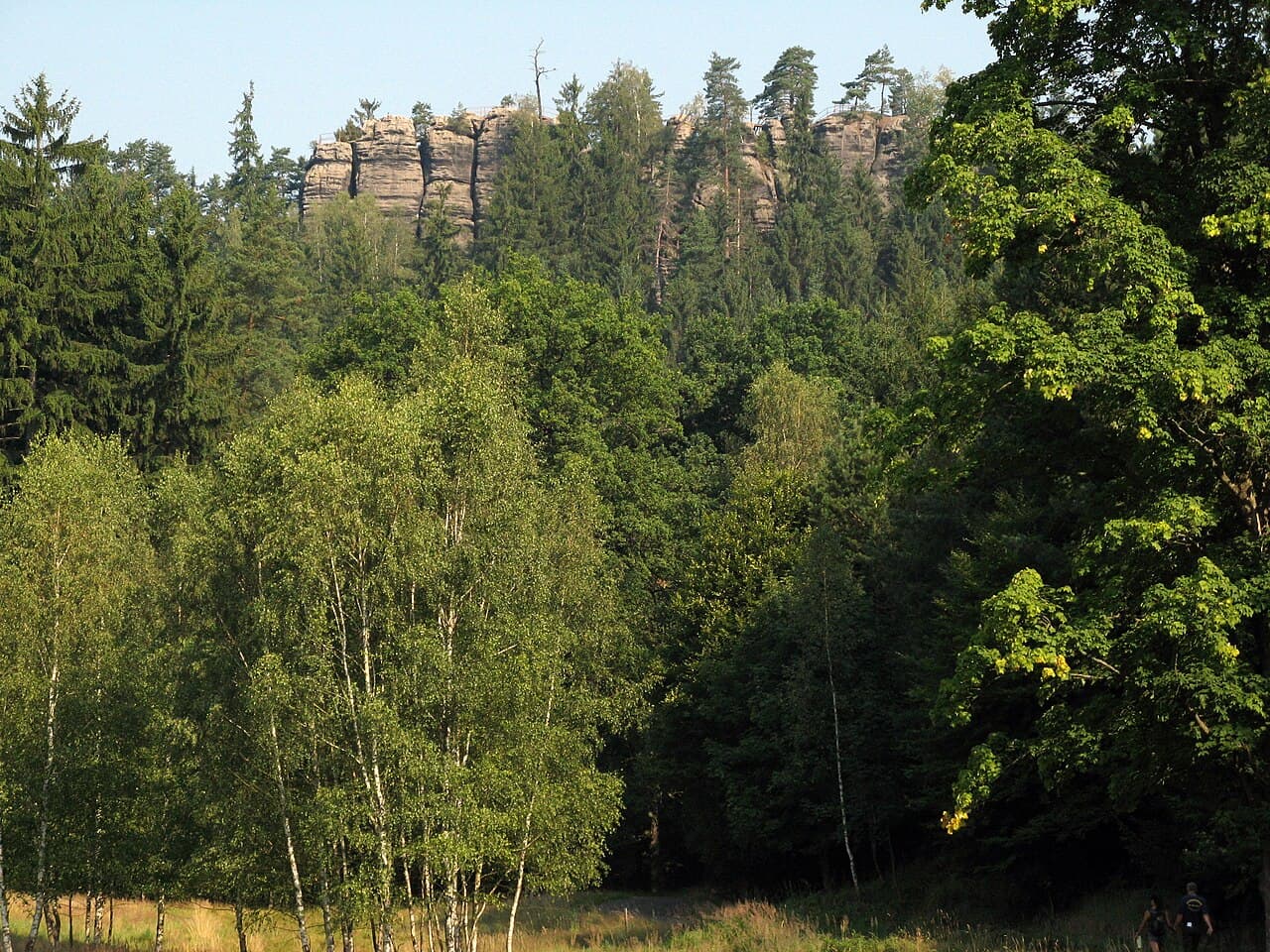
Šaunštejn Castle stands as a remarkable example of a medieval rock castle nestled within the dramatic landscape of the Bohemian Switzerland National Park in Czechia. Founded in the late 14th century, this hill castle was strategically positioned atop a sandstone outcrop approximately 340 meters above sea level, near the village of Vysoká Lípa. Its location was chosen to control the vital Old Bohemian Road, an important trade route linking Bohemia with Lusatia, underscoring the castle's significant military and economic role during the Late Medieval period.

The castle's origins are closely tied to the Berken family from Dubá, who likely established it as a fortified stronghold to oversee and protect regional commerce. The earliest written records date to between 1413 and 1446, with notable mentions during the years 1431 and 1444 that highlight the castle's involvement in military conflicts. Ownership passed in the early 15th century to the influential Vartenberk family, who used Šaunštejn as a base for raids against neighboring territories, provoking tensions with the Lusatian Six-City League and Saxon authorities.

Historical significance and military role

Šaunštejn's history is marked by its strategic military importance during the turbulent 15th century. The castle was repeatedly besieged, with the most significant assault occurring in 1444 when a large Lusatian force of about 9,000 soldiers, armed with early firearms, laid siege to the fortress. Despite withstanding intense bombardments, the castle ultimately fell in September 1444. This event reflects the evolving nature of medieval warfare, where gunpowder weapons began to challenge traditional fortifications.

Following the cessation of regional conflicts and the restoration of relative peace, Šaunštejn's military relevance diminished. By the late 15th century, it had been abandoned and fell into ruin, with the last known historical mention in 1490. The castle was fully destroyed by the early 16th century, leaving behind only its rock-hewn foundations and carved chambers.

Architectural features and construction

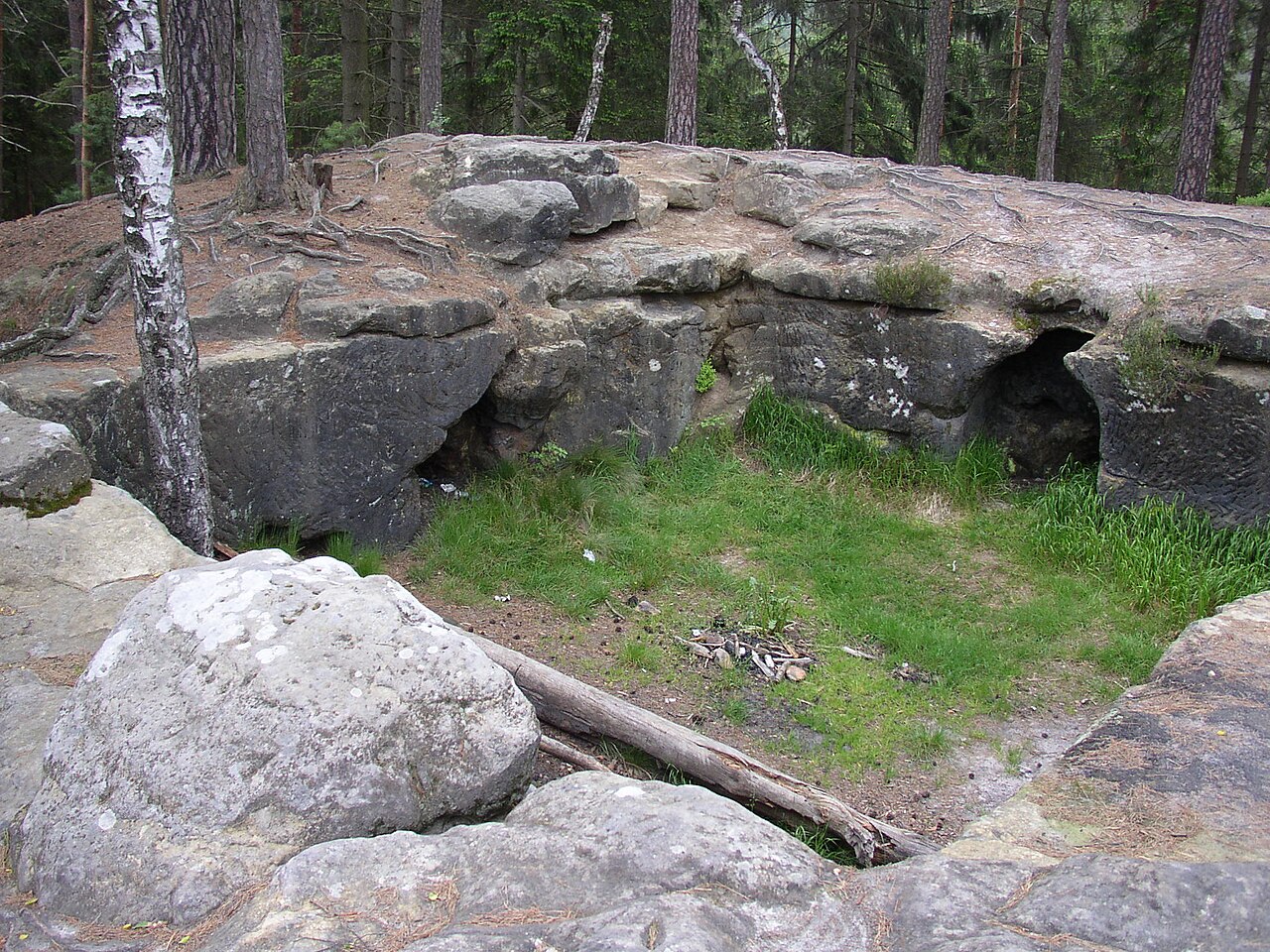
Šaunštejn is a classic example of a rock castle, ingeniously integrated into the natural sandstone formations of the region. The castle's structures were carved directly into the rock, utilizing natural ledges and crevices to create living quarters, defensive positions, and storage areas. The main entrance was situated about four meters above ground level and was originally accessed via a wooden square tower. This elevated entry was protected by stone-cut stairs reachable only by ladders that defenders could retract during attacks, emphasizing vertical defense mechanisms.

At the summit plateau, visitors can find a small chamber carved into the sandstone, believed to have served as a living space or possibly a chapel, indicating the castle's dual military and residential functions. Nearby lies the base of a residential tower, with numerous grooves and holes cut into the rock that once supported wooden beams and structures. Essential water storage was provided by a large circular cistern carved into the rock, designed with a narrow neck to collect and retain rainwater, a crucial feature for sustaining the castle's inhabitants during sieges.

The forecourt below the main rock formation housed operational buildings necessary for daily life and defense. While wooden superstructures have not survived, their foundations and rock-cut rooms remain visible, offering insight into the castle's complex layout. Additional carvings found at the site, including incised crosses, human faces, and a depiction of a deer alongside a crucifix, suggest symbolic or religious significance, adding cultural depth to the fortress beyond its military purpose.

Preservation and modern access

Šaunštejn Castle's ruins have been recognized for their cultural and historical value since the 20th century. Preservation efforts began in earnest with its designation as a protected cultural monument in 1966. Archaeological investigations have clarified the castle's origins, architectural techniques, and historical role in the border region between Bohemia and Lusatia.

Natural erosion and visitor impact have posed challenges to the site's integrity. In 2021–2022, a comprehensive renovation project addressed these issues by restoring access routes, replacing ladders and railings, and installing walkways to minimize further damage to the delicate sandstone. During this process, the southwestern summit group and its associated viewpoint were removed to preserve the remaining rock formations.

Today, Šaunštejn is accessible exclusively on foot via marked hiking trails, preserving the site's natural environment and historical ambiance. Visitors can explore the castle's rock-hewn chambers, cistern, and foundations while enjoying the stunning scenery of the Bohemian Switzerland National Park.

Architectural context and regional importance

As a rock castle, Šaunštejn exemplifies a distinctive medieval fortification style adapted to the sandstone landscape of the Elbe Sandstone Mountains. Its design reflects a sophisticated use of natural topography for defense, combining carved stone elements with wooden structures supported by beams anchored into the rock. This hybrid construction method allowed for a compact yet formidable fortress that leveraged the natural verticality and ruggedness of its setting.

The castle's role in controlling the Old Bohemian Road highlights its importance in regional trade and military strategy. By overseeing this key route, Šaunštejn influenced economic flows and territorial control between Bohemia and Lusatia, making it a focal point in the borderland conflicts of the Late Middle Ages.

Symbolism and cultural heritage

The carved motifs at Šaunštejn, including crosses and animal imagery, provide a glimpse into the spiritual and cultural dimensions of the castle's inhabitants. These symbols may have served protective or devotional purposes, reflecting the medieval worldview that intertwined military power with religious faith.

Šaunštejn's preservation as a protected monument and its location within a national park underscore its value as both a historical site and a cultural landmark. It attracts historians, archaeologists, and tourists interested in medieval architecture, military history, and natural beauty.

Frequently asked questions (FAQ)

How do I get to Šaunštejn Castle?
Šaunštejn Castle is accessible only on foot via marked hiking trails from nearby villages such as Vysoká Lípa and Jetřichovice. Visitors should be prepared for a moderate hike through the Bohemian Switzerland National Park.
What is the historical significance of Šaunštejn Castle?
Šaunštejn Castle played a key role in controlling the Old Bohemian Road, a vital trade route between Bohemia and Lusatia. It was involved in several military conflicts during the 15th century, including a major siege in 1444.
Can I explore the remains of Šaunštejn Castle?
Yes, visitors can explore the rock-hewn chambers, foundations, and cistern of Šaunštejn Castle. The site has been preserved as ruins with walkways and ladders installed to facilitate safe access while protecting the sandstone formations.
When was Šaunštejn Castle built?
Šaunštejn Castle was founded at the end of the 14th century, likely by the Berken family from Dubá, as a defensive stronghold to oversee the Old Bohemian Road.
Why was Šaunštejn Castle abandoned?
Following the end of regional conflicts and the restoration of peace in the late 15th century, Šaunštejn Castle lost its strategic importance and was eventually abandoned and destroyed by the early 16th century.

Photo gallery

Šaunštejn Castle
Click to view

Photo by JMleziva•CC BY-SA 3.0

1 photo • Click any image to view in full screen

Information

Hill Castle

Current owner

State monument authority

Sources & official resources

Verify the information above using these authoritative references.

Loading map...

Visitor reviews

No reviews yet. Been here? Write the first review and help other travelers!

Write the first review

Visited this castle? Share your experience

Your review helps other travelers and adds first-hand knowledge to our encyclopedia.
Write a review

(5/5)

0/2000 characters

Your review will be visible after admin approval

Nearby castles

4.1 km
Falkenštejn Castle — Czech Republic castle

Falkenštejn Castle

Jetřichovice, Czech Republic

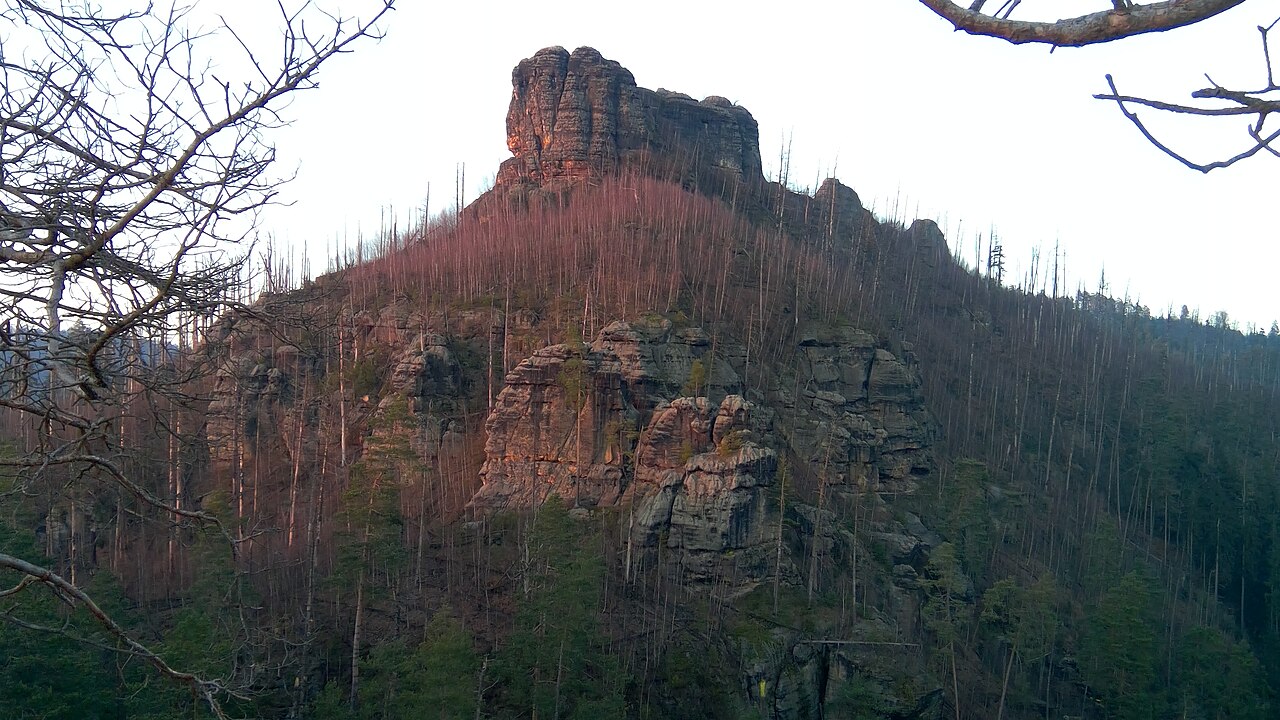
Falkenštejn Castle stands as a remarkable example of a medieval hill castle uniquely integrated into a natural sandstone rock formation near the municipality of Jetřichovice in Czechia. Constructed toward the end of the 13th century, this fortress reflects the strategic and architectural ingenuity of the Bohemian medieval period, serving both defensive and territorial purposes amid the region's complex feudal landscape. Historical background and ownership The castle's origins are closely tied to the expansion of noble families in Bohemia during the high medieval period. Initially, Falkenštejn was part of the estates of the Michalovic family in the 12th and 13th centuries, a prominent local dynasty. The first documented reference to the castle dates to 1395, naming Nice Hokacker as its governor under Jan III of Michalovic. This record attests to the castle's role as a feudal stronghold and administrative center. In 1406, ownership transferred to the Berka of Dubá family, another influential noble lineage. During the turbulent years of the Hussite Wars in the early 15th century, members of this family, notably Jan and Jindřich Berka, are documented to have used Falkenštejn as a base for raiding expeditions into Lusatia, reflecting the castle's strategic military significance and the period's widespread conflict. By 1428, the castle came under the control of Zikmund Děčínský of Vartenberk. Although the Vartenberk family did not reside permanently at Falkenštejn, they maintained a military garrison there throughout the Hussite conflicts. The castle became notorious as a refuge for robber knights, who launched plundering raids in the surrounding regions. Recorded attacks in 1427 and 1430 highlight its role in regional instability, with such activities possibly continuing until around 1444. In a decisive military action, the castle was besieged and destroyed in 1444 by the forces of the Upper Lusatian Six-City League, a coalition formed to maintain regional security and order. After this destruction, Falkenštejn was abandoned and gradually fell into ruin. The last historical mentions of the castle appear in documents from 1457 and 1460, marking the end of its active historical role. Architectural features and layout Falkenštejn Castle exemplifies the adaptation of medieval fortification techniques to a challenging natural environment. The castle is classified as a hill castle, perched atop a prominent sandstone rock outcrop, which provided natural defensive advantages. The layout is characterized by a fortified outer bailey situated below the summit, protected by an earth rampart and a surrounding ditch. These earthworks would have served to slow and expose attackers, enhancing the castle's defensibility. Access to the summit was ingeniously routed through a natural fissure in the rock, which was modified to function as a secure entrance passage. This narrow approach limited enemy movement and facilitated defense. At the plateau on top of the rock, the remains of a hall measuring approximately 6 by 12 meters are still visible. This hall featured a window with built-in seating, an architectural detail that provided both natural light and comfort for the castle's occupants. Adjacent to the hall lies a smaller carved chamber believed to have served as a chapel, indicating the presence of religious practices within the fortress. The integration of a chapel reflects the importance of spiritual life in medieval castles and the self-sufficiency of such fortifications. Historical evidence suggests that the summit was once crowned by a wooden tower surrounded by a wooden palisade. The presence of numerous beam sockets carved directly into the sandstone confirms the existence of significant timber structures, although these wooden elements have long since decayed. These features illustrate a mixed construction approach, combining natural rock formations with timber defenses. A particularly notable architectural element is a deep shaft or well, approximately 25 meters in depth, carved into a vertical fissure in the sandstone. This feature would have been essential for providing a reliable water source during sieges, enhancing the castle's ability to withstand prolonged attacks. The castle's decline and preservation Following its destruction in 1444, Falkenštejn Castle was not rebuilt or reoccupied. Over the centuries, natural erosion and the decay of wooden structures have reduced the site to a series of rock-cut rooms, beam sockets, and earthworks. Despite this, the castle remains a valuable archaeological and cultural heritage site, offering insights into medieval defensive architecture and feudal history in Bohemia. Preservation efforts focus on protecting the fragile sandstone surfaces from further erosion. Measures include restricting visitor access to vulnerable areas and stabilizing the remaining rock-cut features. These efforts aim to maintain the site's integrity and allow ongoing study and appreciation of its historical significance. Visitor experience and significance Today, Falkenštejn Castle is accessible to visitors interested in medieval history, architecture, and natural landscapes. The castle's dramatic setting atop a sandstone rock formation provides scenic views and a tangible connection to the region's medieval past. Interpretive signage and guided tours help contextualize the site’s history and architectural features. The castle’s story, from its origins in the high medieval period through its role in the Hussite Wars and eventual destruction, reflects broader themes of feudal power struggles, military conflict, and adaptation to natural landscapes. Falkenštejn remains a compelling destination for those seeking to explore the layered history of Czechia’s medieval fortifications.

High Medieval (11th–13th c.)
Details
6.9 km
Winterstein Castle Ruins — Germany castle

Winterstein Castle Ruins

Sächsische Schweiz-Osterzgebirge, Germany

Winterstein Castle ruins, also known as the Hinteres Raubschloss, are perched atop an isolated, elongated rock massif in the scenic region of Saxon Switzerland in East Germany. This high medieval hill castle was constructed in the 13th century, likely by the noble family of Berka von Dubá, whose influence extended into this borderland area. The castle's strategic location on a rocky summit provided natural defenses and commanding views of the surrounding landscape, characteristic of many fortifications built during this period. Geographical setting and strategic importance The castle occupies a prominent position in the Sächsische Schweiz-Osterzgebirge district, a region known for its rugged sandstone formations and dense forests. The elevated site on the rock massif allowed the castle's occupants to monitor key routes through the hinterland, controlling movement and providing a defensive stronghold against potential invaders. This placement reflects typical hill castle construction principles, utilizing natural topography to enhance fortification. Architectural features and remains Although now in ruins, the site retains several distinctive features that reveal its original construction and functional design. Visitors can observe rebates for timber beams carved into the sandstone, indicating where wooden structures such as floors, walls, or defensive galleries were once anchored. Hewn-out steps carved directly into the rock facilitated access between different levels of the castle complex, demonstrating the adaptation of architecture to the natural environment. Additionally, cisterns carved into the rock highlight the castle's water management system, essential for sustaining inhabitants during sieges or dry periods. These cisterns collected and stored rainwater, a common feature in medieval castles lacking immediate access to natural water sources. The combination of stone and timber construction would have been typical for the era and location. Defensive structures and layout While much of the original castle has not survived, the elongated shape of the rock massif suggests a linear arrangement of defensive walls and buildings. The castle likely featured curtain walls following the contours of the rock, with watchtowers or fortified gates positioned to control access. The natural steepness of the rock faces would have supplemented the man-made defenses, making direct assault difficult. Historical context and ownership The castle's probable builders, the Berka von Dubá family, were a noble lineage with roots in Bohemia, active during the high medieval period. Their establishment of Winterstein Castle in the 13th century aligns with the broader pattern of fortification construction during a time of territorial consolidation and regional conflicts in Central Europe. The castle may have served as a border fortress, a noble residence, and a base for controlling local resources and trade routes. Role in regional history Although specific historical records about Winterstein Castle are limited, the castle's location in Saxon Switzerland places it within a contested frontier zone between German and Bohemian territories. Castles such as Winterstein were often focal points in disputes over land and influence during the medieval period. Its isolated position and relatively modest size suggest it was a smaller stronghold rather than a major seat of power. Present condition and preservation Today, Winterstein Castle exists as partially preserved ruins, with visible remains primarily consisting of rock-cut features and foundational elements. The site is accessible to hikers and history enthusiasts who appreciate the combination of natural beauty and medieval architecture. Preservation efforts focus on maintaining the integrity of the rock formations and preventing further erosion of the carved features. The castle ruins contribute to the cultural heritage of the Sächsische Schweiz-Osterzgebirge region and offer insights into medieval fortification techniques adapted to challenging terrain. Visitors can explore the site to gain a tangible connection to the high medieval period and the noble families who shaped this borderland landscape. Visitor information and accessibility Winterstein Castle ruins are accessible via hiking trails in the Saxon Switzerland National Park area, with no formal entrance fee. The site is open year-round, though visitors should be prepared for uneven terrain and limited facilities. Informational signage at the site provides context about the castle's history and architectural features.

High Medieval (11th–13th c.)
Details
7 km
Chřibský hrádek — Czech Republic castle

Chřibský hrádek

Doubice, Czech Republic

Chřibský hrádek, historically known as Karlštejn and in German as Unterer Karlstein or Wüstes Schloss, is a ruined rock castle situated in the village of Doubice within the Ústí nad Labem Region of the Czech Republic. This castle is located in the Elbe Sandstone Mountains, a distinctive geological formation known for its sandstone cliffs and unique rock formations, which provided natural defensive advantages for medieval fortifications.Constructed in the 13th century during the high medieval period, Chřibský hrádek was strategically built as a rock castle, utilizing the natural sandstone outcrops to form part of its defensive structures. This type of castle integrated the rugged terrain into its design, often resulting in a complex layout adapted to the rocky environment rather than traditional masonry alone.Historical background and significanceThe castle's origins trace back to the high medieval era, a time marked by the expansion of feudal territories and the establishment of numerous fortifications across Bohemia. The castle was likely erected to secure local trade routes and assert control over the surrounding land. Its alternative name, Karlštejn, should not be confused with the more famous Karlštejn Castle near Prague; rather, it reflects a common naming practice in medieval times.Throughout its history, Chřibský hrádek served as a minor stronghold and residence for local nobility. However, due to its remote location and the challenges posed by the sandstone terrain, it never evolved into a major political center. Over the centuries, the castle fell into disuse and was eventually abandoned, leading to its current state as ruins.Architectural features and layoutAs a rock castle, Chřibský hrádek was constructed by integrating natural sandstone formations into its defensive system. The castle's design made use of steep cliffs and rock faces as natural walls, reducing the need for extensive stone masonry. Remnants of defensive walls, gate structures, and small chambers carved into the rock can still be identified among the ruins.The castle likely included a keep or central stronghold area carved on or around a prominent rock outcrop, which would have served as the last refuge during attacks. Surrounding this were defensive walls and possibly wooden structures that have since decayed. The natural terrain limited the extent of the castle's footprint but enhanced its defensibility.Defensive advantages of the sandstone environmentThe Elbe Sandstone Mountains provided a natural fortress environment. The sandstone cliffs offered elevated vantage points for surveillance and made direct assaults difficult. The castle's builders exploited these features by positioning walls and watchpoints to maximize visibility and protection.Current condition and preservationToday, Chřibský hrádek remains in a state of ruins, classified as an archaeological site. The remnants of walls and rock-carved chambers are accessible to visitors interested in medieval history and castle architecture. Due to the fragile nature of sandstone, preservation efforts focus on preventing further erosion and damage caused by natural weathering.The site is a popular destination for hikers and history enthusiasts exploring the Elbe Sandstone Mountains. Informational signs and guided tours occasionally provide insights into the castle's history and architectural features, although no extensive reconstruction has been undertaken.Visiting Chřibský hrádekThe castle ruins can be reached by hiking trails from the nearby village of Doubice. Visitors should be prepared for uneven terrain and limited facilities at the site. There are no entrance fees, and the site is open year-round, with the best visiting conditions in late spring through early autumn.While the castle is not equipped with modern visitor amenities, its atmospheric ruins and scenic surroundings offer a glimpse into medieval fortification techniques adapted to the unique sandstone landscape of the region.

High Medieval (11th–13th c.)
Details