Sauerburg Castle

Sauerburg Castle in Kaub, Germany
Kaub, Germany
Late Medieval (14th–15th c.)
Well Preserved

Sauerburg Castle, located near the village of Kaub in Germany, is a notable example of a late medieval fortress with strong architectural and historical significance. Constructed in the 14th century, this castle was strategically positioned in the Sauerthal valley to serve as a powerful border stronghold within the region that is now part of the Rhine Gorge, a UNESCO World Heritage Site.

Historical background and strategic importance

The castle's origins date back to 1355 when Count Palatine Ruprecht I of the Palatinate obtained permission from the Archbishop of Mainz to erect a fortress that would secure the border and control important trade routes along the Rhine River. This period was marked by territorial conflicts and the need for fortified structures to defend key points. Sauerburg Castle was designed to fulfill these defensive and administrative roles, overseeing the surrounding valley and river approaches.

Architectural features and layout

Sauerburg Castle is distinguished by its 32-metre bergfried, a tall defensive tower typical of medieval castles, which served as a last refuge and lookout point. The bergfried's height and robust construction made it a dominant feature of the castle's silhouette and a symbol of power. Alongside the bergfried, the castle is protected by a high dividing wall topped with timber framing, which adds both defensive strength and architectural character.

Defensive structures

The castle's fortifications include thick stone walls and strategic positioning on elevated terrain, which provided natural defense advantages. The timber-framed upper sections of the walls are characteristic of the architectural style in the region during the late medieval period, blending stone and wood construction methods. These features helped to resist sieges and assaults during times of conflict.

Interior and functional spaces

While much of the castle's interior has undergone changes over the centuries, the core layout reflects its original purpose as a fortified residence and administrative center. The castle includes living quarters, storage areas, and spaces for garrison troops. The preservation of the structure allows visitors to appreciate the functional aspects of a medieval stronghold.

20th-century restorations and current use

In the 20th century, Sauerburg Castle experienced several extensions and historicised upgrades aimed at preserving its architectural integrity and adapting it for modern use. Despite these changes, the castle retains remarkable substance for monument protection, maintaining an authentic image of a strong late medieval to early modern age castle.

Since 2021, the castle has become a venue for various cultural events, attracting visitors and locals alike. Additionally, it offers vacation apartments within its walls, providing a unique opportunity to experience the atmosphere of a historic castle firsthand. Its location near the Rheinsteig hiking trail makes it particularly appealing for hikers exploring the scenic Rhine Gorge area.

Geographical and cultural context

Situated in the picturesque Sauerthal valley, Sauerburg Castle stands isolated yet prominent, overlooking the surrounding landscape. Its position near Kaub places it within a region rich in medieval history and castle architecture, contributing to the cultural heritage of the Rhine Gorge. The castle's preservation and adaptive reuse contribute to ongoing heritage tourism and education about medieval fortifications in Germany.

Frequently asked questions (FAQ)

When was Sauerburg Castle built and by whom?
Sauerburg Castle was built in the 14th century, with construction authorized in 1355 by Count Palatine Ruprecht I of the Palatinate with permission from the Archbishop of Mainz.
What are the main architectural features of Sauerburg Castle?
The castle is known for its 32-metre bergfried, a tall defensive tower, and a high dividing wall topped with timber framing, typical of late medieval fortifications.
Can visitors stay overnight at Sauerburg Castle?
Yes, since 2021, Sauerburg Castle offers vacation apartments inside the castle, allowing guests to experience its historic atmosphere.
Is Sauerburg Castle accessible for hikers?
Yes, the castle lies on an entry path from the Rheinsteig trail, making it a popular destination for hikers exploring the Rhine Gorge region.
What is the current condition of Sauerburg Castle?
The castle is well preserved, with significant restoration work carried out in the 20th century to maintain its structural and historical integrity.

Information

Hill Castle

Loading map...

Visitor reviews

No reviews yet. Been here? Write the first review and help other travelers!

Write the first review

Visited this castle? Share your experience

Your review helps other travelers and adds first-hand knowledge to our encyclopedia.
Write a review

(5/5)

0/2000 characters

Your review will be visible after admin approval

Nearby castles

3.8 km
Gutenfels Castle — Germany castle

Gutenfels Castle

Kaub, Germany

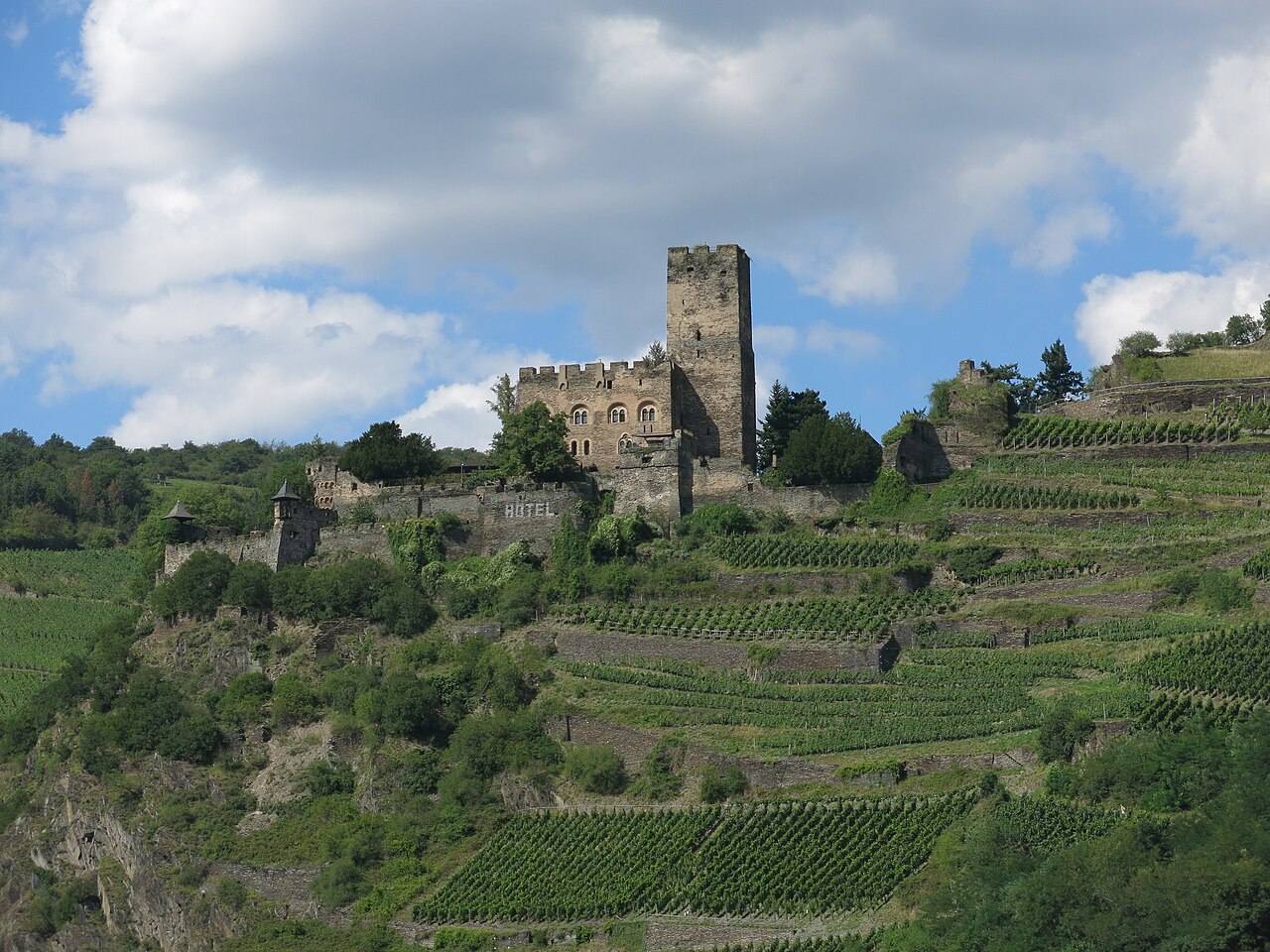
Gutenfels Castle, perched approximately 110 meters above the town of Kaub in Rhineland-Palatinate, Germany, is a significant example of a high medieval hill castle with a rich history tied to the control of the Rhine River. Constructed around 1220, the castle was strategically positioned to dominate the river valley and enforce toll collection, a vital source of revenue and power during the Holy Roman Empire. Historical significance and strategic role Originally known as Caub Castle or Kaub Castle, Gutenfels Castle was part of a triad of fortifications that included Pfalzgrafenstein Castle situated on an island in the middle of the Rhine, and the fortified town of Kaub on the opposite bank. This network created an impenetrable toll zone for river traffic, allowing the Holy Roman Emperor to control and tax commerce along this crucial waterway. The castle's role in toll enforcement continued until the mid-19th century, ending when Prussia acquired the territory in 1866 and abolished the toll in 1867. Architectural features and style The castle is a prime example of the Hohenstaufen military and residential architecture characteristic of the Rhine region during the high medieval period. Its construction reflects the practical and defensive needs of the era, with thick stone walls, a commanding keep, and fortified towers designed to withstand sieges and control the surrounding landscape. The castle's elevated position on a hill provided a natural defensive advantage and panoramic views of the Rhine, essential for monitoring river traffic and approaching threats. Defensive structures Gutenfels Castle features a robust curtain wall, battlements, and a gatehouse that controlled access to the inner ward. The layout includes multiple defensive layers, typical of hill castles built to maximize natural topography for protection. The castle's name, which means "solid rock," was adopted after a failed siege in 1504 by Landgrave Wilhelm of Hesse, underscoring its reputation for strength and resilience. Residential and functional spaces Inside the castle, there were residential quarters for the ruling family, storerooms, and facilities to support a garrison. The castle's design balanced military functionality with the needs of a noble household, reflecting its dual role as a fortress and a residence. Ownership and historical transitions Since 1257, the castle was primarily owned by the Falkenstein family, a noble lineage influential in the region. From 1277, it became part of the possessions of the Electorate of the Palatinate, a significant principality within the Holy Roman Empire. This transfer of control highlights the castle's importance in regional politics and military strategy. The castle's military significance was tested during the early 16th century when it withstood an unsuccessful siege by Landgrave Wilhelm of Hesse in 1504. This event reinforced the castle's reputation for formidable defenses and contributed to its renaming as Gutenfels, emphasizing its solid and enduring construction. Later history and preservation After centuries of military use, the castle's strategic importance declined with changes in political power and military technology. In the late 19th century, between 1889 and 1892, Gutenfels Castle underwent significant rebuilding and restoration efforts, adapting it for new uses while preserving its historical character. Today, the castle functions as a hotel, allowing visitors to experience its historic ambiance and commanding views of the Rhine. Its preservation as a well-preserved high medieval hill castle offers valuable insights into medieval military architecture and the history of the Rhine Valley. Architectural and cultural importance Gutenfels Castle stands as one of the most important examples of Hohenstaufen-era military architecture on the Rhine. It illustrates the integration of natural landscape features with man-made fortifications typical of hill castles of this period. The castle's enduring presence reflects the complex history of territorial control, commerce, and defense along one of Europe's most significant rivers. Its association with the Electorate of the Palatinate and the Falkenstein family connects it to broader historical narratives of medieval German nobility and imperial authority. The castle's survival through sieges, political changes, and modernization efforts underscores its resilience and historical value. Visiting gutenfels castle today Visitors to Gutenfels Castle can explore its historic architecture and enjoy panoramic views of the Rhine Gorge, a UNESCO World Heritage site. The castle's adaptation as a hotel offers a unique opportunity to stay within medieval walls, combining history with hospitality. The surrounding town of Kaub provides additional cultural and historical attractions, making the castle a focal point for tourism in the region.

High Medieval (11th–13th c.)
Details
4 km
Pfalzgrafenstein Castle — Germany castle

Pfalzgrafenstein Castle

Kaub, Germany

Pfalzgrafenstein Castle, famously known as "the Pfalz," stands as a remarkable example of a medieval toll castle uniquely situated on Falkenau Island in the Rhine River near Kaub, Germany. Constructed between 1326 and 1327 under the commission of King Ludwig IV of Bavaria, also known as Ludwig the Bavarian, this castle was strategically designed to control one of the most vital trade routes in Europe. Its distinctive pentagonal keep, oriented with its pointed end upstream, was intended to break ice and waves, ensuring the castle's resilience against the harsh natural elements of the river. The castle's primary function was to enforce and collect tolls from passing ships, an economic role that sparked significant regional tension. The toll station worked in concert with nearby Gutenfels Castle and the fortified town of Kaub on the right bank of the Rhine, using a heavy chain stretched across the river to compel compliance. Ships that refused to pay tolls risked being detained, with crews imprisoned in the castle's dungeon, a wooden float located at the bottom of a well, until ransom was paid. This system made Pfalzgrafenstein a critical point of control over river traffic and commerce. Architectural design and fortifications The castle's architecture is notable for its robust and functional design. The central pentagonal tower rises approximately 36 to 37 meters and contains six floors. Its base measures about 9.5 by 8.5 meters. Surrounding this tower is a formidable hexagonal defensive wall, constructed between 1338 and 1340, which reaches up to 12 meters in height and 2.6 meters in thickness. This wall features two rows of galleries equipped with narrow arrow slits, allowing defenders to repel attackers while remaining protected. The upstream-facing southern corner of the wall was specifically engineered to break up ice flows during spring, a vital feature given the castle's riverine location. In 1607, a gun bastion was added on the upstream side to accommodate artillery, consisting of two floors: a lower storage area for gunpowder and ammunition, and an upper battery platform for cannons. Additional corner turrets and a baroque-style tower cap were later added in 1658 and 1714 respectively, enhancing both the castle's defensive capabilities and its distinctive silhouette. Interior layout and living quarters Access to the castle is through an entrance located on the third floor of the tower, emphasizing its defensive design. The interior floors vary, with the third and fifth floors featuring vaulted ceilings, while the others have flat ceilings. The top floor housed two rooms equipped with a kitchen and fireplace, intended for the commandant and his family. The first floor accommodated the guards, while the second floor contained a prison cell accessed by a hatch, where prisoners were lowered into the dungeon below. The castle's dungeon was notably a wooden float in the well, which could flood during high water, adding a perilous element to imprisonment. The garrison was small, typically no more than twenty men, who lived under Spartan conditions with basic furnishings and supplies. Historical significance and events Pfalzgrafenstein Castle played an important role in regional power dynamics and military history. Its toll collection activities provoked opposition from the archbishops of Mainz, Trier, and Cologne, who feared losing income. Despite efforts by Pope John XXII to excommunicate Ludwig and challenge the castle's tolls, these actions were unsuccessful. Ownership was transferred to Ludwig's nephew, Count Rudolph II, Elector Palatine, in 1339. The castle also served judicial functions by the late 15th century, acting as a prison and site for capital punishment under the Elector Palatine's authority. It withstood a 39-day siege in 1504 during the War of the Succession of Landshut without damage, demonstrating its formidable defenses. During the Thirty Years' War, it was occupied by Spanish forces from 1620 to 1631. In the winter of 1814, Prussian and Russian troops under Field Marshal von Blücher used the island as a crucial crossing point while pursuing Napoleon’s retreating forces. This strategic use underscores the castle's continued military importance well beyond the medieval period. Modern history and preservation After Prussia annexed the region in 1866, toll collection at Pfalzgrafenstein ceased the following year. The castle then transitioned to a role as a signal and beacon station for river traffic, a function it maintained for about a century. In 1946, ownership passed to the State of Rhineland-Palatinate, which undertook restoration efforts between 1967 and 1975 to preserve both the medieval and baroque architectural elements. Today, Pfalzgrafenstein Castle is part of the UNESCO World Heritage Rhine Gorge, recognized for its cultural and historical significance. The castle operates as a museum, presenting visitors with an authentic experience of 14th-century conditions, deliberately lacking modern amenities such as electricity and lavatories to maintain historical accuracy. Access is via ferry from Kaub, contingent on river conditions. Visitor experience and accessibility Visitors to Pfalzgrafenstein Castle can explore its well-preserved fortifications and interiors, gaining insight into the life of a medieval toll castle garrison. The museum's restoration reflects the baroque color scheme, adding to the visual appeal. The castle's isolated island location and unique architectural features make it a standout attraction in the Rhine Valley. The ferry service from Kaub offers a scenic approach, allowing visitors to appreciate the castle's strategic placement and its role in controlling river traffic. The absence of modern facilities provides an immersive historical atmosphere, though it requires visitors to prepare accordingly. Cultural and architectural legacy Pfalzgrafenstein Castle remains one of the few Rhine castles never conquered or destroyed, a testament to its robust construction and strategic design. Its combination of medieval fortification techniques with later baroque enhancements illustrates the evolution of military architecture along the Rhine. The castle's enduring presence on Falkenau Island continues to symbolize the historical importance of river tolls and control over commerce in medieval and early modern Europe. As a cultural landmark, the castle contributes significantly to the heritage of the Rhine Gorge region. Its preservation and inclusion in the UNESCO World Heritage site highlight the ongoing efforts to protect and celebrate Germany's rich castle-building tradition and the historical narratives embedded in these structures.

Late Medieval (14th–15th c.)
Details
4.1 km

Nollig Castle Ruins

Lorch, Germany

Nollig Castle ruins stand prominently on the right bank of the Rhine River above the town of Lorch in Germany. The site features the remains of a massive tower that was part of a larger medieval fortress complex. The castle's origins date back to around 1300, during the late medieval period, when it was initially constructed as a cornerstone of the city's fortifications. This early structure was soon expanded into a more extensive fortress to strengthen the defenses along this strategically important stretch of the river.Historical context and strategic importanceThe Rhine River has long been a crucial trade and transportation route in Europe, making control over its banks a significant military and economic advantage. Nollig Castle was built to protect the town of Lorch and to oversee river traffic, serving as a defensive stronghold against potential invaders. Its position on the elevated right bank provided commanding views over the river valley, allowing early detection of approaching threats.During the late medieval period, castles such as Nollig were essential components of territorial defense systems. The initial construction around 1300 reflects the period's architectural and military trends, emphasizing fortified towers and walls designed to withstand sieges and control key routes.Architectural features and constructionThe surviving structure of Nollig Castle primarily consists of a large stone tower, which was likely the keep or main defensive stronghold of the fortress. This tower would have been surrounded by curtain walls and additional fortifications, although much of these have not survived. The robust masonry and elevated position highlight the castle's role as a defensive bastion.The castle's design reflects typical late medieval military architecture, with thick walls and limited openings to resist attacks. The tower's height and mass would have provided both a lookout point and a refuge during assaults. While detailed floor plans and additional structures are not well documented, the castle's remains suggest a compact but formidable fortress.Ownership and current statusToday, the Nollig Castle ruins are privately owned and are not open to the public. The site remains an important cultural and historical landmark in the region, symbolizing the medieval heritage of Lorch and the surrounding Rhine valley. Although visitors cannot access the ruins directly, the castle can be viewed from nearby vantage points along the river and in the town.Preservation and cultural significanceAs a late medieval ruin, Nollig Castle offers valuable insights into the military architecture and regional history of the Rhine valley. Its preservation as a ruin allows for the study of medieval fortification techniques and the strategic use of riverbank locations for defense. The castle contributes to the cultural landscape of Rhineland-Palatinate, attracting interest from historians, architects, and tourists who appreciate medieval heritage.

Late Medieval (14th–15th c.)
Details