Pfalzgrafenstein Castle
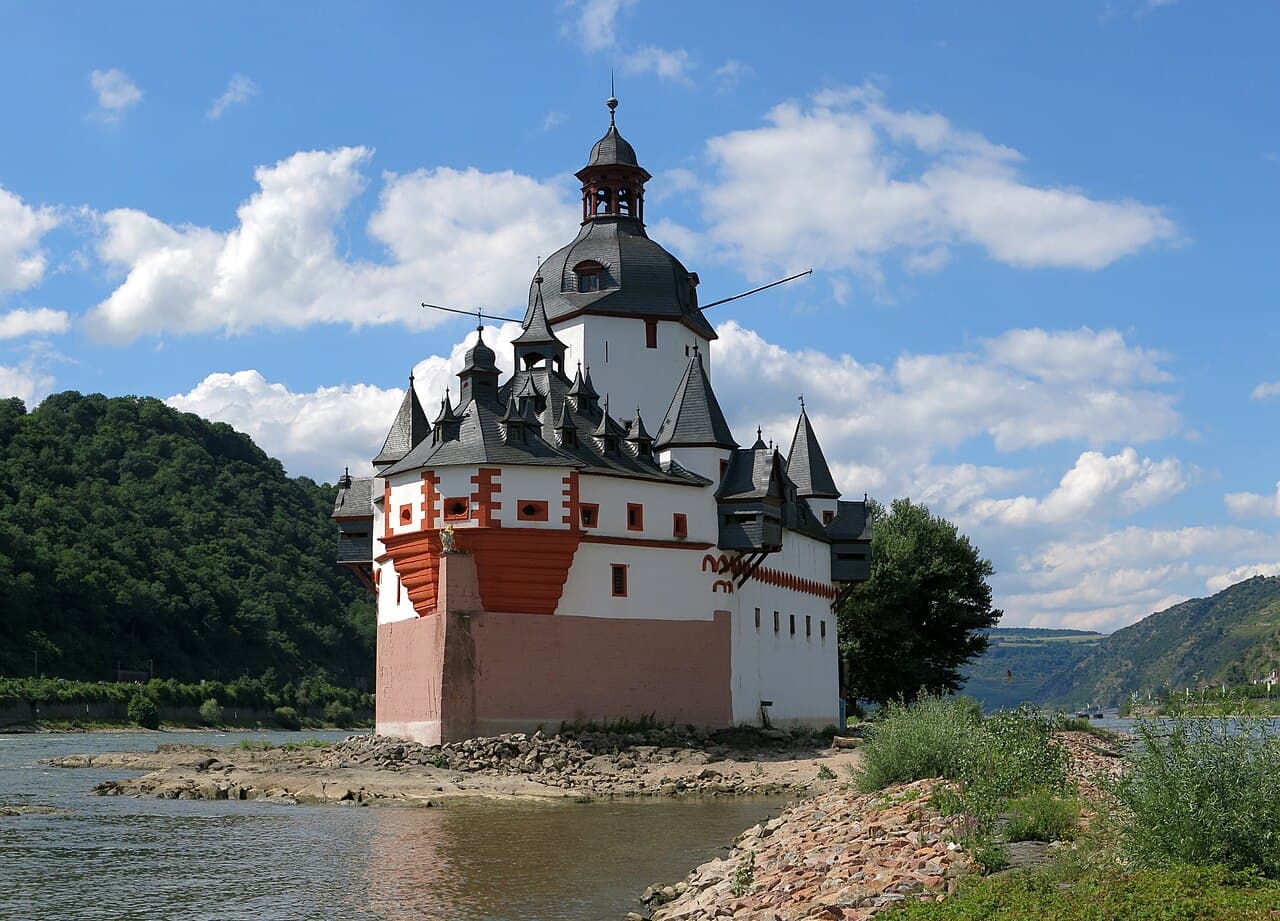
Pfalzgrafenstein Castle, famously known as "the Pfalz," stands as a remarkable example of a medieval toll castle uniquely situated on Falkenau Island in the Rhine River near Kaub, Germany. Constructed between 1326 and 1327 under the commission of King Ludwig IV of Bavaria, also known as Ludwig the Bavarian, this castle was strategically designed to control one of the most vital trade routes in Europe. Its distinctive pentagonal keep, oriented with its pointed end upstream, was intended to break ice and waves, ensuring the castle's resilience against the harsh natural elements of the river.
The castle's primary function was to enforce and collect tolls from passing ships, an economic role that sparked significant regional tension. The toll station worked in concert with nearby Gutenfels Castle and the fortified town of Kaub on the right bank of the Rhine, using a heavy chain stretched across the river to compel compliance. Ships that refused to pay tolls risked being detained, with crews imprisoned in the castle's dungeon, a wooden float located at the bottom of a well, until ransom was paid. This system made Pfalzgrafenstein a critical point of control over river traffic and commerce.
Architectural design and fortifications
The castle's architecture is notable for its robust and functional design. The central pentagonal tower rises approximately 36 to 37 meters and contains six floors. Its base measures about 9.5 by 8.5 meters. Surrounding this tower is a formidable hexagonal defensive wall, constructed between 1338 and 1340, which reaches up to 12 meters in height and 2.6 meters in thickness. This wall features two rows of galleries equipped with narrow arrow slits, allowing defenders to repel attackers while remaining protected.
The upstream-facing southern corner of the wall was specifically engineered to break up ice flows during spring, a vital feature given the castle's riverine location. In 1607, a gun bastion was added on the upstream side to accommodate artillery, consisting of two floors: a lower storage area for gunpowder and ammunition, and an upper battery platform for cannons. Additional corner turrets and a baroque-style tower cap were later added in 1658 and 1714 respectively, enhancing both the castle's defensive capabilities and its distinctive silhouette.
Interior layout and living quarters
Access to the castle is through an entrance located on the third floor of the tower, emphasizing its defensive design. The interior floors vary, with the third and fifth floors featuring vaulted ceilings, while the others have flat ceilings. The top floor housed two rooms equipped with a kitchen and fireplace, intended for the commandant and his family. The first floor accommodated the guards, while the second floor contained a prison cell accessed by a hatch, where prisoners were lowered into the dungeon below.
The castle's dungeon was notably a wooden float in the well, which could flood during high water, adding a perilous element to imprisonment. The garrison was small, typically no more than twenty men, who lived under Spartan conditions with basic furnishings and supplies.
Historical significance and events
Pfalzgrafenstein Castle played an important role in regional power dynamics and military history. Its toll collection activities provoked opposition from the archbishops of Mainz, Trier, and Cologne, who feared losing income. Despite efforts by Pope John XXII to excommunicate Ludwig and challenge the castle's tolls, these actions were unsuccessful. Ownership was transferred to Ludwig's nephew, Count Rudolph II, Elector Palatine, in 1339.
The castle also served judicial functions by the late 15th century, acting as a prison and site for capital punishment under the Elector Palatine's authority. It withstood a 39-day siege in 1504 during the War of the Succession of Landshut without damage, demonstrating its formidable defenses. During the Thirty Years' War, it was occupied by Spanish forces from 1620 to 1631.
In the winter of 1814, Prussian and Russian troops under Field Marshal von Blücher used the island as a crucial crossing point while pursuing Napoleon’s retreating forces. This strategic use underscores the castle's continued military importance well beyond the medieval period.
Modern history and preservation
After Prussia annexed the region in 1866, toll collection at Pfalzgrafenstein ceased the following year. The castle then transitioned to a role as a signal and beacon station for river traffic, a function it maintained for about a century. In 1946, ownership passed to the State of Rhineland-Palatinate, which undertook restoration efforts between 1967 and 1975 to preserve both the medieval and baroque architectural elements.
Today, Pfalzgrafenstein Castle is part of the UNESCO World Heritage Rhine Gorge, recognized for its cultural and historical significance. The castle operates as a museum, presenting visitors with an authentic experience of 14th-century conditions, deliberately lacking modern amenities such as electricity and lavatories to maintain historical accuracy. Access is via ferry from Kaub, contingent on river conditions.
Visitor experience and accessibility
Visitors to Pfalzgrafenstein Castle can explore its well-preserved fortifications and interiors, gaining insight into the life of a medieval toll castle garrison. The museum's restoration reflects the baroque color scheme, adding to the visual appeal. The castle's isolated island location and unique architectural features make it a standout attraction in the Rhine Valley.
The ferry service from Kaub offers a scenic approach, allowing visitors to appreciate the castle's strategic placement and its role in controlling river traffic. The absence of modern facilities provides an immersive historical atmosphere, though it requires visitors to prepare accordingly.
Cultural and architectural legacy
Pfalzgrafenstein Castle remains one of the few Rhine castles never conquered or destroyed, a testament to its robust construction and strategic design. Its combination of medieval fortification techniques with later baroque enhancements illustrates the evolution of military architecture along the Rhine. The castle's enduring presence on Falkenau Island continues to symbolize the historical importance of river tolls and control over commerce in medieval and early modern Europe.
As a cultural landmark, the castle contributes significantly to the heritage of the Rhine Gorge region. Its preservation and inclusion in the UNESCO World Heritage site highlight the ongoing efforts to protect and celebrate Germany's rich castle-building tradition and the historical narratives embedded in these structures.
Frequently asked questions (FAQ)
- How do I get to Pfalzgrafenstein Castle?
- Pfalzgrafenstein Castle is accessible by a ferry from Kaub, which operates depending on river conditions. Visitors should check the ferry schedule before planning their trip.
- What is the historical significance of Pfalzgrafenstein Castle?
- The castle was built in the 14th century to control and collect tolls on the Rhine River. It played important roles in regional conflicts and military campaigns, including during the Thirty Years' War and the Napoleonic Wars.
- Can I tour the interior of Pfalzgrafenstein Castle?
- Yes, the castle operates as a museum reflecting 14th-century conditions. Visitors can explore its well-preserved interiors, including the keep, defensive walls, and dungeon areas.
- When was Pfalzgrafenstein Castle built?
- Construction began in 1326 and was completed in 1327 under King Ludwig IV of Bavaria.
- Is Pfalzgrafenstein Castle part of a World Heritage site?
- Yes, it is part of the UNESCO World Heritage Rhine Gorge, recognized for its cultural and historical significance.
- What architectural styles are visible at Pfalzgrafenstein Castle?
- The castle features primarily late medieval military architecture with later baroque additions such as the tower cap and corner turrets.
Photo gallery

Information
Opening hours
Typically 10:00-16:00, seasonally, check local schedules
Ticket prices
€5 adult, €3 child, family tickets available
Current owner
State of Rhineland-Palatinate
Website
Visit websiteSources & official resources
Verify the information above using these authoritative references.
Loading map...
Visitor reviews
No reviews yet. Been here? Write the first review and help other travelers!
Write the first reviewVisited this castle? Share your experience
Your review helps other travelers and adds first-hand knowledge to our encyclopedia.