Sarvestan Palace
Sarvestan Palace stands as a remarkable example of Sassanid Empire architecture, located near the modern town of Sarvestan in Iran. Constructed in the 5th century AD, it reflects the political and cultural developments of the late Sassanid period under the reign of Bahram V (Bahramgur), who ruled from 420 to 438 AD. This palace exemplifies the architectural ingenuity and stylistic elements that characterize Sassanid royal and administrative buildings.
The historical context of Sarvestan Palace
The palace's construction during the late antique period coincides with a time of significant architectural innovation in Persia. The Sassanid dynasty, known for consolidating power and fostering cultural achievements, commissioned grand structures that combined functional design with symbolic grandeur. Sarvestan Palace was likely intended as a multifunctional estate serving as a royal residence, a hunting retreat, or possibly a sanctuary with religious associations linked to Zoroastrianism.
Historical accounts, including those by the 9th-century geographer Ibn Khordadbeh, describe a substantial edifice composed of stone and mortar, featuring domes, columns, and several iwans — vaulted open halls integral to Persian architectural tradition. These descriptions align closely with the archaeological remains, reinforcing the palace's attribution to the reign of Bahram V.
Architectural features and layout
Design and spatial organization
The palace covers approximately 25 hectares and is distinguished by its sophisticated and imaginative spatial configuration. Unlike many contemporaneous Sassanid structures, Sarvestan Palace exhibits an irregular layout with rooms of varying sizes interconnected in complex patterns rather than strict symmetry. This design reflects advanced architectural planning and a departure from purely defensive constructions.
The southern façade and main hall
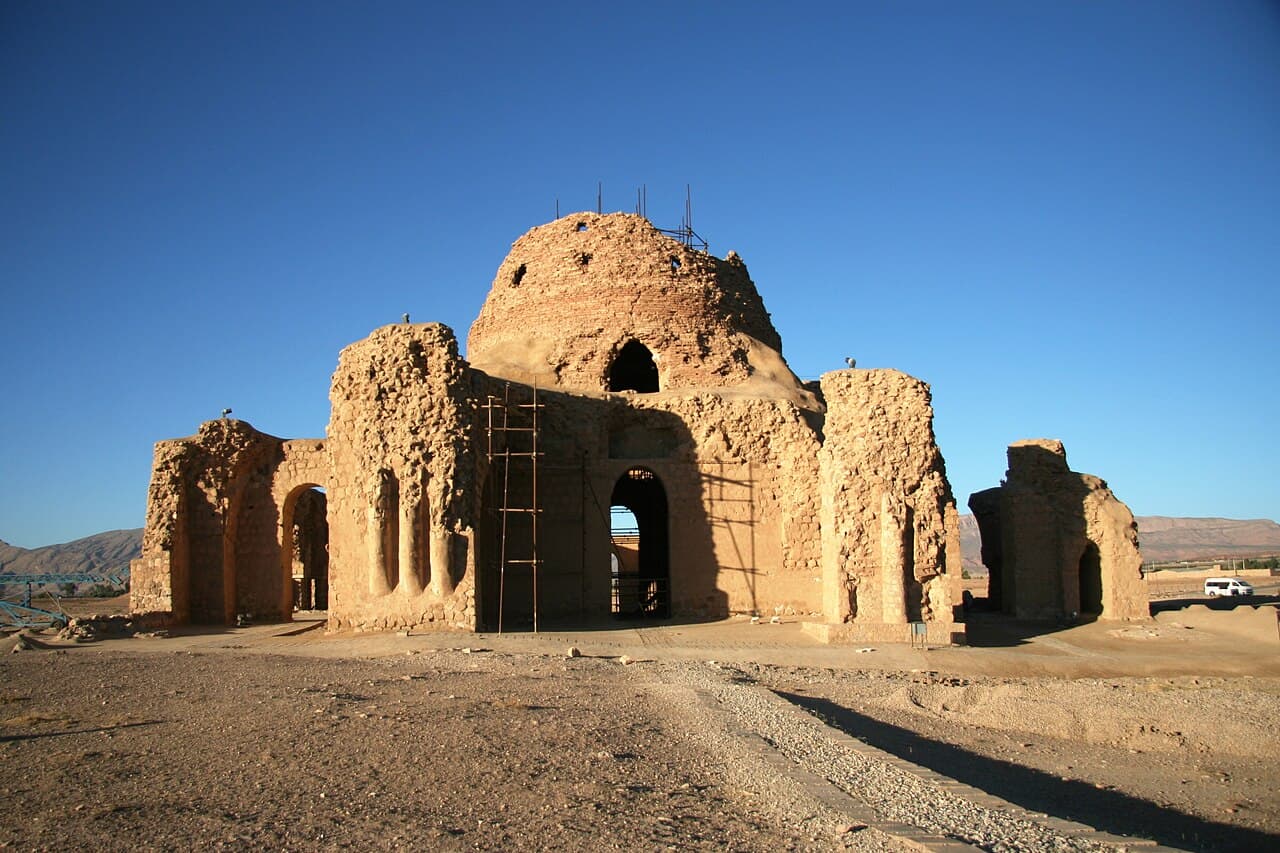
The southern façade is dominated by a large central iwan, flanked by two smaller iwans on each side. The central iwan leads into a grand square main hall measuring roughly 13 meters in length and width and soaring to a height of 18 meters. This hall is crowned by a massive baked brick dome, supported internally by architectural solutions such as squinches and pendentives, which facilitate the transition from the square base to the circular dome.
Courtyard and surrounding quarters
Beyond the main hall lies a rectangular courtyard enclosed by residential quarters arranged around its perimeter. The southern wall of the central hall connects to an external side iwan, while the northern iwan provides access to the exterior via a series of steps. To the east, a large iwan joins the main hall to other parts of the complex, adjacent to two narrow barrel-vaulted rooms oriented in different directions, highlighting a non-symmetrical spatial arrangement.
Construction materials and techniques
The palace was built using a combination of stone and mortar, baked bricks, and plaster, some of which still bear traces of fine decorative work. Columns are strategically placed within several rooms to support ceilings and reinforce structural integrity. The use of squinches and pendentives in dome construction demonstrates the advanced engineering skills of Sassanid builders.
Compared to other Sassanid palaces such as those at Firuzabad, Ghal’eh Dokhtar, and Ardashir, Sarvestan Palace is notable for its more open layout, with rooms and passageways accessible from multiple sides rather than enclosed by defensive walls. This openness suggests a focus on residential comfort and ceremonial functions rather than military defense.
Preservation and archaeological significance
The palace's location on a plain surrounded by hills with varied elevation hints at the existence of additional structures that once formed a larger complex, though these remain visible only as terrain irregularities today. The current preservation state of Sarvestan Palace is significant, offering detailed insights into Sassanid architectural innovation and the multifunctional use of space within a royal or administrative estate.
Explorations and studies by 19th-century scholars such as Ouzely, Flandin and Coste, and Dieulafoy helped uncover the palace's layout and historical importance. Later archaeological work has confirmed its status as one of the best-preserved examples of late Sassanid architecture, surpassing nearby palaces in complexity and preservation, as noted by archaeologist André Godard.
Debates on function and classification
While some scholars have proposed identifying Sarvestan Palace as a fire temple due to its size and architectural form, the majority consensus favors its interpretation as a royal or administrative residence. The complex spatial arrangement, large halls, and residential quarters support the view of a multifunctional estate rather than a purely religious structure. Its design reflects the Sassanid emphasis on grandeur and practical use, integrating ceremonial, residential, and possibly religious functions.
Legacy and cultural importance
Sarvestan Palace remains a vital cultural heritage site that illustrates the zenith of Sassanid architectural achievement. Its innovative use of domes, iwans, and complex spatial planning influenced later Islamic architecture in Iran and beyond. The palace's preservation allows scholars and visitors alike to appreciate the artistic and engineering prowess of the Sassanid period, contributing to a deeper understanding of Iran's rich historical tapestry.
Frequently asked questions (FAQ)
- What is the historical significance of Sarvestan Palace?
- Sarvestan Palace is an important example of Sassanian architecture in Iran, dating back to the 5th century AD. It reflects the grandeur of the Sassanian Empire and showcases intricate design elements that influenced later Persian architecture.
- When was Sarvestan Palace built?
- The construction of Sarvestan Palace is believed to have started around the 5th century AD, during the reign of the Sassanian king Kavad I. The palace served as a royal retreat and a symbol of the empire's architectural advancements.
- Can I visit Sarvestan Palace, and what are the opening hours?
- Yes, visitors are welcome to explore Sarvestan Palace. The palace is typically open to the public from 8 AM to 6 PM, but it’s advisable to check locally for any changes in hours, especially during holidays.
- Is it possible to access Sarvestan Palace by public transport?
- Yes, you can access Sarvestan Palace by public transport from nearby cities, with buses and taxis available. However, it's recommended to arrange for a private taxi for a more convenient experience.
- What are the ticket prices for visiting Sarvestan Palace?
- The ticket prices for Sarvestan Palace are quite affordable, usually around 200,000 IRR for adults and discounted prices for children and students. It's best to have cash on hand, as card payments may not be accepted.
- When is the best time to visit Sarvestan Palace?
- The best time to visit Sarvestan Palace is during the spring (March to May) and autumn (September to November) when the weather is mild and pleasant. These seasons also offer stunning natural scenery surrounding the palace.
- Are there any nearby attractions to visit after Sarvestan Palace?
- Yes, after visiting Sarvestan Palace, you can explore nearby attractions such as the historical city of Shiraz, the tomb of Hafez, and the ancient ruins of Persepolis, all of which are rich in cultural significance.
Photo gallery

Information
Loading map...
Visitor reviews
No reviews yet. Been here? Write the first review and help other travelers!
Write the first reviewVisited this castle? Share your experience
Your review helps other travelers and adds first-hand knowledge to our encyclopedia.