Qal’eh Dokhtar
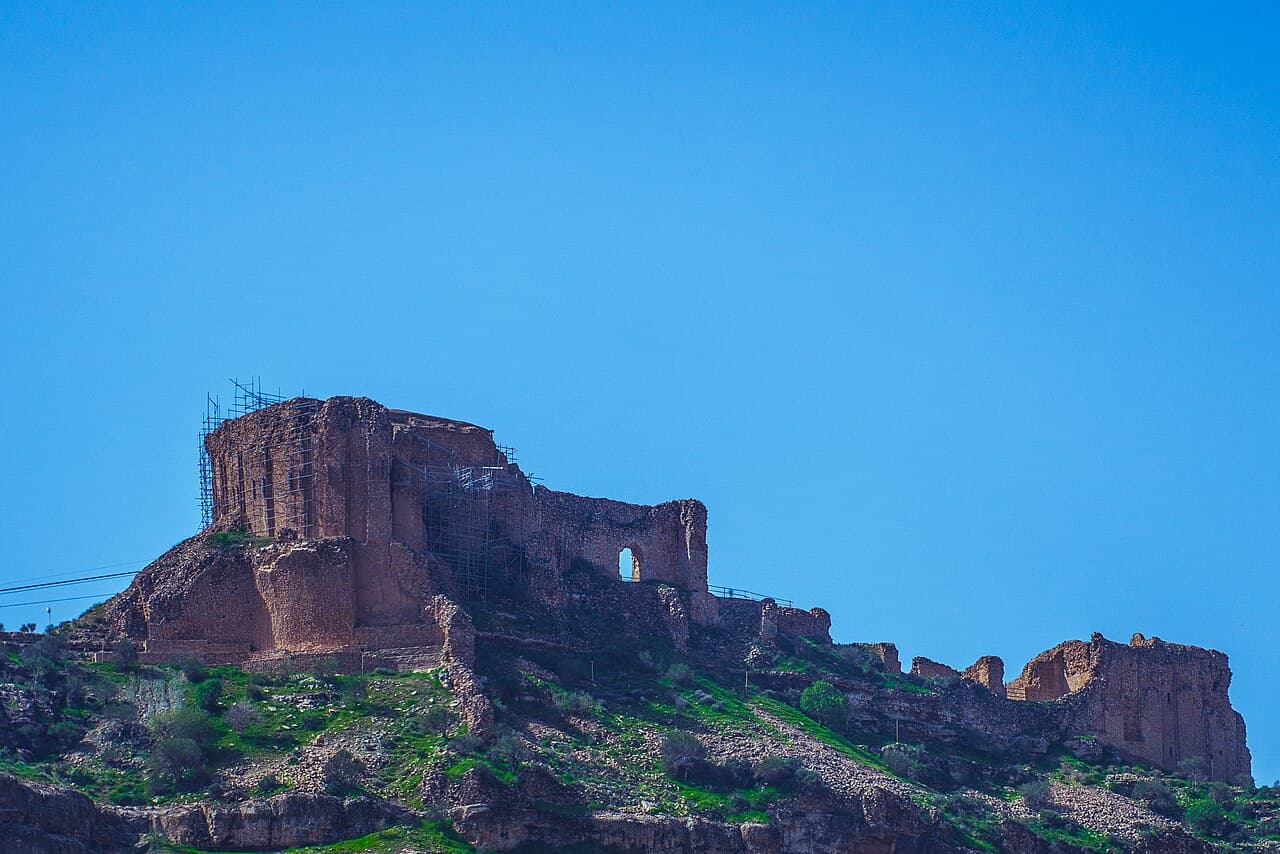
Qal’eh Dokhtar, also known as the "Maiden's Castle," is a remarkable hill castle located near Firuzabad in the Fars Province of Iran. Constructed in the early 3rd century CE, this fortress stands as a significant monument of the Sasanian Empire and reflects the transition from the preceding Parthian rule to the rise of one of Persia's most powerful dynasties.
The castle was built around 209 CE under the direction of Ardashir I, the founder of the Sasanian dynasty. This period was marked by the waning influence of the Parthian Empire, ruled by King Artabanus V, whom Ardashir ultimately defeated to establish Sasanian dominance. Qal’eh Dokhtar served as a strategic military stronghold and royal residence, overseeing the region and protecting the early Sasanian capital, Gur (modern-day Firuzabad).
Historical significance and sasanian context
The fortress played a crucial role during the formative years of the Sasanian Empire, symbolizing the consolidation of power by Ardashir I. It was not only a defensive bastion but also a royal venue where ceremonies, official receptions, and festivities took place, reflecting the dual military and administrative functions of early Sasanian castles.
Though later overshadowed by the nearby Atashkadeh palace on the Firuzabad plains, Qal’eh Dokhtar remains emblematic of the early Sasanian architectural and political landscape. Local tradition speaks of a secret cave passage connecting the fortress to Ardashir's palace, highlighting the strategic foresight in ensuring secure communication and supply lines during times of siege.
Architectural features and construction
Site layout and terraces
Qal’eh Dokhtar is uniquely perched on a mountainside rising in three distinct terraces. The fortress's design ingeniously adapts to this topography, with the original entrance located on the lowest terrace. Visitors would ascend a winding, stepped path to reach a spacious central courtyard, which is surrounded on three sides by rectangular rooms vaulted with stone ceilings. The fourth side opens onto the main palace area, blending defensive and residential functions seamlessly.
Palace and iwans
The principal palace structure features a large iwan, a vaulted hall open on one side, measuring approximately 14 meters wide and 23 to 24 meters long. Central to this hall is a domed chamber supported by thick walls and accessed via a spiral staircase on the southern side. The dome employs squinches, an advanced architectural technique that transitions from a square base to a circular dome, distinct from Roman methods. Flanking the main hall are two smaller iwans, creating a complex spatial arrangement typical of early Sasanian palatial architecture.
Construction materials and fortifications
The fortress's exterior facades are constructed from large, precisely cut stones, while the foundations and inner walls use rough river stones mixed with lime mortar. Despite centuries of weathering, the defensive walls remain imposing, including a circular outer wall enclosing the palace area. The fortifications extend with advanced outworks reaching heights of six to seven meters. A prominent round tower, likely atop the hill, probably served as a throne room or ceremonial chamber, underscoring the fortress's royal associations.
Water supply and secret passages
Carved directly into the mountain is a stone water reservoir, designed to secure water supply during sieges. Additionally, one side of the castle includes the entrance to a cave, believed to be a concealed passage connecting Qal’eh Dokhtar to Ardashir’s palace on the plains. This feature would have allowed for clandestine communication and movement, enhancing the fortress's defensive capabilities.
Preservation and visitor experience
Today, visitors approach the fortress via a staircase of 308 steps, which survives as evidence of the original access route. The site preserves areas that once hosted residential and defensive functions, offering valuable insights into early Sasanian military architecture and palace design. The combination of natural topography and sophisticated construction techniques illustrates the fortress's dual role as a military bastion and a symbol of nascent Sasanian statehood.
Qal’eh Dokhtar remains a significant cultural heritage site, attracting scholars and tourists interested in Persian history and early medieval fortifications. Its well-preserved features provide a rare glimpse into the architectural ingenuity and political history of the Sasanian era.
Frequently asked questions (FAQ)
- What is the historical significance of Qal’eh Dokhtar?
- Qal’eh Dokhtar, or the "Maiden Castle," is a significant ancient fortress in Firuzabad, Iran, dating back to the Sassanian era. It is renowned for its strategic location and impressive architectural features, symbolizing the power of the Sassanid dynasty. The castle offers insights into the military and cultural history of ancient Persia.
- When was Qal’eh Dokhtar built?
- Construction of Qal’eh Dokhtar began in the 3rd century AD during the reign of Ardashir I, the founder of the Sassanian Empire. The castle was designed as a defensive stronghold and showcases advanced architectural techniques of its time. Its enduring structure has made it a focal point for historians and archaeologists studying Persian history.
- Can I visit Qal’eh Dokhtar?
- Yes, visitors are welcome to explore Qal’eh Dokhtar and experience its historical charm. The site is accessible to tourists, and guided tours are available to enhance your understanding of its history and architecture. Be sure to check local guidelines for any visitor restrictions before your visit.
- What are the opening hours of Qal’eh Dokhtar?
- Qal’eh Dokhtar is typically open to visitors from sunrise to sunset, allowing ample time to explore the site. However, it’s advisable to check specific opening hours before your visit, as they may vary seasonally or due to special events. Planning your visit in the early morning or late afternoon can help you avoid crowds.
- What is the best time to visit Qal’eh Dokhtar?
- The best time to visit Qal’eh Dokhtar is during the spring (March to May) and autumn (September to November) when the weather is mild and pleasant. These seasons provide ideal conditions for exploring the castle and its surrounding landscapes. Summer can be quite hot, while winter may bring cooler temperatures.
- Is there an entry fee for Qal’eh Dokhtar?
- Yes, there is a nominal entry fee to visit Qal’eh Dokhtar, which helps in the maintenance and preservation of the site. The ticket prices are generally affordable, making it accessible for most visitors. Be sure to carry cash, as card payments might not be accepted on-site.
- What nearby attractions can I visit while in Firuzabad?
- While visiting Qal’eh Dokhtar, you can also explore other historical sites in Firuzabad, such as the Ardashir Palace and the ancient city ruins. These attractions provide a deeper understanding of the region’s rich history and cultural heritage. Additionally, the scenic landscapes surrounding the castle offer beautiful opportunities for outdoor photography.
- Is Qal’eh Dokhtar accessible for individuals with mobility challenges?
- Qal’eh Dokhtar features some uneven terrain and steep pathways that may pose challenges for individuals with mobility difficulties. It is advisable to check with local authorities for any available assistance or accommodations. Planning ahead can help ensure a more enjoyable visit for everyone.
Photo gallery

Information
Loading map...
Visitor reviews
No reviews yet. Been here? Write the first review and help other travelers!
Write the first reviewVisited this castle? Share your experience
Your review helps other travelers and adds first-hand knowledge to our encyclopedia.