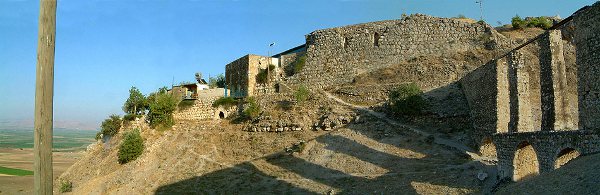
Sarıseki Castle
Sarıseki Castle, locally known as Sarıseki Kalesi, is a historic fortress situated on a rocky hill just south of the village of Sarıseki, in the Hatay province of Turkey. This castle occupies a strategic position near the southern end of the Nur Mountains, historically called the Amanus Mountains, overlooking a narrow passage known as The Portella. The castle's proximity to the sea—only about one kilometer away—allowed it to control access between the coast and the fertile Cilician plain, making it a key military and trade point throughout its history.
Origins and early history
The earliest fortifications at Sarıseki Castle likely date back to Antiquity, although the present structure is primarily attributed to the Knights Templar. The Templars constructed the castle in the 12th century as part of their efforts to secure the southern approaches of the Nur Mountains and protect the crucial mountain pass that connected the Mediterranean coast to the Cilician plain. This location was vital for controlling movement and trade routes in the region.
The Portella and the Pillar of Jonah
The Portella was the narrow passageway between the castle's hill and the seafront, serving as the southern gateway to the Cilician plain. On a rocky outcrop between the passage and the sea, there once stood a tower, which likely functioned as a toll station or watchtower. This tower may have been linked to Sarıseki Castle by a defensive wall, although only a small fragment of this structure remains today.
This fragment is locally known as the Pillar of Jonah (Yunus Sütunu in Turkish). According to religious tradition, it marks the spot where the prophet Jonah was released after being swallowed by a whale. However, historical and archaeological evidence suggests it is more likely a remnant of a Roman triumphal arch, indicating the site's long-standing significance predating the Crusader period.
Medieval control and military significance
Between 1135 and 1150, Sarıseki Castle was probably occupied by the Armenian Prince Thoros II and may have been held twice by the Byzantines. Around 1154, control of the castle and surrounding forts passed to Reginald of Antioch, who returned them to the Knights Templar. The Templars maintained continuous control of Sarıseki until 1266, when the castle fell to the Mamluk Sultan Baibars after a siege. Baibars' forces captured the fortress and massacred its occupants, marking a significant shift in regional power.
Strategic role in the Crusader states
Sarıseki Castle formed part of a network of fortifications guarding the southern approaches to the Crusader-held territories in Cilicia. Its position allowed the Templars to monitor and control movement along the coastal routes and mountain passes, serving both military and economic purposes. The castle's defensive capabilities and its control over the Portella passage made it a valuable asset during the turbulent conflicts of the 12th and 13th centuries.
Ottoman reconstruction and later history
The present ruins of Sarıseki Castle largely reflect the Ottoman reconstruction efforts in the 16th century. Following the Crusader period, the castle fell into disrepair until it was rebuilt according to the original Crusader plan. An inscription above the entrance door records that the Ottoman Sultan Suleiman the Magnificent ordered the reconstruction on March 3, 1546. This rebuilding reinforced the castle's defensive role in the Ottoman frontier region, adapting medieval fortifications to contemporary military needs.
Architectural features and layout
The castle is built on a rocky hilltop, utilizing the natural terrain for defense. The original Crusader design included thick curtain walls, towers, and a gatehouse controlling access to the inner courtyard. The Ottomans preserved much of this layout during their reconstruction, maintaining the castle's strategic vantage points over the surrounding landscape and the sea.
Although much of the structure is now in ruins, key elements such as sections of the walls and the entrance gate remain visible. The castle's interior is heavily overgrown, which, while obscuring some features, contributes to a sense of discovery for visitors exploring the site.
Present condition and visitor experience
Sarıseki Castle stands today as a partially preserved ruin within the grounds of an abandoned military complex. The site is freely accessible, though it is somewhat hidden behind trees and dense vegetation. Visitors can explore the remains of the castle, including the walls and the entrance, although the overgrowth limits visibility of some features.
The castle's location and historical layers—from Roman times through the Crusader period to the Ottoman era—make it an intriguing destination for those interested in military architecture and medieval history. Its remote and somewhat neglected state adds to its atmosphere as a hidden gem in the Hatay region.
Access and surrounding area
Sarıseki Castle is located east of the D817 road, near the Mediterranean coast. The surrounding region offers a rich historical context, with numerous other Crusader and medieval sites in Hatay province. Visitors to Sarıseki can combine their visit with explorations of nearby ancient ruins and natural landscapes.
Frequently asked questions (FAQ)
- How do I get to Sarıseki Castle?
- Sarıseki Castle is located east of the D817 road in Hatay province, Turkey. It is accessible by car, and visitors should look for local signs near the village of Sarıseki.
- What is the historical significance of Sarıseki Castle?
- Sarıseki Castle was built by the Knights Templar in the 12th century to control a strategic mountain pass near the Cilician plain. It played a key role in Crusader and Ottoman military history.
- Can I visit the interior of Sarıseki Castle?
- Yes, the castle is freely accessible. However, the interior is heavily overgrown, so visitors should wear appropriate footwear and be cautious while exploring the ruins.
- When was Sarıseki Castle rebuilt by the Ottomans?
- The castle was rebuilt on the orders of Sultan Suleiman the Magnificent in 1546, preserving much of the original Crusader layout.
- Is Sarıseki Castle suitable for family visits?
- The castle's ruins and overgrown terrain may be challenging for young children or those with mobility issues. It is best suited for visitors comfortable with uneven ground and some climbing.
Information
Address
East of the D817-road, Turkey
Loading map...
Visitor reviews
No reviews yet. Been here? Write the first review and help other travelers!
Write the first reviewVisited this castle? Share your experience
Your review helps other travelers and adds first-hand knowledge to our encyclopedia.