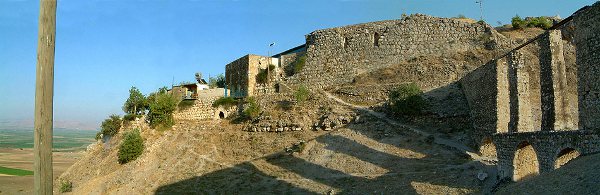
Payas Castle, locally known as Payas Kalesi, is a significant 16th-century Ottoman fortress located in the town of Payas, within the province of Hatay, Turkey. This castle played a crucial role in the Ottoman Empire's coastal defense and trade network during the Renaissance period, serving as a complementary port to the nearby Ayas across the Gulf of Alexandretta.
Historical context and Ottoman foundation
There is limited information regarding any pre-Ottoman settlement at Payas, but the existing fortifications date back to the second half of the 16th century. The Ottomans strategically settled Payas to bolster maritime control and commerce along the eastern Mediterranean coast. Under the patronage of the influential Grand Vizier Sokollu Mehmed Pasha, two key fortifications were constructed: the Cin Tower, which guarded the harbor, and the larger Payas Castle, positioned slightly inland to protect a vital commercial and religious complex known as a bedesten. This complex included a mosque, a bazaar, and a madrasa, reflecting the Ottoman emphasis on integrating military, commercial, and social functions within fortified sites.
Architectural features and layout
Payas Castle is designed with a roughly pentagonal plan, featuring a single circuit wall that encloses the interior. The defensive perimeter includes seven towers and a prominent gate tower. Surrounding the castle is a deep dry moat with vertical sides faced with masonry, enhancing the fortress's defense against siege tactics. The castle has a single entrance located on the east wall, which is fortified by a barbican – a fortified outpost or gateway designed to protect the main gate from direct assault.
The bedesten and its significance
The bedesten adjacent to the castle was a central hub for trade and social interaction. It housed a covered market where merchants could sell goods securely, supported by the nearby mosque and madrasa which served the spiritual and educational needs of the community. This integration of commerce, religion, and education within the fortified area highlights the multifaceted role of Ottoman castles beyond mere military functions.
Historical events and later developments
Payas remained an active and thriving trading center well into the 19th century. However, the site suffered considerable damage during military conflicts, notably inflicted by the troops of Kücük Ali in the mid-1800s. Despite this, the castle and its associated structures have survived, preserving much of their original character.
Modern restoration and visitor experience
In recent years, Payas Castle and the bedesten have undergone restoration efforts aimed at preserving their historical and architectural integrity. The bedesten has been fully restored and is now operational, welcoming visitors who can explore the market area and appreciate its historical ambiance. Unfortunately, the interior of the castle itself remains closed to the public, limiting access to its internal spaces. Nevertheless, the castle's exterior, combined with the nearby Cin Tower and the bedesten, offers a compelling visit for those interested in Ottoman military architecture and urban history.
Architectural style and classification
The castle exemplifies Renaissance Ottoman military architecture, characterized by robust fortifications adapted to the evolving artillery technology of the period. Its pentagonal layout and dry moat are typical defensive features designed to withstand sieges and cannon fire. The castle is classified as a lowland castle, given its position near the coast and the harbor facilities it was intended to protect.
Location and strategic importance
Situated in the town of Payas on Deniz Street, the castle occupies a strategic position overlooking the Gulf of Alexandretta. This location allowed the Ottomans to control maritime traffic and secure a vital commercial route between the Mediterranean and the interior of Anatolia. The proximity of the castle to the harbor and the bedesten complex underscores its role as both a military stronghold and a commercial center.
Visitor information and accessibility
Visitors to Payas can freely explore the restored bedesten and admire the castle's exterior fortifications. While the castle interior is currently closed, the surrounding area offers a rich historical experience. The nearby Cin Tower, only about 700 meters away, complements the visit by providing insight into the harbor defenses. The site is accessible from the town center, making it a convenient destination for those interested in Ottoman history and architecture.
Frequently asked questions (FAQ)
- How do I get to Payas Castle?
- Payas Castle is located in the town of Payas in Turkey, approximately 30 kilometers from the city of Antakya. Visitors can reach the castle by car or via local public transportation options. Be sure to check local bus schedules for the most convenient routes.
- What is the historical significance of Payas Castle?
- Payas Castle dates back to the Roman period and has served various purposes throughout its history, including as a defensive fortress. It reflects the rich cultural heritage of the region and has been a strategic military site due to its location. The castle's history is intertwined with the various civilizations that have inhabited the area, including the Byzantines and Ottomans.
- When was Payas Castle built?
- The construction of Payas Castle began in the Roman era, but most of the current structures were built during the Byzantine period. Over the centuries, it has undergone numerous renovations and expansions, gaining features from different architectural styles. This blend of history makes the castle an intriguing site for visitors interested in historical architecture.
- Can I visit Payas Castle year-round?
- Yes, Payas Castle is open to visitors throughout the year. However, it's advisable to check local conditions and any seasonal opening hours that may apply. The castle is particularly beautiful in the spring and fall when the weather is pleasant for exploration.
- Why is Payas Castle an interesting architectural site?
- Payas Castle showcases a blend of Roman, Byzantine, and Ottoman architectural styles, making it a fascinating study for architecture enthusiasts. Its thick stone walls, towers, and strategic layout are designed for defense, yet they also reflect the artistry of the time. Visitors will appreciate the intricate details and the historical context behind its construction.
- Is it possible to explore the interior of Payas Castle?
- Yes, visitors can explore various parts of Payas Castle, including its towers and walls. Some areas may have limited access due to preservation efforts, but there are guided tours available that provide insights into the castle's history and architecture. Be prepared for some uneven terrain as you wander through this historic site.
- What are the ticket prices for Payas Castle?
- Ticket prices for Payas Castle are generally affordable, making it accessible for all visitors. It’s recommended to check the official website or local tourism information for current prices and any discounts available for students or groups. Tickets usually include access to the main areas of the castle.
- What are the opening hours of Payas Castle?
- Payas Castle typically opens to visitors in the morning and closes in the late afternoon. Exact opening hours may vary by season, so it's best to verify the hours before your visit. This ensures you have ample time to explore the castle and enjoy its scenic views.
- What are some nearby attractions to visit after Payas Castle?
- After exploring Payas Castle, visitors can enjoy nearby attractions such as the historic town center of Payas, the ancient city of Antioch, and the beautiful Hatay Archaeology Museum. These sites offer additional insights into the rich history and culture of the region. Each location is easily accessible, making for a fulfilling day of exploration.
Information
Address
Deniz Sk., Payas
Loading map...
Visitor reviews
No reviews yet. Been here? Write the first review and help other travelers!
Write the first reviewVisited this castle? Share your experience
Your review helps other travelers and adds first-hand knowledge to our encyclopedia.