Sargans Castle
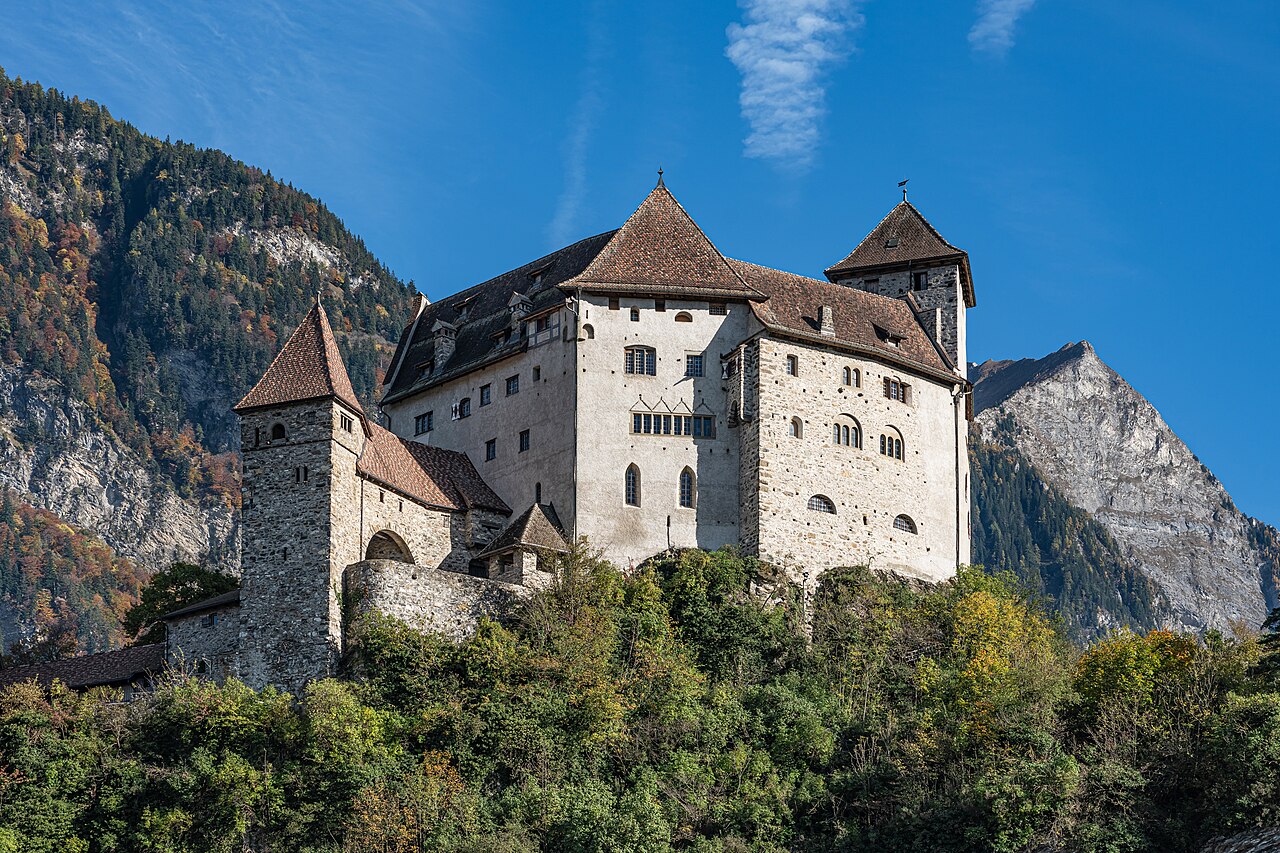
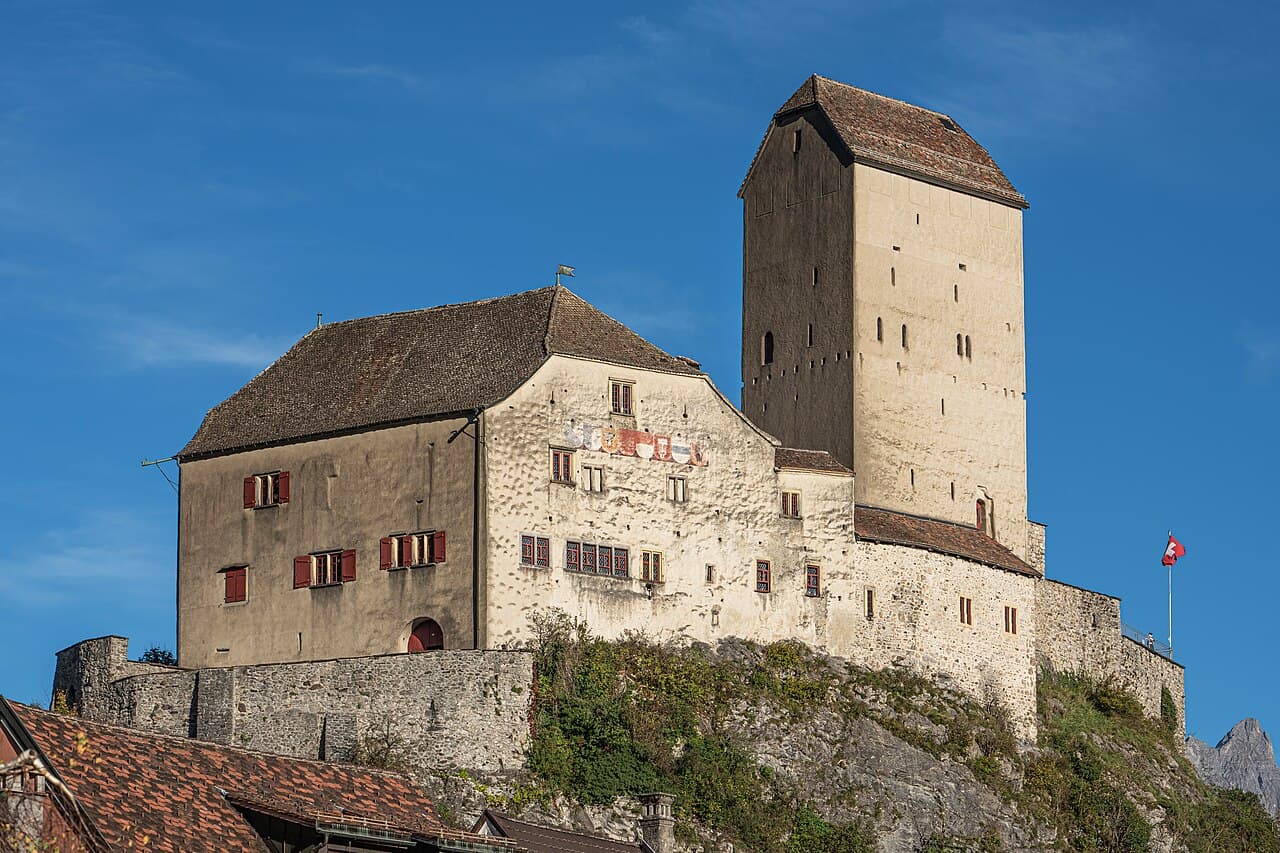
Sargans Castle stands prominently above the town of Sargans in Switzerland, embodying centuries of medieval history and architectural evolution. Its origins trace back to an earlier fortification, with the castle first explicitly mentioned in 1282. Constructed primarily as a hill castle, it served as a strategic stronghold and administrative center for the noble families that controlled the region.
The castle's early history is intertwined with the noble Counts of Bregenz, whose male lineage ended in 1160. Through marital inheritance, the lands, including Sargans, passed to Count palatine Hugo of Türbingen. His son, Hugo of Montfort und Werdenberg, significantly expanded the castle before his death in 1228. He is credited with building the large bergfried, a towering keep that remains the castle's oldest surviving structure, as well as expanding the western walls and possibly constructing the palas, the main residential building.
Medieval origins and architectural development
Archaeological excavations beneath the bergfried reveal foundations of an even earlier fortification, though details about this structure remain elusive. By the mid-13th century, the castle became the seat of the Counts of Werdenberg-Sargans, with Hartmann I likely expanding the palas to enhance the living quarters. The castle was first documented in a legal context in 1282, confirming its established role in regional governance.
The bergfried stands approximately five stories tall, with walls measuring two to two-and-a-half meters thick at the base, constructed from locally quarried tuff stone for the lower sections and plaster-finished masonry above. Its original entrance was elevated on the southeast side, a defensive feature typical of medieval keeps. Inside, a single round-arched window on the second floor and the remains of a fireplace on the third floor indicate its dual role as both lookout and living space. The roofline still bears the outline of battlements, underscoring its defensive purpose.
The palas and courtyard defenses
The palas, located on the castle's western side, was the largest building within the complex. It underwent significant rebuilding after the 1459 earthquake, which partially collapsed the structure. Reconstruction spanned from the late 1400s to the early 1500s, evidenced by dated roof beams and door lintels from 1506, 1508, and 1510. The palas housed important rooms such as the audience chamber and the bailiff's parlor, the latter bearing a 1537 inscription.
The castle's courtyard is enclosed by a robust ring wall with an outer defensive zone called a zwinger on the west, designed to impede attackers. Inner buildings were attached directly to the bergfried and walls, maintaining uninterrupted defenses. A passageway beneath the palas connects the zwinger and courtyard, its walls decorated with 16th and 17th-century paintings and coats of arms.
Historical significance and political role
Throughout the 14th century, the castle's ownership fragmented due to divisions among the Counts of Werdenberg-Sargans. By the late 1300s, Count Johann I ruled a diminished county under Habsburg influence. He participated in the 1388 Battle of Näfels, commanding a wing of the Austrian army but retreating when the main force was threatened. Financial strains forced him to sell Sargans Castle and the village to Leopold of Austria.
The castle endured military conflicts during the early 15th century, including the Appenzell Wars (1405) and the Old Zürich War (1436–1450). While the fortress withstood sieges, the surrounding town suffered destruction, highlighting the castle's defensive resilience.
In 1483, Sargans Castle and its territory became a jointly administered lordship of the Old Swiss Confederacy, managed by seven cantons. It served as the residence for the Confederacy's bailiffs (Landvögte) for over three centuries. These officials governed from the castle, which contained official rooms such as an audience chamber and a bailiff's parlor, both enhanced in the early 1500s.
The castle's walls display numerous heraldic shields representing the cantons and bailiffs, notably added in 1611, commemorating the 181 bailiffs who ruled from Sargans. This heraldry underscores the castle's long-standing administrative function within the Swiss Confederation.
Later history, restoration, and museum use
The French Revolution brought significant change, with the castle becoming public property in 1798 and later passing to the Canton of St. Gallen in 1803. A fire in 1811 damaged the building, after which it was repurposed as a schoolhouse. In 1834, Johann Georg von Toggenburg acquired the castle, styling himself "Count of Toggenburg-Sargans," though his family never resided there, leading to gradual deterioration.
A community purchase in 1899 initiated extensive restoration efforts beginning around 1900. Further repairs to facades and walls occurred in 1969–70, supported by heritage organizations. Since 1966, Sargans Castle has housed the Museum Sarganserland, which showcases local history and culture. Renovations culminated in a 1983 reopening, establishing the museum as a prominent cultural institution in the region.
Museum exhibits and cultural significance
The museum features diverse exhibits, including a notable 16th-century wine press beam called the Torkelbaum, displayed in the Trotte or wine press house. The castle is recognized as a Swiss heritage site of national importance and forms part of the Geopark Sardona geosite network, emphasizing its geological and cultural value.
Architectural features and preservation
The castle's central bergfried remains a dominant feature, with its thick walls and elevated entrance exemplifying medieval defensive architecture. The surviving "Grafenstube" or Count's room on the tower's southern face contains two arched windows with stone seating and medieval wall paintings uncovered during early 20th-century restorations. These murals provide rare insight into the castle's artistic heritage.
The palas and courtyard buildings, while altered over centuries, retain their historical character, with heraldic decorations and structural elements reflecting various phases of construction and renovation. The zwinger adds an important layer of defense, illustrating the castle's military design sophistication.
Today, Sargans Castle stands as a well-preserved monument to medieval Swiss history, combining architectural grandeur with rich cultural narratives. Its continued use as a museum ensures public engagement with the region's heritage and promotes preservation of this significant historical site.
Frequently asked questions (FAQ)
- How do I get to Sargans Castle?
- Sargans Castle is located in the town of Sargans, Switzerland, easily accessible by train or car. The castle is a short walk from the Sargans train station, making it convenient for visitors using public transportation.
- What is the best time to visit Sargans Castle?
- The castle is open daily from 10:00 to 17:00. Spring through early autumn offers pleasant weather for exploring the castle grounds and nearby town. Visiting during weekdays may provide a quieter experience.
- What can I see inside Sargans Castle museum?
- The Museum Sarganserland inside the castle features exhibits on local history, including medieval artifacts, the 16th-century Torkelbaum wine press beam, and medieval wall paintings. It offers a rich cultural insight into the region's past.
- Is Sargans Castle wheelchair accessible?
- While the castle has some accessibility limitations due to its medieval structure, efforts have been made to accommodate visitors with mobility challenges. Contact the museum in advance for specific accessibility information and assistance.
- Are guided tours available at Sargans Castle?
- Guided tours are offered periodically, providing detailed historical and architectural insights. Visitors can check the museum's schedule or contact the visitor center for tour availability and booking.

Information
Opening hours
10:00-17:00, daily
Ticket prices
CHF 8 adult, CHF 5 child, free under 16
Current owner
Municipality of Sargans
Website
Visit websiteSources & official resources
Verify the information above using these authoritative references.
Loading map...
Visitor reviews
No reviews yet. Been here? Write the first review and help other travelers!
Write the first reviewVisited this castle? Share your experience
Your review helps other travelers and adds first-hand knowledge to our encyclopedia.