Santo Stefano Castle
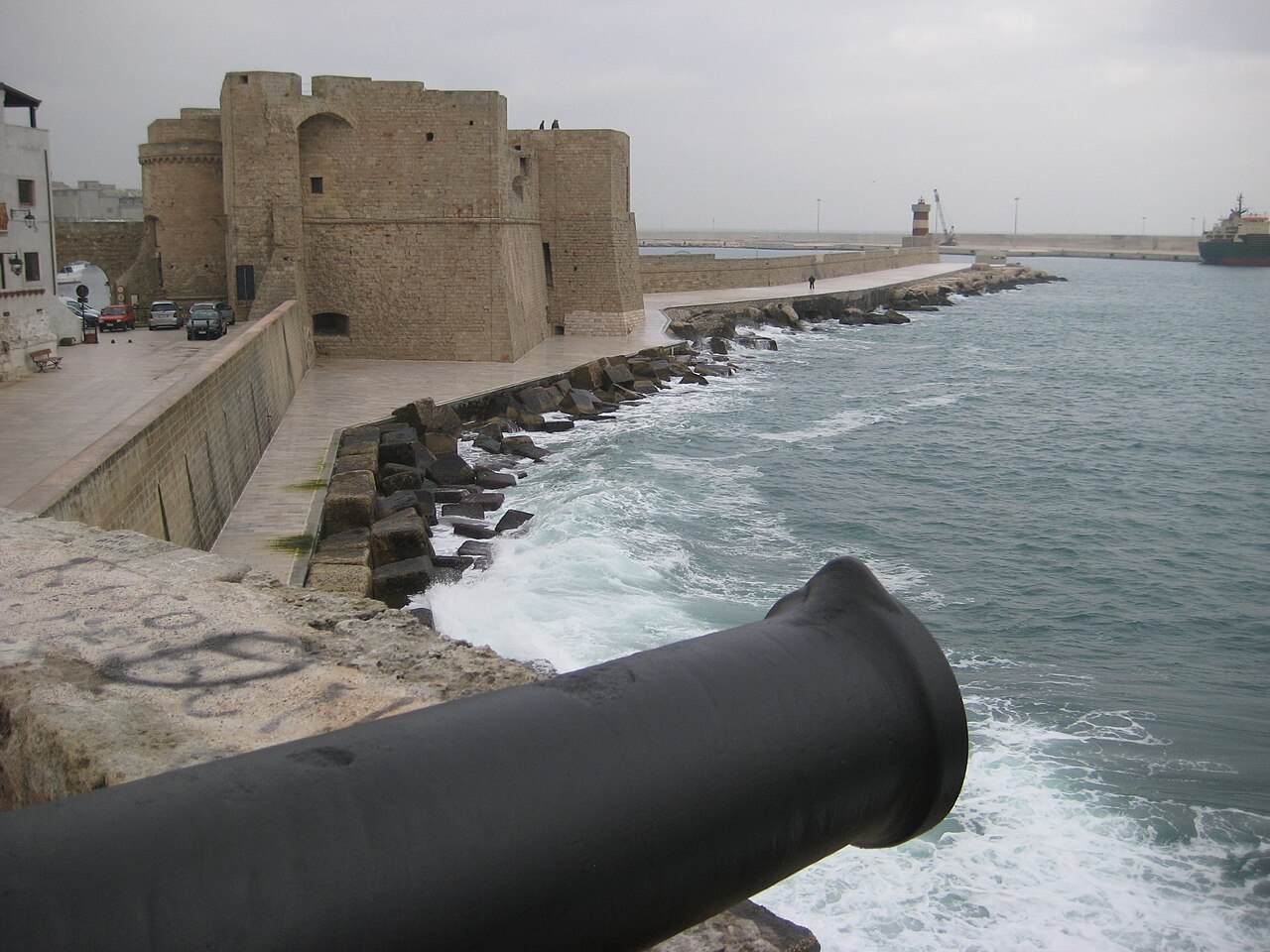
Santo Stefano Castle, located just outside the city of Monopoli in the region of Apulia, Italy, stands as a significant example of a medieval coastal fortress with a rich history spanning several centuries. Originally constructed in 1086 at the behest of Goffredo, Count of Conversano, the castle occupies a strategic peninsula flanked by two natural bays on the Adriatic Sea. These bays, now known as the beaches of Santo Stefano and Ghiacciolo, provided safe harbors and docking facilities that were crucial for maritime activities, including ship repair and provisioning for voyages to the Holy Land.
The castle’s location on a peninsula with access to fresh water from a natural spring made it an ideal site for a Benedictine monastery. The monastery, dedicated to Saint Benedict, was established here due to the presence of a relic of the saint, which was housed in the abbey until it was moved to Putignano in 1365 to protect it from frequent attacks by Turkish and pirate forces in the Mediterranean. This religious significance added a spiritual dimension to the fortress, intertwining monastic life with military defense.
Medieval origins and strategic importance
The site of Santo Stefano Castle has a history that predates the medieval fortress. Archaeological evidence reveals that the area was once part of a late antique fortified settlement connected to the nearby ancient city of Egnazia. Remnants of opus reticulatum masonry, a Roman construction technique characterized by a diamond-shaped pattern of small stones, have been found beneath the abbey, indicating the presence of a castrum or military camp and port from Roman times. This long-standing defensive role highlights the site’s enduring strategic importance along the Adriatic coast.
During the early medieval period, the establishment of the Benedictine monastery introduced a religious and communal aspect to the site. The monastery served not only as a spiritual center but also as a refuge and waypoint for travelers and pilgrims navigating the Adriatic Sea. The castle and monastery complex functioned as a necessary stopover for ships traveling between Bari and Brindisi, especially those coming from the Greek or Greco-Levantine directions.
The knights of malta and fortification enhancements
In the late 13th century, the Knights of Malta (also known as the Johanniter) took control of the abbey and fortress, relocating from their hospital within Monopoli’s city walls to this coastal stronghold. Their presence marked a shift towards a more militarized function, aimed at protecting maritime routes and pilgrims heading to the Holy Land. In 1435, the Knights formally established the Bailiwick of Santo Stefano of Monopoli, reinforcing the fortress and adapting it to the evolving military needs of the period.
One of the key defensive improvements made by the Knights was the construction of a moat surrounding the fortress, which is still visible today. This moat enhanced the castle’s defenses against attacks by land or sea, reflecting the military architecture trends of the late medieval period. The fortress’s quadrangular plan, with a large internal courtyard and an old well, also dates from this era, providing both defensive strength and logistical support for its occupants.
Architectural features and layout
The castle’s quadrangular plan encloses a spacious courtyard that includes a historic well, essential for sustaining the inhabitants during sieges or long periods of isolation. The presence of the well underscores the site’s self-sufficiency and strategic design. Parts of the structure, such as the altar and the portal of the church, date back to the 13th century and feature artistic elements like a low-relief lunette depicting Saints Stefano and Giorgio.
The two bays on either side of the peninsula were adapted to serve as docking areas capable of accommodating multiple ships simultaneously. This maritime infrastructure was vital for the castle’s role in controlling Adriatic sea routes and supporting naval logistics, including ship repair and provisioning.
Roman and medieval construction layers
Beneath the visible medieval structures lie remnants of late Roman construction, including opus reticulatum masonry. These archaeological remains attest to the site’s continuous use as a fortified port from antiquity through the medieval period. The layering of Roman and medieval architectural elements illustrates the adaptive reuse of the site across different historical eras.
Later history and current status
In the 18th and 19th centuries, the lands surrounding the castle were incorporated into the ecclesiastical chapter of Monopoli’s cathedral. This integration brought the abbey, its estates, and the castle under the administration of the Bourbon-Sicily kingdom following Monopoli’s voluntary annexation. Ownership of the castle eventually passed to the De Bellis family, descendants of Saverio De Bellis, who maintain the site as a family inheritance.
The castle’s historical significance has been documented through detailed photography, notably by Paolo Monti in 1970, which has contributed to the preservation and study of its architectural and cultural heritage. Today, Santo Stefano Castle remains a well-preserved example of a medieval coastal fortress that reflects the complex history of defense, religion, and maritime activity along the Adriatic coast.
Preservation and archaeological importance
The visible remains, including the moat, courtyard, church portal, and Roman masonry, provide valuable insights into the site’s historical development. The castle’s preservation allows visitors and scholars to explore the evolution of military architecture from Roman times through the medieval period. Its location and features continue to illustrate the strategic and cultural significance of coastal fortifications in southern Italy.
Frequently asked questions (FAQ)
- How do I visit Santo Stefano Castle in Monopoli?
- Santo Stefano Castle is located just outside Monopoli and can be reached by car or local transport. Check local tourism websites for current visiting hours and any guided tours available.
- What is the historical significance of Santo Stefano Castle?
- The castle served as a crucial coastal fortress since 1086, protecting maritime routes and hosting a Benedictine monastery and later the Knights of Malta.
- Can I see the medieval moat and church portal at the castle?
- Yes, the moat constructed by the Knights of Malta is still visible, as is the 13th-century church portal featuring a low-relief of Saints Stefano and Giorgio.
- When was the castle built and by whom?
- Santo Stefano Castle was built in 1086 by Goffredo, Count of Conversano, as part of the coastal defense system near Monopoli.
- Is the castle accessible for visitors with limited mobility?
- Accessibility may be limited due to the castle's historic structure and terrain. Visitors with mobility concerns should inquire locally before visiting.
Information
Loading map...
Visitor reviews
No reviews yet. Been here? Write the first review and help other travelers!
Write the first reviewVisited this castle? Share your experience
Your review helps other travelers and adds first-hand knowledge to our encyclopedia.