Marchione Castle
Marchione Castle, located near the town of Conversano in southern Italy, is a remarkable example of a medieval hunting lodge that evolved into a noble residence over several centuries. Originally constructed around the 11th century, the castle was built by the Acquaviva d'Aragona family, counts of Conversano, as a fortified retreat amidst the vast oak and Mediterranean scrub forests that once covered the region. The name "Marchione" likely derives from the Italian word "macchione," meaning "large forest," reflecting the estate's original purpose as a hunting ground.
The castle's architecture embodies a blend of medieval fortification and later Neoclassical-Baroque refinements, showcasing the transformation of a utilitarian hunting lodge into a stately residence. Its rectangular layout is fortified by four cylindrical towers at each corner, which were originally taller but were truncated in the early 17th century to suit the changing residential needs of the noble family. The structure spans three floors, including a ground floor and mezzanine from the Middle Ages, and an upper floor added during the Neoclassical-Baroque period, possibly designed by the school of the renowned architect Luigi Vanvitelli.
Historical development and noble lineage
The origins of Marchione Castle trace back to around the year 1000 AD, when it served primarily as a hunting lodge for the Acquaviva d'Aragona counts. This family was influential in the region, holding the County of Conversano and maintaining various estates. The castle's initial function was closely tied to the surrounding forest, which spanned approximately 1260 hectares and provided an ideal hunting environment.
During the late 15th century, the castle underwent significant construction and enhancement, aligning with improvements to the main fortress of Conversano. This period marked the castle's establishment as a fortified hunting retreat and a symbol of the nobility's power and leisure pursuits.
In the early 1600s, Count Giangirolamo II Acquaviva d'Aragona, known locally as "il Guercio delle Puglie," initiated major renovations. He reduced the height of the four corner towers and added an upper floor, transforming the castle from a purely functional hunting base into a more comfortable summer residence. These modifications were made in collaboration with his wife, Isabella Filomarino, reflecting the evolving lifestyle of the aristocracy.
Further transformation occurred around 1730 under Count Giulio Antonio III, who commissioned architect Vincenzo Ruffo, a disciple of Vanvitelli, to remodel the castle into a refined noble residence. This renovation incorporated contemporary architectural styles and cultural tastes, transitioning the castle into a symbol of prestige and elegance.
The 19th century brought political changes when the County of Conversano was absorbed into the Kingdom of Naples in 1806. The extensive forest was cleared for agriculture, and the estate was leased to local peasants, signaling a decline in its aristocratic function. The castle suffered neglect until restoration efforts began in the early 20th century under Princess Giulia Acquaviva d'Aragona and later her son, Fabio Tomacelli Filomarino, the last heir of the family.
Architectural features and layout
Fortifications and exterior
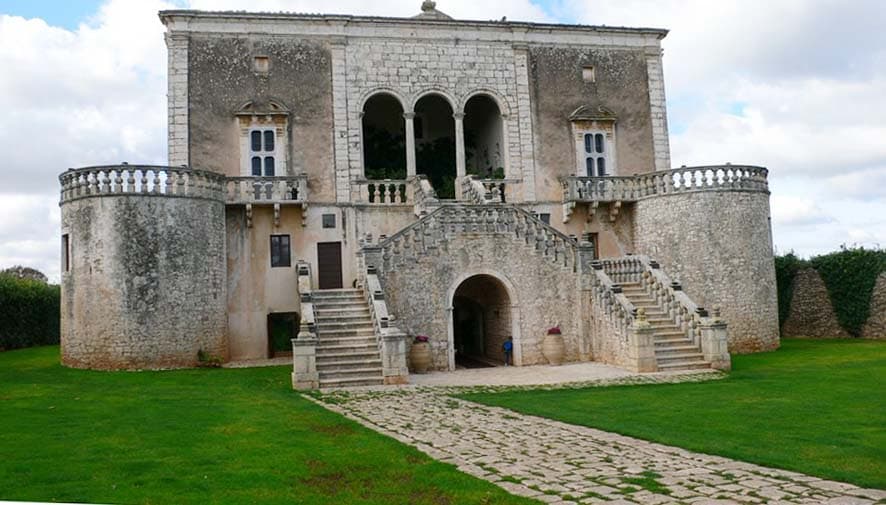
Marchione Castle features a rectangular plan with four cylindrical corner towers, originally medieval in origin but modified over time. The towers, once taller, were truncated in the 17th century and now are topped with decorative balustrades. The castle rises over three levels: a robust ground floor with a medieval character, a mezzanine, and an upper floor reflecting later stylistic influences.
The main façade is symmetrically divided into three vertical sections, with window loggias at the edges that lead to circular terraces crowning the corner towers. Access is granted by an elegant double staircase ascending to a covered exterior gallery or loggia, featuring three central arched openings. This loggia connects to the balustraded terraces, offering panoramic views of the former estate grounds.
The entrance vestibule, rebuilt in the Neoclassical style, contains sculptural elements set within semicircular lunettes, adding artistic refinement and a ceremonial transition from exterior to interior spaces.
Interior spaces and decoration
The ground floor retains its medieval ambiance, highlighted by a grand hall richly decorated with painted designs, including the Acquaviva d'Aragona family coat of arms and hunting motifs that emphasize the castle's original function. The ceiling of this hall is a notable wooden structure adorned with the family emblem at its center and an 18th-century painted genealogical tree illustrating the family's lineage.
The upper floors showcase the late Baroque remodeling, furnished with period furniture, ornamental ceramics, and a distinguished collection of oval portraits depicting eleven members of the Counts of Conversano, including Giulio Antonio I and his son Andrea Matteo. Among the most significant artworks are oil portraits believed to represent Giangirolamo II and his wife Isabella Filomarino. Isabella's portrait, attributed to a 17th-century Neapolitan artist from the school of Paolo Finoglio, exemplifies regional artistic traditions.
Chapel and ancillary structures
Within the castle courtyard stands a small chapel housing a Baroque painting of the Virgin and Child, attributed to the Neapolitan school. This chapel reflects the religious devotion of the noble family and their connection to the cultural milieu of southern Italy.
Outside the main enclosure, a 16th-century dovecote tower remains, historically used for breeding pigeons or doves, a common feature of noble estates symbolizing status and providing a food source.
Cultural significance and folklore
Marchione Castle is not only architecturally significant but also steeped in local folklore. Stories tell of a hidden underground passage linking the castle to the main fortress in Conversano, allegedly constructed during the lifetime of Giangirolamo II. While no archaeological or documentary evidence confirms this tunnel, the legend adds to the castle's mystique and cultural heritage.
Declared a national monument in 1976, the castle today serves as a venue for cultural events and ceremonies, preserving the legacy of the Acquaviva d'Aragona family and the historical narrative of the region.
Visitors to Marchione Castle can appreciate the layered history reflected in its architecture, from its medieval fortifications to its elegant Neoclassical-Baroque enhancements, alongside the art and artifacts that tell the story of one of southern Italy's prominent noble families.
Frequently asked questions (FAQ)
- How do I get to Marchione Castle?
- Marchione Castle is located in Conversano, Italy, easily accessible by car or public transport. The nearest train station is in Conversano, and from there, you can take a short taxi ride or enjoy a pleasant walk to the castle.
- What is the historical significance of Marchione Castle?
- Marchione Castle dates back to the 12th century and played a crucial role in the defense of the region. It has witnessed numerous historical events and changes in ownership, reflecting the rich heritage of Conversano and its strategic importance in medieval Italy.
- When was Marchione Castle built?
- The construction of Marchione Castle began in the 12th century, with significant modifications made in the following centuries. Its architectural evolution showcases various styles and influences, making it a fascinating site for history enthusiasts.
- Can I take guided tours of Marchione Castle?
- Yes, guided tours are available for visitors to explore the castle's rich history and impressive architecture. Tours typically include access to key areas of the castle and are conducted by knowledgeable guides who can provide deeper insight into its significance.
- Why is Marchione Castle a popular tourist attraction?
- Marchione Castle attracts visitors for its stunning views, historical architecture, and cultural significance. Its picturesque setting and well-preserved structure make it an ideal spot for both sightseeing and photography.
- Is it possible to visit Marchione Castle year-round?
- Yes, Marchione Castle is open to visitors throughout the year, though hours may vary by season. It's best to check the official website for the most current opening hours and any seasonal events that may be taking place.
- What are the ticket prices for Marchione Castle?
- Ticket prices for Marchione Castle are generally affordable, with discounts available for students and seniors. Children under a certain age may be admitted for free, making it a great family-friendly destination.
- What is the best time to visit Marchione Castle?
- The best time to visit Marchione Castle is during the spring and early fall when the weather is mild and pleasant for outdoor exploration. These seasons also tend to have fewer crowds, allowing for a more enjoyable experience.
- Are there any nearby attractions to visit?
- Yes, there are several nearby attractions, including the charming town of Conversano itself, with its quaint streets and local eateries. Additionally, the beautiful beaches of the Adriatic Sea are just a short drive away, offering a perfect complement to your castle visit.
Photo gallery

Information
Website
Visit websiteSources & official resources
Verify the information above using these authoritative references.
Loading map...
Visitor reviews
No reviews yet. Been here? Write the first review and help other travelers!
Write the first reviewVisited this castle? Share your experience
Your review helps other travelers and adds first-hand knowledge to our encyclopedia.