Conversano Castle
Conversano Castle stands prominently on the highest point of the hill overlooking the town of Conversano in the Apulia region of southern Italy. This hill castle commands sweeping views over the surrounding countryside and the Adriatic Sea, embodying centuries of military and noble history. Originally constructed by the Normans in the 11th century, the castle was built atop the remains of an earlier defensive structure dating back to the Gothic War (535–554). This early fortification incorporated parts of the ancient megalithic walls of the city of Norba, highlighting the site's long-standing strategic importance.
For nearly seven centuries, the castle served as the residence of the Counts of Conversano, evolving through various architectural phases that reflect the changing needs of defense and noble habitation. The earliest Norman phase is still visible today, notably in the imposing Torre Maestra, a square-based tower that rises approximately 25 meters. This tower features a preserved fresco of Saints Cosmas and Damian on its original vaulted entry, underscoring the blend of military and religious functions within the fortress.
Medieval origins and norman construction
The castle's origins are deeply rooted in the turbulent medieval period when the Normans established their rule in southern Italy. The 11th-century reconstruction imposed by the Norman feudal lords transformed the site into a formidable fortress. The core of the castle, including the Torre Maestra and several large square towers, was designed for defense and control over the surrounding territory, which was vital in the fragmented political landscape of the time.
Architectural evolution through the centuries
14th-century expansions by the counts of Luxembourg
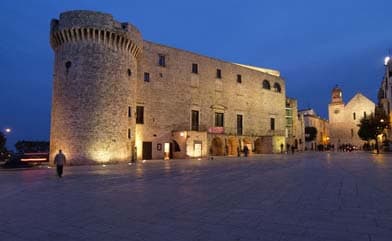
In the 14th century, the castle underwent significant enlargement under the Counts of Luxembourg. They commissioned the construction of a high cylindrical tower at the northern corner of the acropolis, where the ridge steepens sharply. This tower replaced an earlier square tower and was designed to enhance the castle's defensive capabilities in response to evolving military technology.
15th-century innovations by the acquaviva family
The Acquaviva family, who became the castle's lords in the 15th century, further transformed the fortress with innovative architectural features. Around 1460, they built a distinctive twelve-sided polygonal tower characterized by embankment-type walls and a sloping base known as a scarpa. This design was particularly advanced for its time, engineered to withstand artillery attacks. The tower contains a round internal tank surrounded by a corridor equipped with drainage systems, essential for the castle's defense and water supply.
Baroque and renaissance modifications
By the 18th century, the castle's military role diminished, and it increasingly took on the character of an elegant noble residence. In 1710, Countess Dorotea Acquaviva commissioned the construction of the current main entrance on Piazza Conciliazione. This portal leads into a spacious courtyard bordered by late Renaissance porticoes and open loggias, which softened the fortress's austere medieval appearance and introduced refined Baroque elements. Several rooms retain their 16th and 17th-century furnishings, including the notable bridal chamber adorned with Old Testament scenes painted by Paolo Domenico Finoglio.
Historical significance and military events
The castle's history is intertwined with regional power struggles and military conflicts. During the tenure of Count Andrea Matteo Acquaviva (1481–1511), the fortress was besieged and captured in 1503 by Spanish troops led by General Gonzalve de Cordova. This event marked a significant moment in the castle's martial history, reflecting the broader geopolitical contests in Italy during the Renaissance.
Architectural features and defensive structures
Conversano Castle is laid out in a trapezoidal plan, combining various defensive towers of different shapes and eras. The Torre Maestra remains the most imposing feature, standing on foundations of massive megalithic stones from the ancient city walls. The northern cylindrical tower added in the 15th century is notable for its corbel-supported parapet, which was modified to accommodate cannon embrasures, illustrating the adaptation to gunpowder warfare.
The polygonal tower built by the Acquaviva family is a rare example of late medieval military engineering, with its embankment walls and angled base designed to deflect artillery fire. The presence of narrow slits for cannon fire and the strategic placement of artillery on the parapet reflect the castle's role as a modernized fortress in the face of evolving siege technologies.
Artistic heritage and current use
Inside the castle, visitors can explore rooms that showcase a rich artistic heritage. The civic art gallery housed within the public sections displays a remarkable cycle of paintings by Paolo Domenico Finoglio, illustrating scenes from the Italian epic poem Jerusalem Delivered. These artworks were commissioned by Giangirolamo II Acquaviva d’Aragona in the mid-17th century, highlighting the castle's cultural significance beyond its military origins.
The castle remains partially privately owned, with some wings including the bridal chamber still under private possession. However, the public areas are accessible and offer a fascinating glimpse into the layered history of this high medieval fortress turned noble residence. The well within the Torre Maestra is linked to local legend, adding a layer of folklore to the castle's rich narrative.
Visitor experience and panoramic views
Visitors to Conversano Castle can enjoy panoramic views from the top of the Torre Maestra, which overlooks the town and the surrounding Apulian landscape. The castle's position on the hilltop provides a unique vantage point to appreciate the strategic importance that dictated its original construction and subsequent modifications.
The blend of military architecture, Renaissance elegance, and artistic treasures makes Conversano Castle a compelling destination for those interested in medieval history, architecture, and Italian cultural heritage.
Frequently asked questions (FAQ)
- How do I visit Conversano Castle?
- Conversano Castle is open to the public with access to the municipal art gallery and some historic rooms. Visitors can explore the courtyard, Renaissance porch, and climb the Torre Maestra for panoramic views. Check local tourism websites for current opening hours and guided tours.
- What is the historical significance of Conversano Castle?
- The castle served as the residence of the Counts of Conversano for nearly 700 years and played a key role in regional military conflicts, including a notable siege in 1503. It reflects Norman military architecture and later Renaissance and Baroque modifications.
- What architectural styles are present in Conversano Castle?
- Conversano Castle exhibits a mix of architectural styles, including Norman medieval fortifications, 14th-century Gothic elements, and Renaissance and Baroque additions from the 15th to 18th centuries.
- Can I see artwork inside the castle?
- Yes, the castle houses a civic art gallery featuring a significant collection of paintings by Paolo Domenico Finoglio, including scenes from the epic poem Jerusalem Delivered, commissioned in the 17th century.
- Is the castle accessible for visitors with mobility issues?
- Due to the medieval structure and hilltop location, some areas of Conversano Castle may be challenging for visitors with mobility issues. It is advisable to contact the castle administration in advance for accessibility information and assistance.
Photo gallery

Information
Current owner
Municipality and private owners
Loading map...
Visitor reviews
No reviews yet. Been here? Write the first review and help other travelers!
Write the first reviewVisited this castle? Share your experience
Your review helps other travelers and adds first-hand knowledge to our encyclopedia.