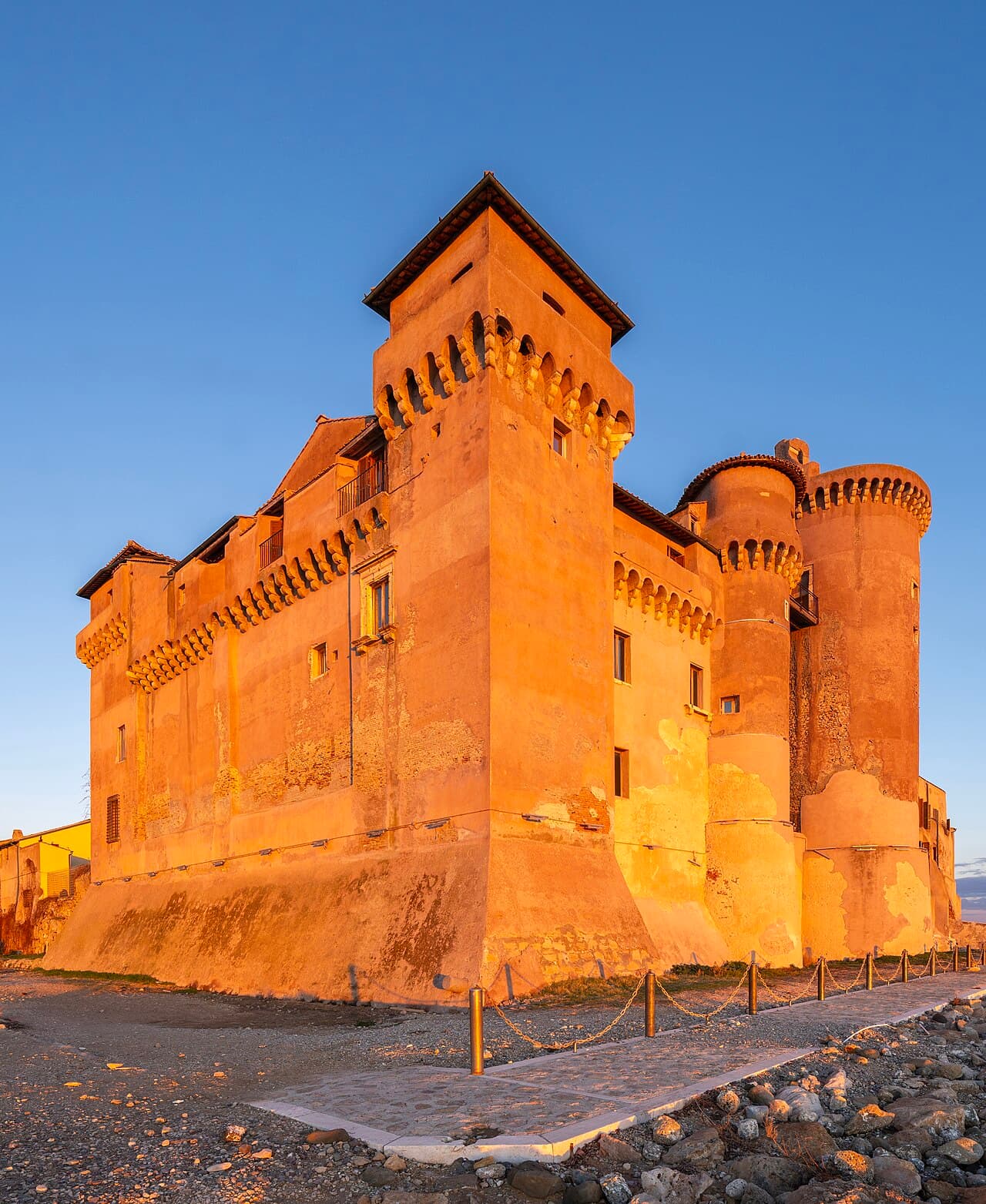
Santa Severa Castle
Santa Severa Castle stands as a remarkable testament to the layered history of the Lazio coast in Italy, where medieval military architecture intersects with ancient Etruscan civilization and early Christian heritage. Located within the municipality of Santa Marinella, this castle occupies a strategic position overlooking the Tyrrhenian Sea, commanding views of the surrounding landscape and the ancient harbor of Pyrgi. The site’s continuous occupation from the Etruscan period through Roman times and into the Middle Ages highlights its enduring importance as a cultural and defensive landmark.
The castle’s origins are deeply intertwined with the ancient city of Pyrgi, an Etruscan port connected to the larger settlement of Caere (modern Cerveteri), founded between the late 7th and early 6th centuries BC. Pyrgi was a thriving harbor town extending approximately 10 hectares around the natural bay, including a significant sanctuary area to the south. Archaeological excavations by the Institute of Etruscology at the University of La Sapienza in Rome have revealed extensive remains of this Etruscan settlement, illuminating its religious and commercial significance in the ancient Mediterranean world.
During the 3rd century BC, as Roman influence expanded along the coast, the Etruscan settlement evolved into a Roman fortification known as the castrum of Pyrgi. This fort was enclosed by massive polygonal walls characteristic of Roman military engineering. The site remained inhabited without interruption into late antiquity, with evidence of occupation continuing through the 4th and 5th centuries AD. This continuity of settlement laid the foundation for the medieval village known as Castellum Sanctae Severae, which developed on the ruins of the Roman fort.
Medieval evolution and noble ownership
The present-day castle was primarily constructed in the 14th century, reflecting a period of significant fortification and expansion during the Middle Ages. The rectangular plan with four corner towers that defines the castle today dates largely from this era. The village surrounding the castle also grew through various construction phases during the 15th and 16th centuries, reflecting the evolving needs of the local community and its rulers.
Throughout the 13th and 14th centuries, Santa Severa Castle passed through the hands of several influential noble families, including the Papareschi, Orsini, and Anguillara. These families undertook important reconstruction projects to strengthen the fortress, adapting it to the changing military technologies and political landscape of the time. The castle’s strategic coastal position made it a valuable asset for controlling maritime routes and local territories.
In 1482, the castle came under the ownership of the Order of the Holy Spirit, a religious order that maintained control for nearly five centuries until 1980. Under the order’s stewardship, the castle served not only as a defensive stronghold but also as a center for local administration and religious activity. The order’s patriarchal cross remains a visible symbol of their long-standing presence in the village.
Architectural features and fortifications
Santa Severa Castle is distinguished by its robust medieval military architecture. The fortress’s rectangular layout is fortified by four imposing square towers, one at each corner, which were constructed during the 14th-century building campaigns. These towers provided vantage points for surveillance and defense against invaders, embodying the military architectural principles of the Middle Ages.
One of the castle’s most notable features is the circular tower known as the Torre del Castello, connected to the main structure by a bridge. This tower predates much of the current castle, originating around the 9th century, and was later rebuilt during the 16th and 17th centuries. Its survival and adaptation over centuries illustrate the site’s continuous strategic importance and the layering of architectural styles and functions.
The castle’s walls are constructed primarily of stone, with battlements and defensive walkways that allowed defenders to repel attacks effectively. The thickness and height of the walls reflect the need to withstand artillery and siege tactics that evolved over time. Inside the castle, the main piazza contains the remains of an early Christian church dedicated to Saint Severa, linking the fortress to its religious heritage and the martyrdom tradition associated with the site.
Historical and religious significance
The site of Santa Severa Castle holds profound religious importance dating back to early Christianity. Tradition holds that Saint Severa, along with her brothers Calendino and Marco, was martyred near this location around 298 AD. The remains of a church dedicated to Saint Severa stand within the castle grounds, preserving this sacred legacy. This early Christian connection adds a spiritual dimension to the castle’s historical narrative, intertwining faith with military and civic functions.
Throughout its history, the castle has witnessed the presence of notable figures, including several popes such as Gregory XIII, Sixtus V, and Urban VIII, who used the castle as a resting place during the 16th and 17th centuries. This papal association highlights the castle’s role beyond mere fortification, serving also as a place of refuge and governance.
Modern history and preservation
After reaching a peak in importance during the Renaissance, the castle experienced a gradual decline from the 17th century onward. Its strategic value diminished, and it fell into periods of neglect. During World War II, the castle’s coastal position was again recognized for military purposes, and it was used by German forces as a strategic post.
Today, Santa Severa Castle is owned by the Lazio Region and managed by the municipality of Santa Marinella. Preservation efforts have focused on maintaining the castle’s structural integrity and enhancing public access to this historic site. The castle and its surrounding village remain a popular destination for visitors interested in medieval architecture, ancient history, and religious heritage.
Archaeological context and nearby sites
The castle’s location near the ancient Etruscan city of Pyrgi situates it within a rich archaeological landscape. Excavations have uncovered significant artifacts and structures from the Etruscan period, including the famous Pyrgi Tablets—inscribed gold leaves that provide invaluable insight into Etruscan language and religion. While these finds are outside the castle walls, they contribute to understanding the broader historical and cultural significance of the area.
The juxtaposition of the medieval fortress with the ancient harbor and sanctuary sites creates a unique historical tapestry that attracts scholars and tourists alike. Visitors to Santa Severa can explore the castle’s fortifications, the early Christian church ruins, and nearby archaeological parks, gaining a comprehensive view of the region’s long and varied past.
Frequently asked questions (FAQ)
- How do I get to Santa Severa Castle?
- Santa Severa Castle is accessible by train and car. Visitors can take the train to Santa Severa station, which is a short walk from the castle. There are also parking facilities nearby for those traveling by car.
- What are the opening hours of Santa Severa Castle?
- The castle is generally open to visitors from morning until late afternoon, typically from 10:00 to 18:00 daily. It is advisable to check the official website or local tourist information for any changes or special closures.
- Is there an entrance fee to visit the castle?
- Entrance fees may apply, often modest, with discounts available for children, seniors, and groups. Some special events or exhibitions might have separate charges. It is best to confirm current prices before visiting.
- What is the historical significance of Santa Severa Castle?
- Santa Severa Castle is significant for its continuous occupation from the Etruscan era through Roman times and medieval periods. It served as a strategic military fortress, a religious site linked to Saint Severa, and a residence for noble families and religious orders.
- Can I explore the archaeological sites near the castle?
- Yes, visitors can explore nearby archaeological sites related to the ancient Etruscan city of Pyrgi. These sites include remnants of the harbor, sanctuary, and artifacts like the Pyrgi Tablets, enriching the historical experience.
- Is the castle accessible for people with mobility challenges?
- The castle has some areas with uneven terrain and stairs, which may limit accessibility for visitors with mobility impairments. However, efforts have been made to improve access where possible, and it is recommended to contact the site in advance for specific accommodations.
Photo gallery

Information
Sources & official resources
Verify the information above using these authoritative references.
Loading map...
Visitor reviews
No reviews yet. Been here? Write the first review and help other travelers!
Write the first reviewVisited this castle? Share your experience
Your review helps other travelers and adds first-hand knowledge to our encyclopedia.



