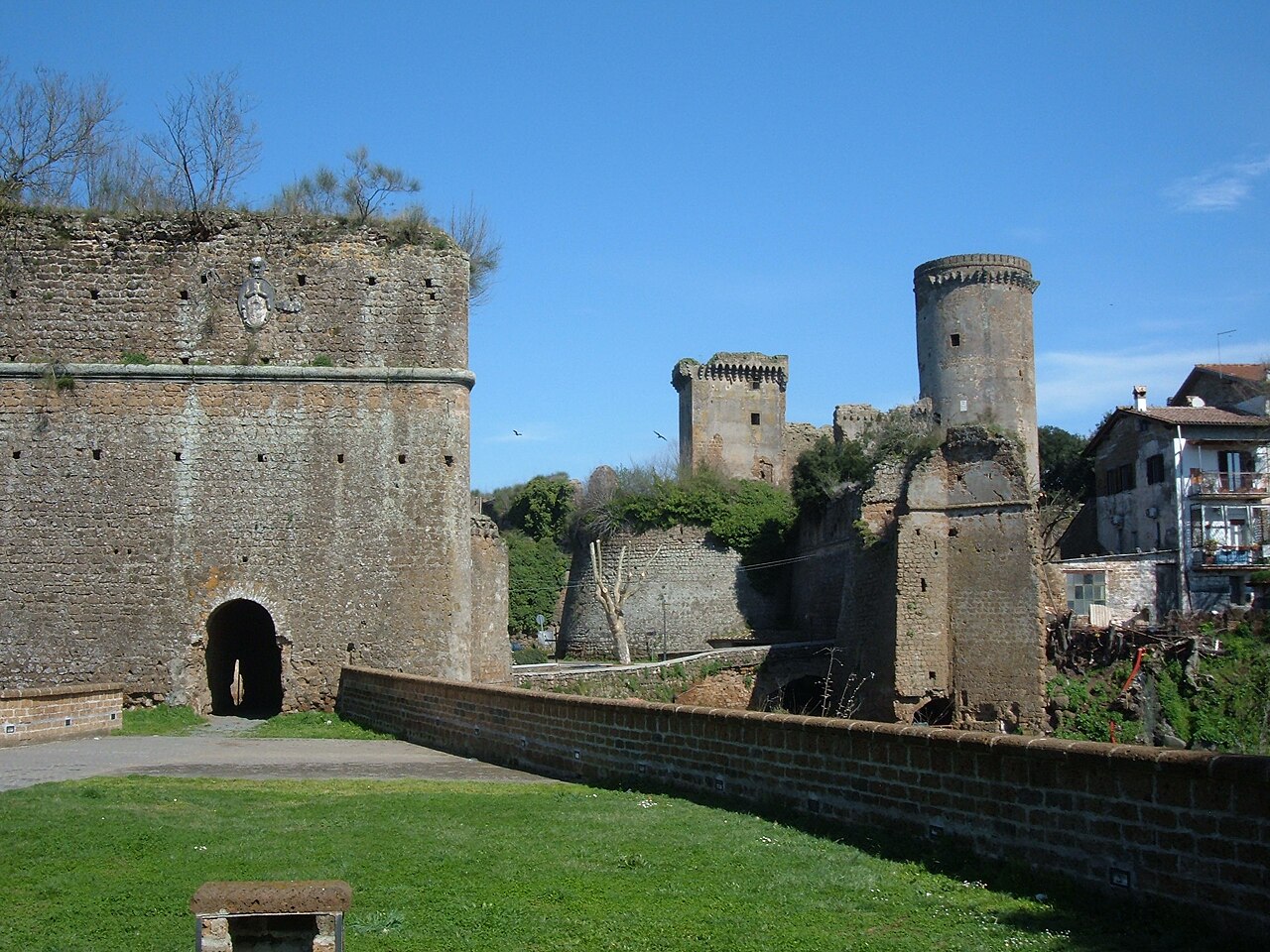
Orsini-Odescalchi Castle

Orsini-Odescalchi Castle: historic fifteenth-century fortress in Lazio
Lazio, Italy
Late Medieval (14th–15th c.)
Well Preserved

Orsini-Odescalchi Castle, also known as the Castle of Bracciano, is a remarkable example of a fortified Renaissance castle located in the Lazio region of Italy. Constructed primarily in the fifteenth century, this castle stands as a testament to the military architecture and noble residences of its era, combining defensive features with artistic and residential grandeur.

The castle's origins trace back to a medieval fortress built by the Prefects of Vico in the thirteenth century. Around 1470, the castle was extensively rebuilt and expanded under the direction of Napoleon Orsini, a prominent member of the Orsini family, a powerful noble house in Italy. His son, Gentil Virginio Orsini, completed the construction by 1485, transforming the structure into a pentagonal fortress with five towers, one at each vertex of the outer walls. This design provided robust defensive capabilities while also serving as a symbol of Orsini power and prestige.

Architectural features and fortifications

The castle's pentagonal layout is distinctive, with thick outer walls and five imposing towers that dominate the skyline of Bracciano. Each tower was strategically placed to provide overlapping fields of fire, enhancing the castle's defensive strength against sieges and attacks. The walls and towers are constructed from local stone, giving the castle a formidable and enduring presence.

The castle also features an inner courtyard, residential quarters, and richly decorated halls that reflect the transition from purely military architecture to a more palatial residence. The combination of defensive and residential elements illustrates the dual role of such castles during the Renaissance period, serving both as fortresses and noble homes.

Historical significance and ownership

Originally built by the military leader Braccio da Montone, the castle passed to the Orsini family at the request of Pope Martin V in 1418, marking the beginning of centuries of Orsini influence over Bracciano. The Orsini family were key players in Italian politics and military affairs during the Renaissance, and the castle served as their stronghold.

The castle's history is marked by significant events, including its seizure by Pope Alexander VI in 1496, who harbored deep resentment against the Orsini family. Despite this, the Orsini regained possession and continued to enhance the castle's beauty and functionality. The castle also hosted notable figures such as Ludovico Gonzaga, bishop of Mantua, who took refuge there during the plague in 1485, and Pope Sixtus IV della Rovere, who fled to the castle in 1481 to escape the plague in Rome.

The Odescalchi family and later history

In 1696, the castle came under the ownership of the Odescalchi family, a noble lineage originally from Como. Their prestige was significantly enhanced when one of their members ascended to the papal throne as Pope Innocent XI. The Odescalchi family continues to own the castle today, maintaining its historical legacy.

Since 1952, under the stewardship of Livio IV Odescalchi, the castle has been open to the public. It serves not only as a museum but also as a venue for receptions, weddings, and cultural events, blending historical preservation with contemporary use.

Artistic heritage and interior decoration

The castle's interiors are renowned for their rich artistic decoration, reflecting the tastes and wealth of its noble owners. The frescoes by Antoniazzo Romano depict the triumph of Gentil Virginio Orsini and are among the most important examples of fifteenth-century Italian painting within the castle. These artworks provide valuable insight into the cultural and political aspirations of the Orsini family.

Later enhancements in the late sixteenth century were overseen by Giacomo del Duca, a pupil of Michelangelo, who contributed architectural speeches for the lavish wedding of Isabella de' Medici and Paolo Giordano Orsini. The brothers Taddeo and Federico Zuccari, prominent late sixteenth-century artists, were commissioned to decorate several rooms, including one that hosted Pope Sixtus IV during his flight from the plague. Their frescoes feature the couple's horoscope and the emblems of the Orsini and Medici families, symbolizing the union of two powerful dynasties.

Cultural importance and tourism

Today, Orsini-Odescalchi Castle stands as one of the best-preserved Renaissance castles in Italy, attracting visitors interested in history, architecture, and art. Its combination of military fortification and elegant residential spaces offers a comprehensive glimpse into Renaissance noble life.

The castle's location in Bracciano, near Rome, makes it accessible for day trips and cultural tourism. Visitors can explore the extensive grounds, admire the frescoes and architectural details, and attend various events held throughout the year. The castle's preservation and continued use as a cultural venue contribute to the appreciation and understanding of Italy's rich medieval and Renaissance heritage.

Frequently asked questions (FAQ)

How do I get to Orsini-Odescalchi Castle?
Orsini-Odescalchi Castle is located in Bracciano, Italy, approximately 50 kilometers northwest of Rome. The easiest way to reach the castle is by taking a train from Rome to Bracciano, followed by a short walk to the castle. There are also buses and taxis available for convenience.
What is the historical significance of Orsini-Odescalchi Castle?
Orsini-Odescalchi Castle, built in the 15th century, is a remarkable example of medieval architecture and has played a significant role in Italian history. It has served as a fortress, a noble residence, and a venue for important events, including royal weddings. The castle's rich history reflects the power struggles and cultural developments of the time.
When was Orsini-Odescalchi Castle built?
Construction of the castle began in 1470 under the Orsini family and was completed in the early 16th century. The castle has undergone various renovations and expansions over the centuries, maintaining its historical integrity while adapting to modern needs. Its architectural evolution showcases the changing styles of Italian fortifications.
Can I visit Orsini-Odescalchi Castle?
Yes, Orsini-Odescalchi Castle is open to visitors throughout the year. Guided tours are available, providing insights into its history, architecture, and the stunning views of Lake Bracciano. It’s advisable to check the official website for any special events or closures before planning your visit.
Why is Orsini-Odescalchi Castle a popular tourist attraction?
The castle's stunning architecture, picturesque location overlooking Lake Bracciano, and rich historical significance make it a popular destination for tourists. Visitors are captivated by its well-preserved interiors, beautiful gardens, and breathtaking views. Additionally, the castle often hosts cultural events and exhibitions, enhancing its appeal.
Is it possible to hold events at Orsini-Odescalchi Castle?
Yes, Orsini-Odescalchi Castle is a sought-after venue for weddings, corporate events, and private celebrations. Its enchanting atmosphere and spectacular views create a memorable setting for any occasion. Interested parties should contact the castle's administration for more information on booking and available services.
What are the ticket prices for Orsini-Odescalchi Castle?
Ticket prices for Orsini-Odescalchi Castle vary depending on the type of tour and age group. Generally, adult tickets cost around €10, while discounts are available for students and children. Special rates may apply for guided tours or events, so it is recommended to check the official website for the latest pricing information.
What are the opening hours of Orsini-Odescalchi Castle?
Orsini-Odescalchi Castle typically opens at 10 AM and closes at 6 PM, with varying hours depending on the season. It is recommended to visit the official website or contact the castle directly for the most current opening hours, as they may change for holidays or special events.
What is the best time to visit Orsini-Odescalchi Castle?
The best time to visit Orsini-Odescalchi Castle is during the spring and autumn months when the weather is mild and pleasant for exploring the grounds. Additionally, visiting during these seasons allows you to enjoy fewer crowds and more intimate experiences. Summer can be hot, while winter may bring fewer visitors but also limited accessibility.
Are there any nearby attractions to Orsini-Odescalchi Castle?
Yes, there are several attractions near Orsini-Odescalchi Castle, including the charming town of Bracciano, which features lovely shops and restaurants. Lake Bracciano offers opportunities for boating, swimming, and picnicking along its shores. Additionally, the nearby Etruscan archaeological sites provide insight into Italy's ancient history.

Information

Hill Castle

Loading map...

Visitor reviews

No reviews yet. Been here? Write the first review and help other travelers!

Write the first review

Visited this castle? Share your experience

Your review helps other travelers and adds first-hand knowledge to our encyclopedia.

Write a review

(5/5)

0/2000 characters

Your review will be visible after admin approval

Nearby castles

19.8 km

Castello di Torre in Pietra

Torrimpietra, Italy

The Castello di Torre in Pietra is a remarkable example of a hill castle located in the municipality of Torrimpietra, Italy. This fortified complex has a rich history dating back to the medieval period, originally constructed as a castrum—a defensive settlement designed to protect its inhabitants with robust towers and strong walls. The castle’s strategic location and architectural evolution reflect its importance as a noble residence and defensive stronghold over several centuries. Medieval origins and noble ownership The castle first appears in historical records in the mid-13th century, notably owned by the Normanni family in 1254. This family expanded their influence over neighboring lands including Pruniano (historically known as Leprignana) and Castel Lombardo, consolidating regional power. The ownership later passed to the Anguillara family, a significant noble lineage in the area, likely through inheritance. A key transaction occurred in 1457 when Lorenzo and Felice Anguillara sold the estate for 3000 gold ducats to Massimo di Lello di Cecco dei Massimo, marking a shift in stewardship. Subsequent transfer to the Peretti family introduced new phases of aristocratic management and estate development. Baroque transformation under the Falconieri family In 1639, the castle was acquired by the Falconieri princes, who initiated significant architectural enhancements. They commissioned the renowned architect Ferdinando Fuga to redesign important elements, including the church and the grand staircase leading to the noble floor. This period saw the castle’s interiors enriched by the frescoes of Pier Leone Ghezzi, painted in 1725 to celebrate the Jubilee year, a major religious event in the Catholic calendar. The Falconieri era marked the castle’s transformation into a refined noble residence with elegant Baroque features. Architectural features and interior spaces The castle is set within gardens featuring large pine trees, blending natural and built environments. The central courtyard is notable for its portico supported by columns with lowered arches, providing sheltered walkways and connecting various parts of the complex. The ground floor houses the Sala Peretti, a spacious 220-square-meter room distinguished by a large fireplace and a barrel-vaulted ceiling with window spandrels, which enhance both the structural rhythm and natural lighting. Access to the noble floor is via the historic staircase designed by Ferdinando Fuga. This upper level contains several frescoed rooms originally decorated by Pier Leone Ghezzi, including the main hall with its lowered vault ceiling and window spandrels. Other notable rooms are the Falconieri rooms, the stanza del bosco (forest room), the green room, and a gallery corridor with a vaulted full-arch ceiling. These spaces feature painted wooded landscapes, creating immersive naturalistic environments within the castle. The baroque chapel of sant’antonio abate A prominent architectural feature on the grounds is the octagonal Baroque chapel dedicated to Sant’Antonio Abate. The chapel has a single nave with a round-arched main entrance topped by a triangular pediment. Its facade is framed by four pilaster lesenes, two on each side, which are flat rectangular columns integrated into the wall surface. Inside, the altar houses a painting of the Madonna and Child. The chapel remains in use for wedding ceremonies, maintaining its religious and cultural significance. Historic wine cellars and archaeological significance Beneath the castle lies an extensive wine cellar carved into a hill of tuff, a volcanic rock from the nearby Bracciano area. This cellar has been used for wine production since the 1600s and was notably expanded in 1938. During these expansions, remains of the prehistoric elephant species Elephas Europeus were discovered, highlighting the site’s unique geological and paleontological importance alongside its historical functions. Modern stewardship and cultural legacy After the extinction of the Falconieri family in the late 19th century, the castle experienced decline until its purchase in 1926 by Senator Luigi Albertini. Albertini modernized the estate with a focus on agriculture and livestock farming, establishing its reputation as a prominent agricultural property. In 1941, ownership passed to his daughter Elena Albertini and her husband, Count Nicolò Carandini, whose descendants continue to own and inhabit the castle. Today, the Albertini-Carandini family maintains the castle as a living historical residence, offering exclusive hospitality services such as private events and wine tastings. This blend of heritage preservation and contemporary cultural engagement ensures the castle remains a vibrant part of Italy’s noble architectural legacy.

Late Medieval (14th–15th c.)
Details
20 km

Castello di Isola Farnese

Rome, Italy

The Castello di Isola Farnese is a significant hill castle located in the rural area of Isola Farnese within the municipality of Rome, Italy. Originally constructed in the 13th century by the powerful Orsini family, this medieval fortress served as a strategic stronghold and symbol of territorial control during the Middle Ages. The Orsini lineage, influential in central Italy, established the castle as a baronial seat, reflecting its dual military and administrative functions. Throughout the Late Medieval period, the castle maintained its importance as a noble residence and center of local governance. In the 16th century, ownership transitioned to the Farnese family, marking a pivotal chapter in the castle's history. The Farnese, renowned patrons of Renaissance culture and architecture, commissioned significant renovations to modernize the fortress into a refined noble residence. Renaissance transformation under Cardinal Alessandro Farnese In 1567, Cardinal Alessandro Farnese engaged the eminent Renaissance architect Jacopo Barozzi da Vignola to redesign and enhance the castle's structure. Vignola, celebrated for his mastery of Renaissance architectural principles, introduced stylistic and functional improvements that harmonized the medieval fortress with contemporary tastes. These modifications included the integration of a baronial palace within the castle walls, blending defensive elements with residential elegance. The renovations emphasized Renaissance architectural features such as balanced proportions, refined masonry, and ornamental details reflective of the period's aesthetic ideals. While the medieval core of the castle remained evident, Vignola's work transformed the fortress into a symbol of Renaissance nobility and cultural sophistication. Historical significance and ownership changes The castle's history is intertwined with the shifting political landscape of central Italy. In 1649, Ranuccio II Farnese ceded the Duchy of Castro and related properties, including Castello di Isola Farnese, to the Apostolic Chamber of the Papal States. This transfer reflects the broader territorial realignments affecting noble estates during the 17th century. Over subsequent centuries, the castle was associated with several prominent European aristocrats, including Maria Anna of Savoy, Maria Cristina of Bourbon-Two Sicilies (Queen consort of Sardinia), and Teresa Cristina, Empress of Brazil. In the 20th century, ownership passed to the Ferraioli family and later to the Di Robilant family, who have maintained the estate since 1961. Throughout its history, the castle has functioned primarily as a rural noble residence rather than a military fortress. Architectural features and preservation The Castello di Isola Farnese retains a blend of medieval and Renaissance architectural elements. The original 13th-century fortress design is still perceptible in the castle's robust walls and defensive layout. The Renaissance renovations introduced by Vignola are evident in the palace's harmonious proportions and decorative masonry. Although detailed descriptions of specific architectural features are limited, photographic evidence highlights the castle's solid exterior and well-preserved condition. The castle's structure includes typical medieval fortification components such as battlements and towers, alongside Renaissance residential quarters. Location and historical context Situated amidst the rural estates of Isola Farnese, the castle occupies a historically rich landscape connected to the ancient city of Veii and its extensive Etruscan cemeteries. This setting situates the castle within a continuum of Italian history spanning from antiquity through the medieval and Renaissance periods. While archaeological studies directly related to the castle are scarce, the surrounding area's historical significance enhances the cultural value of the site. Visiting and cultural importance Today, Castello di Isola Farnese stands as a testament to the evolution of Italian noble residences from medieval fortresses to Renaissance palaces. Its preservation allows visitors and scholars to appreciate the architectural transitions and noble heritage of the region. The castle's association with prominent families and historical figures enriches its narrative, making it a noteworthy destination for those interested in medieval and Renaissance architecture, Italian history, and aristocratic culture.

Late Medieval (14th–15th c.)
Details
20.3 km
Castello Borgia — Italy castle

Castello Borgia

Nepi, Italy

Castello Borgia is a remarkable historic hill castle located in Nepi, in the province of Viterbo, Italy. Originally constructed in the medieval period, the castle gained its present form during the 16th century when it was refurbished for the Borgia family, notably Lucrezia Borgia. This castle stands out for its blend of medieval military architecture and later neo-Gothic stylistic enhancements, reflecting centuries of transformation and noble ownership. Situated on a wooded hill, the castle commands strategic views over the surrounding landscape, including the picturesque Lake Trasimeno. Its location was historically significant, serving as a military outpost near the border between the Papal States and the Grand Duchy of Tuscany. This positioning underscores its original defensive role during the turbulent Middle Ages. Historical development and ownership The earliest form of the castle was a fortified tower accompanied by auxiliary structures such as a mill. These features highlight its initial function as a lookout and a defensive site. In the 16th century, the estate came under the ownership of the descendants of Ippolita Borgia, a member of the Borgia family lineage connected to Cesare Borgia. This branch, known as the Borgia dei Sulpizi, transformed the modest military post into a more elaborate castle complex. During the 17th century, the family incorporated the Meniconi surname, and the castle remained a symbol of their noble status. The last heir of this line, Tiberio, appointed Ippolito, a maternal descendant of Duke Valentino, as his successor, maintaining the castle within the extended Borgia family network. In the late 18th century, the Borgia Mandolini family, who had been elevated to comital rank by the Pope, undertook significant renovations. They remodeled the castle in an eclectic style with pronounced neo-Gothic influences, converting it into a noble summer residence. Despite primarily residing in Perugia, the family preserved the castle as a seasonal home, linking it to other nearby properties such as those around the Mongiovino church. Following the Borgias, ownership passed to the Massini Nicolai marquises from Florence, who expanded the castle further, incorporating Tuscan medieval architectural elements. In 1933, industrialist Ottavio Palombaro acquired the property. During World War II, the castle was seized by both Nazi and Allied forces but was eventually returned to the Palombaro family after the conflict. Architectural features and layout The castle's core is a large brick and stone structure characterized by a slender cylindrical tower and two lower square towers, which reflect its medieval military origins. These towers served both defensive and residential purposes, typical of hill castles designed to monitor and control the surrounding territory. A central feature of the complex is a spacious neo-Renaissance courtyard, which includes a monumental staircase leading to the main building. The interior boasts numerous rooms adorned with arches and coffered vaults, showcasing architectural sophistication. A representative hall features period brick flooring and a fireplace decorated with heraldic coats of arms, emphasizing the noble lineage of its occupants. The noble floor contains frescoes and retains original furnishings such as tapestries, paintings, and chandeliers crafted from wood and wrought iron. These elements contribute to the castle’s historical ambiance and aesthetic appeal. From the terraces atop the towers, visitors can enjoy panoramic views of Lake Trasimeno, including the island of Polvese and the promontory of Castiglione del Lago. The castle is accessed via a long tree-lined avenue set within a nine-hectare park containing ancient trees, enhancing its stately presence. Neo-Gothic architectural details remain visible throughout the castle, particularly from the 18th-century renovations, blending medieval defensive features with romantic stylistic flourishes typical of the period. Chapel and cultural significance The castle chapel houses an ex-voto left by Tiberio Borgia Sulpizi Mandolini, expressing gratitude to the Madonna for saving him from drowning in nearby Lake Trasimeno. This artifact serves as a poignant historical and religious testament within the castle. While no other inscriptions or archaeological finds such as tools or pottery have been documented at the site, the castle’s layered history and architectural evolution provide rich insights into the region’s noble families and their shifting fortunes. The castle is also associated with esoteric and supernatural tales, notably recounted by Giorgio Harold Stuart, an Anglo-Tuscan writer who once managed the Palombaro estate. These stories add a layer of local legend and mystique, enhancing the cultural significance of Castello Borgia beyond its architectural and historical importance. Visiting Castello Borgia today Today, Castello Borgia remains a prominent historic landmark in Nepi, attracting visitors interested in medieval and neo-Gothic architecture, noble heritage, and panoramic natural scenery. Its combination of defensive structures, elegant renovations, and scenic location offers a multifaceted experience for tourists and scholars alike. The castle’s preservation allows for exploration of its architectural details, frescoes, and period furnishings, providing a tangible connection to Italy’s complex feudal and noble past. The surrounding park and views of Lake Trasimeno further enhance its appeal as a destination for cultural tourism.

High Medieval (11th–13th c.)
Details