Sandown Castle
Sandown Castle stands as a significant relic of England's Tudor period coastal defences, located near the town of Deal on the southeastern coast of Kent. Constructed between 1539 and 1540 under the orders of King Henry VIII, it formed a crucial part of the monarch's "Device" programme, a series of fortifications designed to protect England from the threat of invasion by France and the Holy Roman Empire during a time of heightened European tensions.
The castle's strategic placement along the Kent coast was intended to guard the important maritime area known as the Downs, a sheltered stretch of water that was vital for naval anchorage and trade routes. Sandown Castle was one of three key forts built to secure this zone, alongside Deal Castle and Walmer Castle. Together, these fortifications formed a defensive complex known as the "castles of the Downs," which also included earthwork forts and an extended system of ditches and banks, representing an innovative approach to coastal defence in the early 16th century.
Architectural design and features
Sandown Castle was designed as a compact, nearly square artillery fort occupying just over half an acre, with sides measuring approximately 165 feet. At its core was a large central tower or keep measuring roughly 83 feet across, surrounded by a robust curtain wall punctuated by four circular bastions known as lunettes. These rounded bastions allowed defenders to cover all angles of approach, reflecting the evolving military architecture that responded to the increasing use of artillery in warfare.
The castle was encircled by a water-filled moat, enhancing its defensive capabilities by creating an additional obstacle for attackers. The walls were constructed to be exceptionally thick, approximately 15 feet, to withstand artillery bombardment. The design incorporated multiple levels for mounting artillery pieces: the upper floors featured 39 embrasures for heavy guns, while the basement contained 31 gunloops designed for handguns. Both embrasures and gunloops were splayed internally to maximize the firing angles available to defenders.
Inside, the castle included sophisticated ventilation systems to allow gun smoke to escape during combat, ensuring that visibility was maintained for gunners. The garrison stationed at Sandown was relatively small but effective, consisting of a captain, two lieutenants, two porters, ten gunners, and three soldiers, sufficient to operate the artillery and maintain security.
Historical significance and military role
Sandown Castle played a notable role during the Second English Civil War (1648–1649), when it was seized by Royalist forces. The castle endured a prolonged siege by Parliamentary troops, culminating in the Royalists' surrender on 5 September 1648. This episode underscored the continued strategic importance of the fortification well beyond its Tudor origins.
Despite its military significance, Sandown Castle's active defensive role diminished by the 19th century. The British War Office began dismantling the upper parts of the structure after 1863, salvaging stone and materials for other construction projects, including the reuse of approximately 600 tonnes of stone at Dover Castle. Further demolition occurred in 1882 and 1893, reflecting changing military technologies and coastal defence strategies.
Decline, preservation, and current state
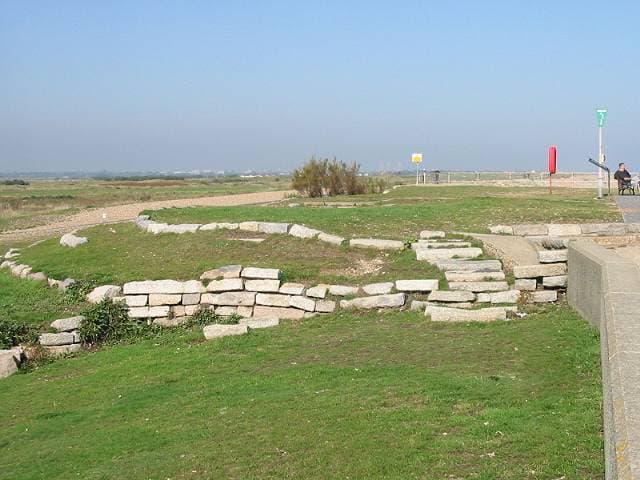
Coastal erosion and natural decay severely affected Sandown Castle over the centuries, particularly on its sea-facing side. Much of the original height of the walls and bastions was lost, leaving a flattened platform where towering fortifications once stood. In the late 1980s, conservation efforts focused on stabilizing the ruins by encasing the remaining masonry within a concrete shell, effectively transforming the site into a sea defence structure to protect against further erosion.
Today, the surviving elements of Sandown Castle include portions of its thick curtain walls, the lower sections of the central keep, and two or more bastions, all set within the outline of the former moat. These remnants provide a rare and tangible example of early Tudor artillery fort design and England's historical coastal defence network. The site is protected as a scheduled monument under UK heritage law, preserving its legacy for future generations.
Architectural innovation in Tudor coastal forts
Sandown Castle exemplifies the transition in military architecture during the early 16th century, as traditional medieval castles evolved to address the challenges posed by gunpowder artillery. Its thick walls, rounded bastions, and embrasured gunports reflect an understanding of artillery's destructive power and the need for fortifications to both mount and withstand heavy cannon fire.
The castle's compact design, with a central keep surrounded by a curtain wall and bastions, was practical for its defensive role while economizing on manpower and resources. The integration of ventilation systems to clear gun smoke highlights the attention to operational detail that characterized Tudor fortifications.
Comparison with deal and walmer castles
Alongside Deal and Walmer Castles, Sandown formed a triad of artillery forts that collectively secured the Downs anchorage. While all three shared common design principles, Sandown's layout was distinctive for its nearly square footprint and the prominent central keep. This contrasts with Deal Castle's concentric design and Walmer Castle's more irregular plan, illustrating the diversity of Tudor coastal fortification strategies adapted to local topography and strategic needs.
Visiting sandown castle today
Although Sandown Castle no longer stands as a complete fortress, its ruins remain a point of historical interest on the Kent coast. Visitors can observe the preserved curtain walls, bastions, and the moat outline, gaining insight into Tudor military engineering and coastal defence history. The concrete encasement, while altering the original fabric, serves to protect the site from further damage, ensuring its survival as a heritage landmark.
The castle's location near the town of Deal also allows visitors to explore other nearby historical sites, including Deal Castle and Walmer Castle, offering a comprehensive understanding of the region's defensive network during the Tudor period and beyond.
Frequently asked questions (FAQ)
- When was Sandown Castle built and for what purpose?
- Sandown Castle was built between 1539 and 1540 during the Tudor period as part of King Henry VIII's Device programme to defend England's southeastern coast against invasion threats from France and the Holy Roman Empire.
- What are the main architectural features of Sandown Castle?
- Sandown Castle features a nearly square layout with a large central keep, thick curtain walls, four circular bastions called lunettes, a surrounding water-filled moat, and embrasures and gunloops designed for artillery and handguns.
- Can visitors see Sandown Castle today?
- Yes, visitors can view the ruins of Sandown Castle, including parts of its curtain walls, bastions, and the moat outline. The remains are encased in concrete to protect them from coastal erosion, preserving the site's historic footprint.
- What role did Sandown Castle play during the English Civil War?
- During the Second English Civil War, Sandown Castle was held by Royalist forces but was besieged and recaptured by Parliamentary troops in 1648, highlighting its continued strategic importance in 17th-century conflicts.
- How has coastal erosion affected Sandown Castle?
- Coastal erosion has significantly damaged Sandown Castle, leading to the loss of much of its original height and fabric. Conservation efforts in the late 20th century included encasing the ruins in concrete to protect against further erosion.
Photo gallery

Information
Current owner
Municipality
Loading map...
Visitor reviews
No reviews yet. Been here? Write the first review and help other travelers!
Write the first reviewVisited this castle? Share your experience
Your review helps other travelers and adds first-hand knowledge to our encyclopedia.