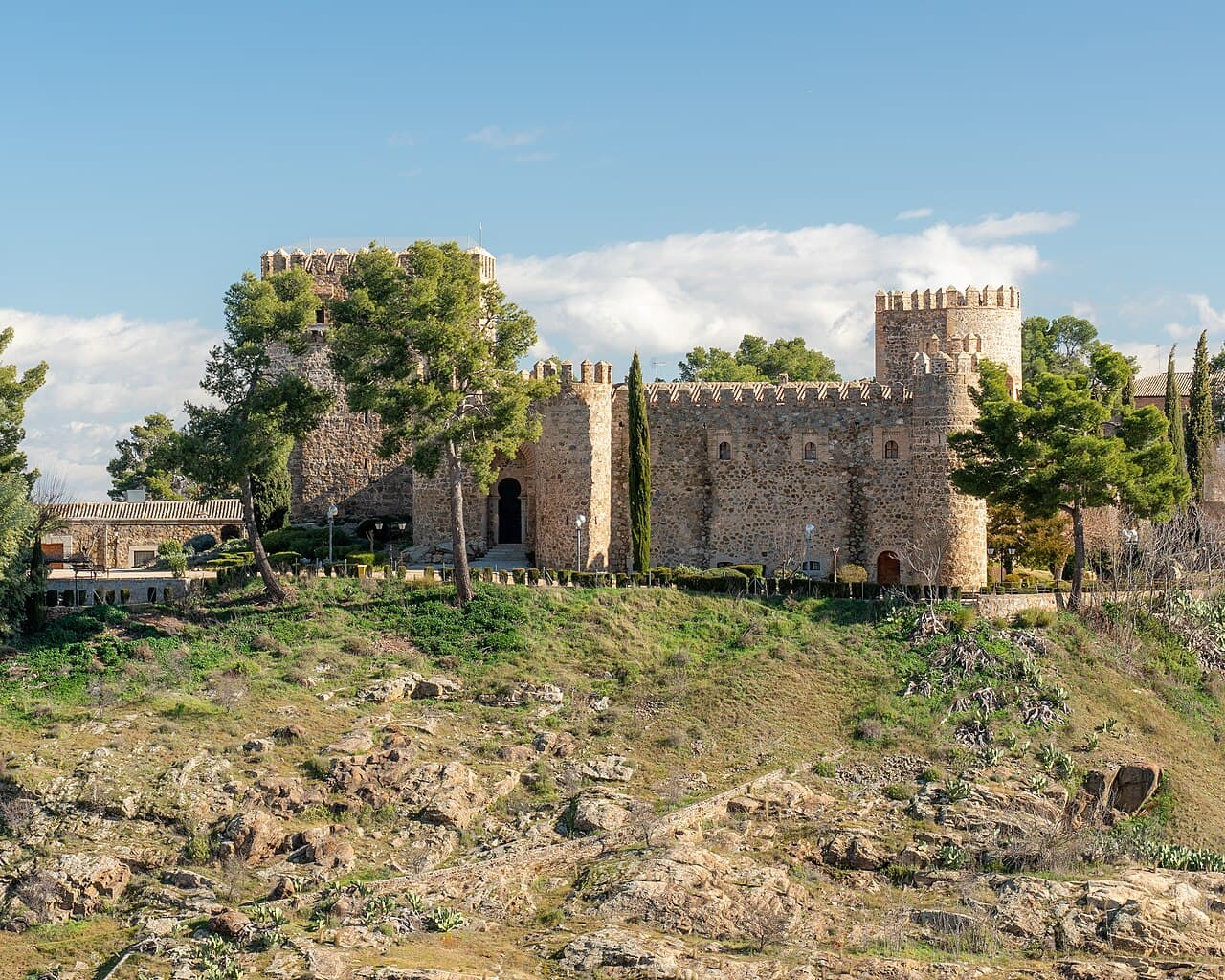
San Servando Castle
San Servando Castle, located on the Cuesta de San Servando hill opposite the historic city of Toledo in Castilla-La Mancha, Spain, is a remarkable example of layered medieval architecture and history. This castle's origins trace back to a 7th-century Visigothic monastery, reflecting the early Christian presence in the Iberian Peninsula before the Muslim conquest.
The site initially housed a Visigothic monastery that was likely founded in the early medieval period. With the Umayyad conquest of Toledo in the early 8th century, the monastery was transformed into an Arab fortress, marking the site's strategic importance overlooking the Tagus River gorge. This early adaptation highlights the castle's long-standing military and religious significance.
The transformation from monastery to fortress
Following the Christian reconquest of Toledo in 1085 by King Alfonso VI of Castile, the structure was rebuilt as a fortified monastery. In 1088, the king donated it to the French Abbey of St. Victor in Marseille, entrusting its administration and religious practices to the Benedictine monks from France. This period saw the introduction of the Rule of St. Benedict and the replacement of the ancient Mozarabic Rite with the Roman Rite, under the guidance of Cardinal Richard of St. Victor, a papal legate.
The monastery enjoyed royal patronage, including donations of surrounding lands and churches, aimed at preserving the Christian identity in a region with a strong Mozarabic tradition. The establishment of a Benedictine nunnery attached to the church further emphasized its religious and social role, including hospitality to the poor and travelers.
Destruction and military reinvention
In 1110, the monastery was destroyed during an Almoravid attack, forcing the monks to return to Marseille. Subsequently, the property came under the control of the Archbishop of Toledo and the cathedral chapter. Later in the 12th century, King Alfonso VIII of Castile granted the site to the Knights Templar, who transformed the ruined monastery into a formidable fortress. Their primary mission was to protect the Puente de Alcántara, a vital bridge over the Tagus River, from potential Muslim incursions.
Architectural features and military significance
San Servando Castle exemplifies the typical early medieval fortress adapted and rebuilt by the Templars. The castle's strategic location on a hill provided commanding views of Toledo and the surrounding landscape, essential for defense and surveillance. The Knights Templar fortified the complex with robust stone walls, towers, and battlements designed to withstand sieges.
The castle's architecture reflects a blend of Visigothic, Islamic, and Christian military styles, illustrating the cultural and political shifts in medieval Spain. The fortifications included a keep, defensive walls, and a courtyard, all arranged to maximize defense while accommodating the needs of the monastic community and the military garrison.
The decline and restoration
With the disappearance of the Muslim threat in the region and the dissolution of the Knights Templar in 1312, San Servando Castle gradually lost its military importance. Over the centuries, it fell into neglect and became a picturesque ruin by the 19th century. The castle's romantic ruin status attracted attention for its historical and cultural value.
In the mid-20th century, specifically the 1950s, restoration efforts were undertaken to preserve and reconstruct the castle, restoring it to a condition that reflects its medieval origins. Today, San Servando Castle is well preserved and repurposed as a youth hostel, allowing visitors to experience its historic ambiance firsthand. Access to the castle is generally limited to guests of the hostel, but its location and history make it a significant cultural landmark in Toledo.
Historical and cultural significance
The castle's long history from a Visigothic monastery through Islamic conquest, Christian reconquest, and Templar fortress encapsulates the complex medieval history of Spain. Its connection to prominent figures such as King Alfonso VI, King Alfonso VIII, and Cardinal Richard of St. Victor underlines its importance in religious and military history.
The castle also features in local legends, including tales of a ghostly knight, Don Nuño Alvear, adding a layer of folklore to its historical narrative. These stories contribute to the castle's allure and its role in Toledo's cultural tourism.
Visiting San Servando Castle today
Visitors to Toledo interested in medieval history and architecture will find San Servando Castle a fascinating site, offering insights into the region's religious, military, and cultural transformations. Although public access is restricted due to its current use as a youth hostel, special tours and events occasionally provide opportunities to explore the castle's interiors and grounds.
The castle's location near the Puente de Alcántara and the Tagus River gorge offers spectacular views and a tangible connection to Toledo's strategic landscape. Its preservation and adaptive reuse ensure that San Servando Castle remains a vital part of Spain's rich heritage.
Frequently asked questions (FAQ)
- What is the historical significance of San Servando Castle?
- San Servando Castle, located in Toledo, Spain, dates back to the 11th century and was originally built as a fortress. It played a crucial role in the Reconquista, serving as a military stronghold against the Moors. Today, it stands as a symbol of the rich history and architectural heritage of Toledo.
- When was San Servando Castle built?
- The construction of San Servando Castle began in the 11th century, around the time of the Christian reconquest of Toledo. Over the centuries, it has undergone various renovations and restorations, reflecting different architectural styles and historical periods. Its enduring presence is a testament to its significance in Spanish history.
- Can I visit San Servando Castle?
- Yes, San Servando Castle is open to visitors, allowing you to explore its historic grounds and enjoy stunning views of Toledo. Guided tours are often available, providing insights into the castle's history and architecture. Be sure to check for any specific visiting requirements or guidelines before your trip.
- What are the opening hours for San Servando Castle?
- San Servando Castle typically opens to visitors from 10:00 AM to 8:00 PM during the summer months, and from 10:00 AM to 6:00 PM in the winter. It's advisable to check the official website or contact local tourism offices for the most current hours, as they may vary seasonally or due to special events.
- Is it possible to access San Servando Castle by public transport?
- Yes, San Servando Castle is accessible by public transport, with several bus routes serving the area. Visitors can take a short walk from the nearest bus stop to reach the castle. Additionally, walking from Toledo's city center offers a scenic route through the historic streets.
- What is the best time to visit San Servando Castle?
- The best time to visit San Servando Castle is during the spring (April to June) and fall (September to October) when the weather is mild and comfortable for exploring. These seasons also tend to be less crowded, allowing for a more enjoyable experience. Summers can be hot, while winters may bring cooler temperatures.
- Are there any nearby attractions to see when visiting San Servando Castle?
- Yes, several attractions are located near San Servando Castle, including the Alcázar of Toledo and the historic Cathedral of Toledo. Visitors can also explore the picturesque streets of the old town, which is rich in history and culture. Combining these sites with a visit to the castle makes for a full day of exploration.
- What are the ticket prices for San Servando Castle?
- As of the latest information, the ticket prices for visiting San Servando Castle are generally very affordable, with discounts often available for students and seniors. Entry fees may vary, so it's recommended to check online or inquire at the ticket office for the most accurate pricing details. Group rates may also be available for larger parties.
Photo gallery

Information
Address
Cuesta de San Servando, Toledo, Spain
Loading map...
Visitor reviews
No reviews yet. Been here? Write the first review and help other travelers!
Write the first reviewVisited this castle? Share your experience
Your review helps other travelers and adds first-hand knowledge to our encyclopedia.