San Sebastián Fortress
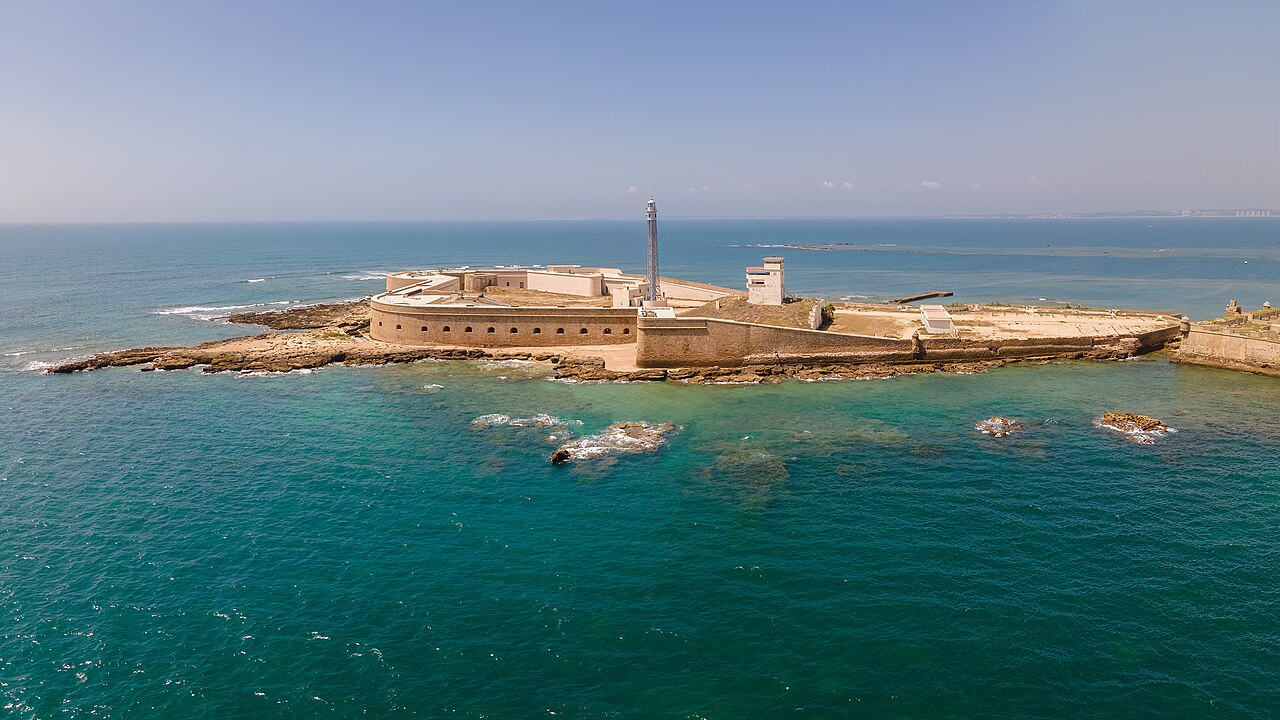
San Sebastián fortress is a significant post-Renaissance military structure located in Cádiz, Spain, perched on a small island at the end of La Caleta beach. This strategic position allowed it to guard the northern flank of the city and control access from the sea. The fortress is an example of early 18th-century coastal defense architecture, reflecting the military engineering advances of its time.
Historical background and site significance
The site of San Sebastián fortress has a long history predating the current structure. According to classical tradition, the island was once home to a Temple of Kronos, honoring the Titan from Greek mythology, father to the Olympian gods. This ancient association underscores the cultural significance of the location through various historical periods.
In 1457, a chapel was built on the island by a Venetian boat crew who had survived the plague, marking the site's continued importance as a place of refuge and spiritual significance.
Construction and architectural features
The current fortress was constructed in 1706, during the post-Renaissance period, resulting in a fortified enclosure with an irregular plan adapted to the island's topography. The design reflects the military engineering principles of the early 18th century, focusing on maximizing defensive capabilities against naval threats.
The fortress includes thick stone walls and bastions that allowed defenders to cover multiple angles of approach. Its position on the island enabled control over the northern maritime approaches to Cádiz, a vital port city.
At the base of the fortress's lighthouse stands a watchtower from the Muslim period, indicating the site's long-standing strategic importance through different ruling cultures.
San Sebastián lighthouse
The lighthouse itself is a notable feature of the fortress complex. It has an iron structure designed by Rafael de la Cerda in 1908 and is recognized as the second electric-powered lighthouse in Spain. The tower rises to 41 meters above sea level, serving both as a navigational aid and a symbol of the fortress's enduring maritime role.
Historical events and notable figures
In 1811, the fortress played a role in international military history when the Maltese navy arrived with Juan Bautista Azopardo, a notable prisoner of war and rebel leader associated with the Buenos Aires Junta. Azopardo was detained at San Sebastián until 1815, when concerns about a security breach led to his transfer to a military prison in Ceuta.
Later developments and preservation
In 1860, a levee was constructed to connect the island more directly to the city of Cádiz, improving access and integrating the fortress more closely with urban infrastructure.
On June 25, 1985, the Castillo de San Sebastián was officially declared a cultural landmark, recognizing its historical and architectural value and ensuring its protection and conservation for future generations.
Architectural and cultural significance
San Sebastián fortress exemplifies the evolution of coastal defense architecture in Spain, combining elements from various historical periods, including the Muslim watchtower and the post-Renaissance fortifications. Its location and design illustrate the strategic military thinking of the 18th century, adapted to the unique geography of Cádiz.
The integration of the early 20th-century lighthouse adds an industrial heritage layer to the site, linking traditional military architecture with modern navigational technology.
Visiting San Sebastián fortress
Today, the fortress is accessible to visitors who can explore its historic walls, bastions, and lighthouse. The site offers panoramic views of Cádiz and the surrounding sea, providing insight into the city's maritime defenses and historical significance.
The cultural landmark status ensures that the fortress is maintained and preserved, allowing visitors to appreciate both its architectural features and its role in Spanish history.
Frequently asked questions (FAQ)
- How do I get to San Sebastián fortress in Cádiz?
- San Sebastián fortress is located on a small island at the end of La Caleta beach in Cádiz. Visitors can reach it via the levee built in 1860 that connects the island to the city, allowing easy pedestrian access.
- What is the historical significance of San Sebastián fortress?
- The fortress was built in 1706 to defend the northern flank of Cádiz from naval attacks. It also incorporates a Muslim-period watchtower and has served various military and strategic roles throughout its history.
- Can I visit the lighthouse at San Sebastián fortress?
- Yes, the lighthouse is part of the fortress complex. It features an iron structure designed in 1908 and is the second electric-powered lighthouse in Spain, making it an interesting site for visitors.
- When was San Sebastián fortress declared a cultural landmark?
- San Sebastián fortress was declared a cultural landmark on June 25, 1985, ensuring its protection and preservation as a historic site.
- Is the fortress well preserved?
- Yes, the fortress is well preserved and maintained, allowing visitors to explore its walls, bastions, and other architectural features safely.
Information
Loading map...
Visitor reviews
No reviews yet. Been here? Write the first review and help other travelers!
Write the first reviewVisited this castle? Share your experience
Your review helps other travelers and adds first-hand knowledge to our encyclopedia.