Castle of San Sebastián, Cádiz
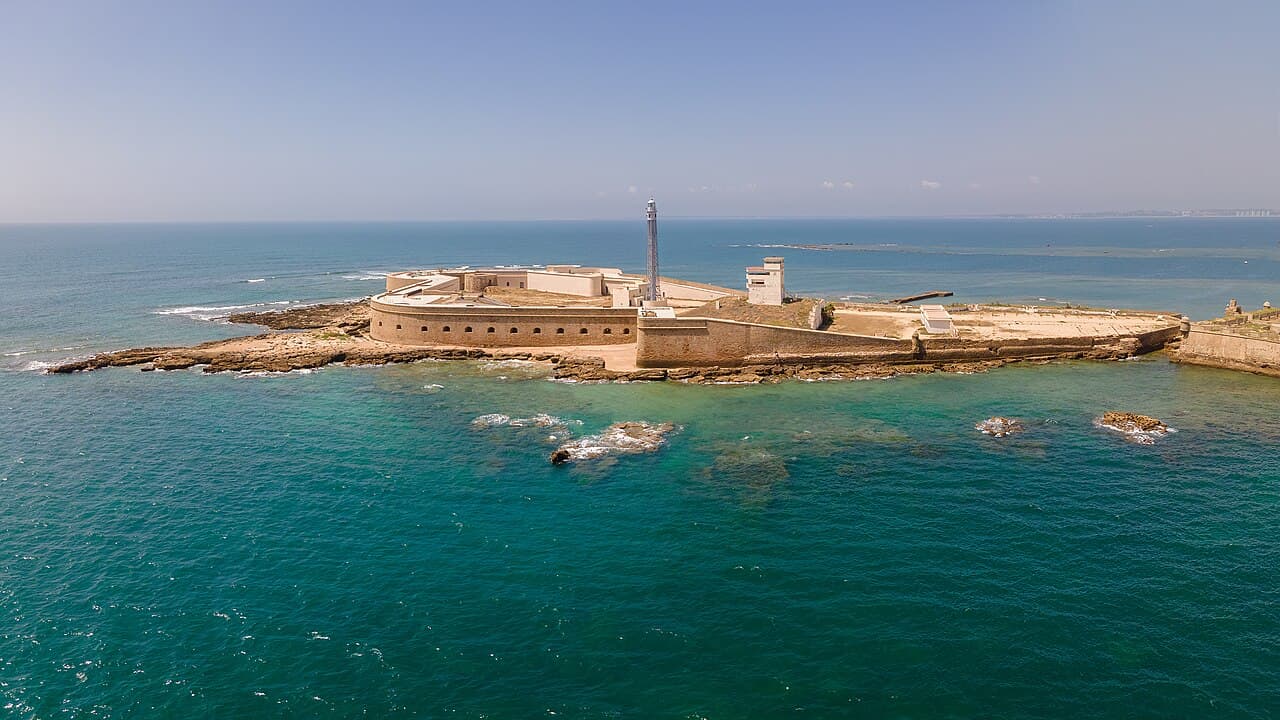
The Castle of San Sebastián is a remarkable fortress located on a small islet at one end of La Caleta beach in the historic city of Cádiz, Spain. This coastal fortress holds a unique position both geographically and historically, serving as a key defensive structure protecting the northern flank of Cádiz from maritime threats. The castle's strategic location on an islet rising approximately three meters above sea level allowed it to control access to the city and the surrounding waters of the Atlantic Ocean.
Historically, the site of the castle is steeped in layers of cultural and religious significance. Traditional accounts associate the location with an ancient temple dedicated to deities such as Moloch or Kronos, figures linked in classical mythology to the pantheon of gods including Hades, Zeus, Poseidon, Hestia, Demeter, Hera, and Cronos. This suggests that long before the fortress was constructed, the islet served as a sacred place, highlighting its importance in the spiritual and mythological landscape of the region.
Early religious significance and chapel construction
In the mid-15th century, specifically in 1457, the site gained renewed religious importance when Venetian sailors recovering from the plague built a chapel on the islet. This chapel symbolized a moment of spiritual renewal and gratitude, marking the beginning of the islet's transformation from a religious site to a fortified position. The chapel's presence underscored the continuing sacred association of the location even as the city of Cádiz developed as a strategic maritime hub.
Construction and military role
The current fortress structure began construction in 1706, during a period when Cádiz was emerging as a vital port city with increasing military and commercial significance. The castle was designed as an irregular fortified enclosure to adapt to the natural contours of the islet and to maximize defensive capabilities against seaborne attacks. Its walls and bastions were constructed to protect the northern approaches to Cádiz, a critical defense against naval incursions.
Architecturally, the castle reflects the military engineering principles of the early 18th century, emphasizing robust coastal fortifications that could withstand artillery bombardment. The irregular plan of the fortress allowed for overlapping fields of fire and improved surveillance of the surrounding waters. Its position on the islet made it a formidable obstacle to any enemy fleet attempting to approach Cádiz from the sea.
19th-century prison use and causeway connection
During the early 19th century, the castle's role expanded beyond military defense. Between 1811 and 1817, it served as a prison, housing notable detainees such as Juan Bautista Azopardo and leaders involved in the 1811 uprising in Granada, Nicaragua. This penal use reflects the fortress's continued strategic importance in regional military and political conflicts during a turbulent period in Spanish and colonial history.
In 1860, a significant infrastructure development connected the castle to Cádiz's urban area via a causeway (malecón). This construction improved accessibility, facilitating the movement of personnel and materials between the city and the fortress. The causeway effectively integrated the castle into the city's fabric, enhancing its functional relevance beyond a mere isolated outpost.
The lighthouse and architectural continuity
One of the most distinctive features of the Castle of San Sebastián is its iron lighthouse, constructed in 1908 atop the base of a former Muslim watchtower (torre-atalaya). Designed by the architect Rafael de la Cerda, the lighthouse stands 41 meters above sea level and is notable for being Spain's second electric lighthouse as well as the only one made entirely of iron. This lighthouse symbolizes the continuity of defensive and navigational functions at the site, bridging medieval military architecture with modern technological advancements.
The reuse of the Muslim watchtower's base demonstrates the long-standing strategic importance of the islet. The tower originally served as an observation post during the period of Muslim rule, and its incorporation into the castle's structure highlights the layering of historical periods and architectural styles at the site.
Modern significance and conservation
The Castle of San Sebastián was officially declared a Bien de Interés Cultural (Cultural Heritage Site) on June 25, 1985, recognizing its historical, architectural, and cultural value. In recent years, the fortress has been adaptively reused to support scientific research. Since 2015, it has housed the Marine Research Laboratory affiliated with the University of Cádiz, reflecting a modern commitment to preserving the site while giving it new functional relevance.
The castle has also played a role in popular culture, serving as a filming location for notable movies such as the Spanish film "Alatriste" (2005) and the James Bond film "Die Another Day". These appearances underscore the site's enduring visual and cultural appeal.
Architectural features and layout
The fortress occupies a small islet with an irregular plan shaped by fortified walls designed to protect Cádiz's northern sector. The walls follow the natural contours of the islet, demonstrating a thoughtful integration of military architecture with the landscape. The defensive structures include bastions and curtain walls typical of coastal fortifications built in the early 18th century.
The castle's causeway provides the only land access, linking the islet to Cádiz's urban core. This feature has been crucial in maintaining the fortress's relevance and accessibility over the centuries. The combination of the castle's walls, the historic watchtower base, and the iron lighthouse creates a unique architectural ensemble that spans multiple historical epochs.
Restoration and preservation efforts
The castle and lighthouse have been well preserved, with significant restoration work undertaken in 2017. These efforts focused on maintaining the lighthouse's structural integrity and preserving the fortress's historical fabric. The balance between conservation and adaptive reuse exemplifies modern heritage management practices, ensuring the site remains a vibrant part of Cádiz's cultural landscape.
Scientific and educational use
Today, the presence of the Marine Research Laboratory within the castle grounds highlights the site's transformation from a military fortress to a center for scientific inquiry. This adaptive reuse respects the castle's historical significance while contributing to contemporary knowledge and research related to marine biology and oceanography.
Frequently asked questions (FAQ)
- How do I access the Castle of San Sebastián?
- Access to the Castle of San Sebastián is via a causeway built in 1860 that connects the islet directly to Cádiz's urban area, allowing easy pedestrian access.
- What is the historical significance of the castle?
- The Castle of San Sebastián has served multiple roles including a religious site, coastal fortress, prison, and now a marine research center, reflecting Cádiz's strategic maritime importance.
- When was the iron lighthouse constructed and what makes it unique?
- The iron lighthouse was constructed in 1908 atop a former Muslim watchtower base and is unique as Spain's only iron lighthouse and its second electric lighthouse.
- Can I visit the Marine Research Laboratory inside the castle?
- The Marine Research Laboratory operates within the castle, but public access may be limited. Visitors should check with the University of Cádiz for any guided tours or public events.
- Why was the castle declared a Cultural Heritage Site?
- The castle was declared a Bien de Interés Cultural in 1985 due to its historical, architectural, and cultural significance as a coastal fortress with layered historical uses.
Photo gallery

Information
Sources & official resources
Verify the information above using these authoritative references.
Loading map...
Visitor reviews
No reviews yet. Been here? Write the first review and help other travelers!
Write the first reviewVisited this castle? Share your experience
Your review helps other travelers and adds first-hand knowledge to our encyclopedia.