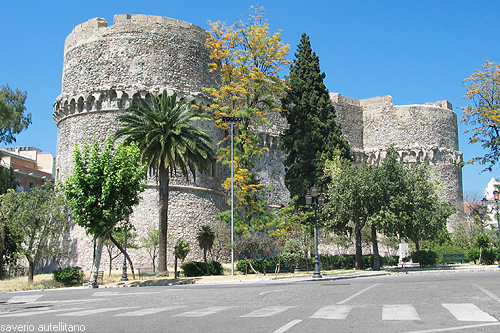
San Niceto Castle
San Niceto Castle, also known as the Castle of Sant'Aniceto, stands as a remarkable example of Norman military architecture built in the early 11th century atop a prominent hill in Motta San Giovanni, Calabria, Italy. This fortress is one of the rare surviving High Medieval structures in the region and uniquely embodies the fusion of Byzantine and Norman defensive styles, reflecting the complex history of southern Italy during the Middle Ages.
The castle's name honors Saint Nicetas, a Byzantine admiral from the 7th to 8th centuries, highlighting the site's deep connections to Byzantine heritage. Originally constructed as a Byzantine kastron or fortified settlement, its primary purpose was to safeguard the valuable local silk industry and provide refuge for the inhabitants of nearby Reggio Calabria against frequent raids, particularly from Saracen forces. The castle's strategic location on a rocky hilltop allowed it to dominate the surrounding landscape, overseeing both the sea and the inland routes.
Historical context and development
The castle was initially built by the Byzantine Empire in the early 11th century, a period marked by ongoing conflict and territorial shifts in southern Italy. Following the Norman conquest around 1060, the fortress was adapted and reinforced to meet the demands of Norman military architecture, which emphasized strong defensive features such as thick walls and fortified towers. The castle thus represents a significant transitional monument bridging Byzantine and Norman influences.
During the 13th century, San Niceto Castle rose in prominence as the administrative center of the feudal domain of Santo Niceto, which included the territories of Motta San Giovanni and Montebello. This period was characterized by political turbulence as the castle became a contested site amid the struggles between the Angevin and Aragonese dynasties for control over southern Italy. In 1321, the castle came firmly under Angevin control, marking a new chapter in its history.
Architectural features and layout
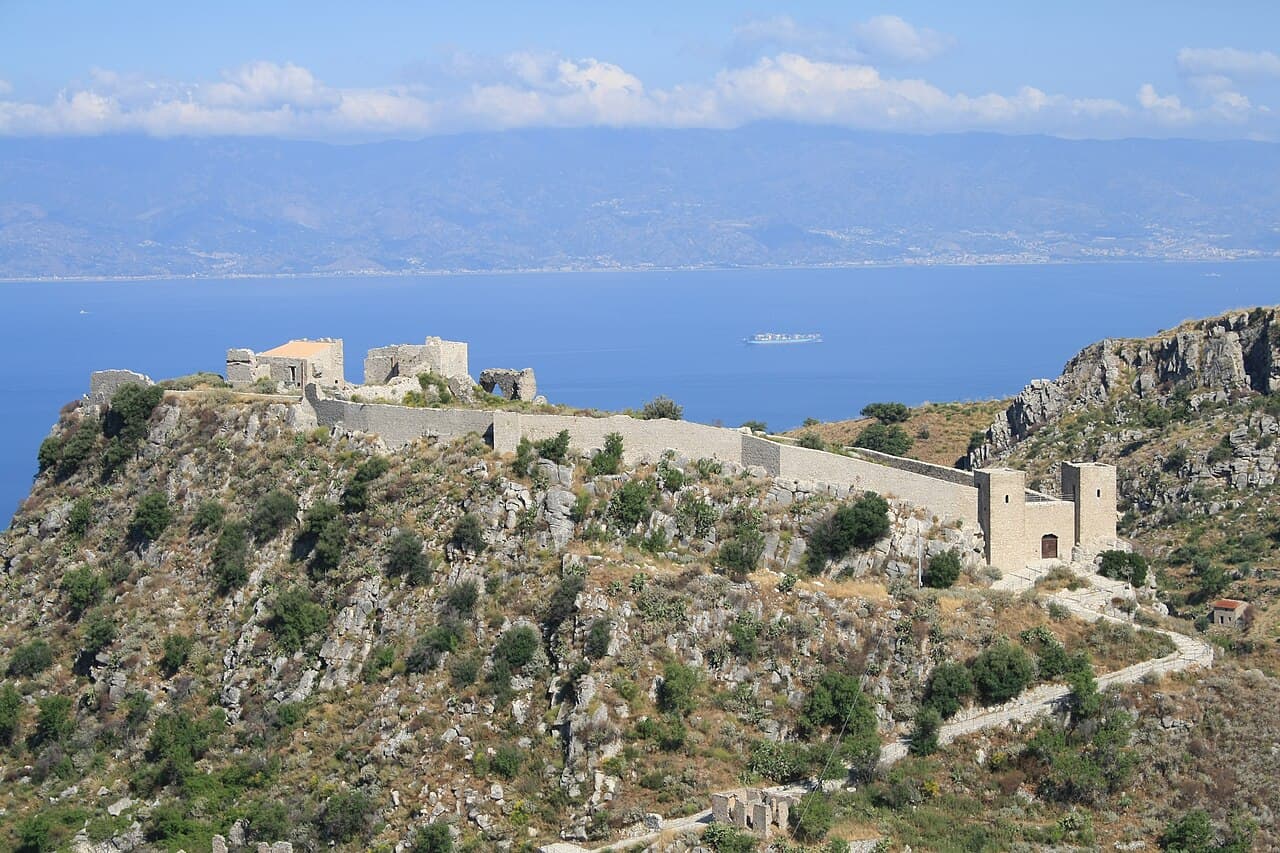
The castle's layout is distinctive and irregular, often described as resembling the shape of a ship, with the bow oriented towards the mountains and the stern facing the sea. This unique design not only reflects the topography of the hill but also strategic considerations for defense and surveillance. The castle walls are constructed from squared stone blocks and bricks bonded with a robust mortar, standing between 3 to 3.5 meters high and approximately one meter thick, demonstrating the fortress's formidable defensive capabilities.
At the entrance, two imposing square towers flank the gateway, a feature likely enhanced during the Norman period to strengthen the castle's defenses against increasingly sophisticated siege tactics. These towers provided vantage points for archers and guards to monitor and repel attackers.
Below the castle, at the base of the steep path leading down to the plain, lies a small chapel notable for its frescoed dome depicting the Christ Pantokrator, a quintessential motif in Byzantine religious art symbolizing Christ's divine authority. This chapel is a rare surviving element of the Byzantine cultural and religious influence in the region, adding significant historical and artistic value to the site.
The castle’s role in regional conflicts and decline
By the 15th century, San Niceto Castle had become a significant barony overseeing several nearby settlements, including Motta San Giovanni, Montebello, and Paterriti. However, its strategic importance also made it a target during the regional power struggles that marked this period. In 1459, the castle was seized and destroyed by forces from Reggio Calabria under the command of Duke Alfonso of Calabria.
The capture of the castle was achieved through cunning military tactics: attackers used a herd of goats with torches tied to their horns to distract the defenders, allowing them to breach the walls and take control. This event marked the end of the castle's active military use, and it subsequently fell into ruin and abandonment for several centuries.
Preservation and cultural significance
Despite its destruction, the castle's robust construction has allowed much of its walls and towers to survive in a well-preserved state. The site today offers valuable insights into the Byzantine and Norman military architecture of southern Italy. Recent restoration efforts have focused on stabilizing the ruins and highlighting the castle's historical significance, making it an important cultural landmark in Calabria.
San Niceto Castle remains a testament to the region's complex history of conquest, cultural exchange, and resilience. Its blend of Byzantine artistic elements and Norman fortification techniques provides a unique window into the medieval period of Calabria. Visitors to the castle can appreciate its commanding views, architectural ingenuity, and the layers of history embedded in its stones.
Visiting San Niceto Castle
The castle is accessible via a steep path from the surrounding plain, offering an engaging experience for visitors interested in medieval history and architecture. The nearby chapel with its Byzantine frescoes is a highlight for those interested in religious art. The site’s elevated position provides panoramic views of the surrounding landscape, including the Ionian Sea and the city of Reggio Calabria.
Visitors are encouraged to explore the castle's irregular layout and imagine its historical role as a fortress and refuge. The preservation of the walls and towers allows for a tangible connection to the past, making San Niceto Castle a significant destination for cultural tourism in Calabria.
Frequently asked questions (FAQ)
- How do I get to San Niceto Castle?
- San Niceto Castle is located on a hill above Motta San Giovanni in Calabria, Italy. Visitors can reach it by car or local transport to Motta San Giovanni, followed by a short hike up a steep path to the castle entrance.
- What is the historical significance of San Niceto Castle?
- San Niceto Castle is a rare example of Byzantine and Norman military architecture in Calabria. It served as a defensive fortress and administrative center from the 11th to 15th centuries, reflecting the region's turbulent medieval history.
- Can I visit the chapel with the frescoed dome?
- Yes, the small chapel at the base of the castle's path features a frescoed dome depicting Christ Pantokrator. It is accessible to visitors and is a highlight of the site, showcasing Byzantine religious art.
- When is the best time to visit San Niceto Castle?
- The best time to visit is during spring and autumn when the weather is mild. Summers can be hot, and winters may be rainy, so planning visits during pleasant weather enhances the experience.
- Are there guided tours available at San Niceto Castle?
- Guided tours may be available through the local municipality or tourist offices in Motta San Giovanni. It is recommended to check in advance for availability and schedules.
Photo gallery

Information
Current owner
Municipality
Loading map...
Visitor reviews
No reviews yet. Been here? Write the first review and help other travelers!
Write the first reviewVisited this castle? Share your experience
Your review helps other travelers and adds first-hand knowledge to our encyclopedia.