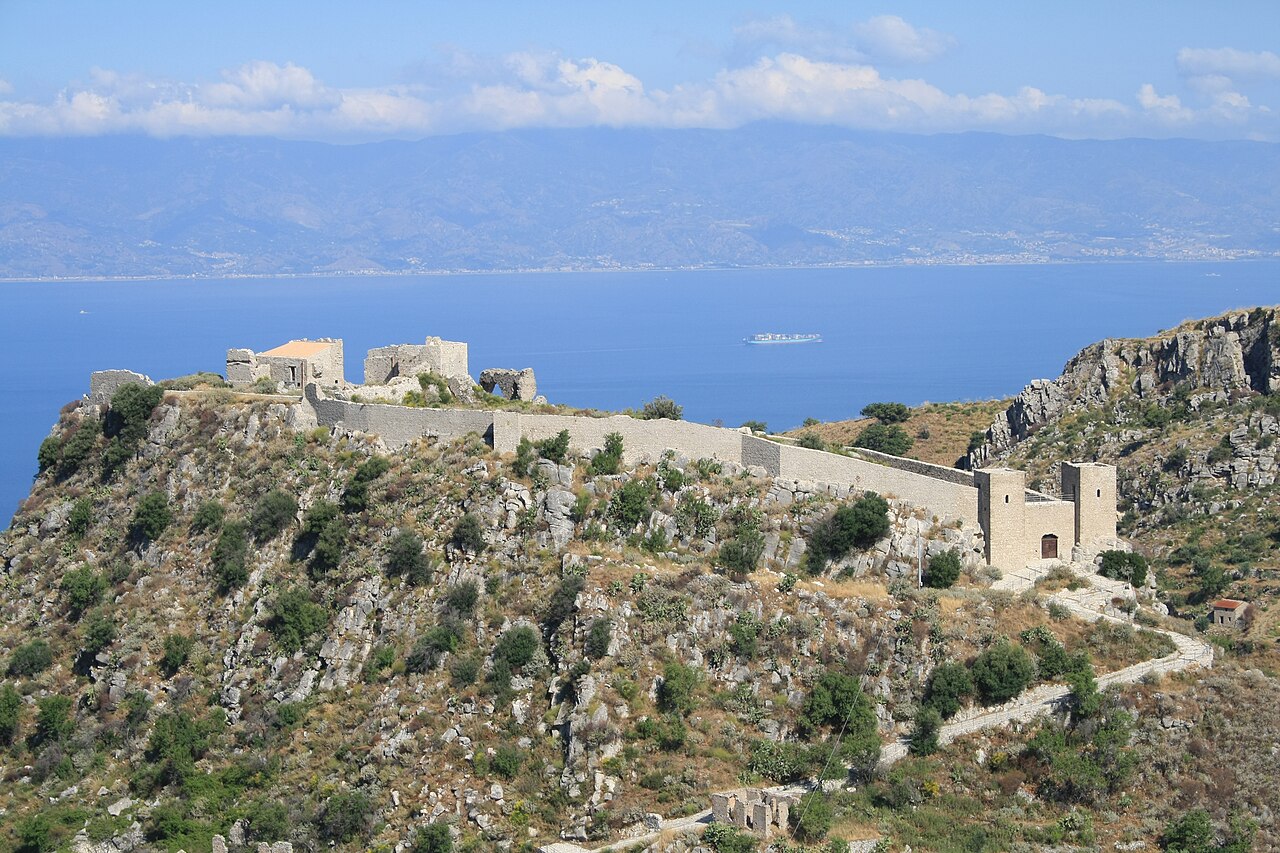
Amendolea Castle
Castello Ruffo di Amendolea stands as a remarkable example of a Norman hill castle in Calabria, southern Italy, with origins tracing back to the 11th century. This fortress reflects a layered history of construction, destruction, and adaptation spanning the High Medieval period through to the early modern era. Strategically perched overlooking the valley of the Fiumara Amendolea, the castle historically controlled a vital passage between ancient city-states, making it a critical military and administrative center.
Norman foundation and medieval development
The castle was originally established by the Normans, with documented founding attributed to Riccardo di Amendolea, a Norman lord active in the region during the 11th century. The fortress's initial construction utilized typical Norman defensive techniques, including strong stone walls and a chapel tower, which remains one of the castle's most distinctive features. The tower contains a small apsidal church on its second level, with an entrance facing south, in accordance with Byzantine architectural tradition, reflecting the cultural influences in Calabria at the time.
Throughout the late Middle Ages, the castle underwent several enlargements and reconstructions. Its layout is irregular, with a combination of defensive walls, residential quarters, and religious buildings. The castle's plan includes a parallel-piped entrance section separated by a defensive wall from the residential area, and a large rectangular hall characterized by very high walls, arched windows, and small towers. One isolated tower served as a dungeon, emphasizing the fortress's role in both defense and incarceration.
Imperial intervention and feudal conflicts
In the 13th century, the castle was impacted by Emperor Frederick II's order in 1230 to demolish fortifications across the region. Evidence of this destruction is visible in the hammered masonry of the castle walls, indicating partial demolition during this imperial campaign. After this period, the fortress was rebuilt and became a focal point of regional power struggles, frequently contested by local noble families.
The Amendolea family, from whom the nearby village takes its name, initially controlled the castle. However, by 1624, the Ruffo family had gained possession of the fief and maintained control until the abolition of feudalism in 1806. The Ruffos governed the domain through appointed bailiffs, including notable figures such as A. Rebuffo, F. Polisteno, and G. Sangallo, who ruled with armed support from Albanian mercenaries and occasionally Saracen auxiliaries. This military backing helped maintain their dominance in the turbulent political landscape of southern Italy during the 17th century.
Architectural features and materials
The castle's construction demonstrates a sophisticated use of local materials. Notably, builders employed a mixture of boiled sulfur and iron extracted from rocks beneath the site, which hardened over time to enhance the structure's stability. This unusual building technique contributed to the fortress's resilience, although it was not immune to damage from significant earthquakes in 1783 and 1908. These seismic events caused substantial cracking and collapses, from which the castle never fully recovered.
Access to the castle is via a long staircase ascending from a nearby asphalt road, emphasizing its elevated and defensible position. Upon entry, visitors encounter a large chamber that served as a cistern for collecting and storing drinking water—an essential feature given the difficulty in accessing water despite the proximity of the Fiumara Amendolea river.
The central area once housed a large hall, now overgrown with grass and scattered stones. The eastern wall retains three large windows flanked by niches that housed sentinels, who provided early warning of approaching threats. Surrounding the main hall are multiple defensive towers, including one with a first-floor entrance accessible by a drawbridge, a classic medieval defensive element designed to impede attackers.
Religious and community life within the castle
South of the castle's core lie the remains of residential buildings and the principal church, known as the protopapal or archpriest church. This religious center served the castle's community, which at its height numbered around three hundred inhabitants. Archaeological excavations within the church uncovered a bas-relief and a Madonna statue attributed to the renowned Sicilian sculptor Antonello Gagini. The statue originally lost its head, which was replaced with a left-facing one; the original right-facing head was later recovered and is now preserved in the newer church of Amendolea dedicated to the Annunciation.
The chapel tower, a hallmark of the castle's Norman heritage, remains a significant architectural and historical feature. Its apsidal church and southern entrance highlight the blend of Norman military architecture with Byzantine ecclesiastical influences, underscoring Calabria's unique cultural crossroads.
Present condition and visitor experience
Today, Castello Ruffo di Amendolea survives as a partially preserved ruin. Visitors can explore the remaining perimeter walls, defensive towers, and the chapel tower, gaining insight into the castle's military and religious functions. The site offers a tangible connection to the region's turbulent medieval history and the complex interplay of cultural influences that shaped its architecture.
The castle's elevated position provides panoramic views of the surrounding valley and the Fiumara Amendolea river, enhancing its historical role as a lookout and defensive stronghold. While the fortress suffered irreparable damage from the 1783 earthquake, its ruins remain a testament to the resilience and strategic importance of this Norman-founded castle in Calabria.
Accessibility to the site involves ascending a staircase from the nearby road, and visitors should be prepared for uneven terrain typical of hill castles. The castle's rich history, combined with its architectural features and scenic location, make it a compelling destination for those interested in medieval fortifications and southern Italian heritage.
Frequently asked questions (FAQ)
- How do I get to Castello Ruffo di Amendolea?
- Castello Ruffo di Amendolea is located in Condofuri, Calabria. Visitors can reach the site by car and then ascend a staircase from the nearby asphalt road to the castle entrance.
- What is the historical significance of Amendolea Castle?
- Amendolea Castle was founded by the Normans in the 11th century and played a crucial role in controlling the valley of the Fiumara Amendolea, marking a boundary between ancient city-states and serving as a feudal stronghold.
- Can I visit the chapel tower at Amendolea Castle?
- Yes, the chapel tower is one of the most distinctive features of the castle and can be explored as part of the ruins. It contains a small apsidal church reflecting Byzantine architectural tradition.
- When was the castle last rebuilt or repaired?
- The castle was rebuilt multiple times throughout its history, but significant damage from the 1783 earthquake caused collapses that were never fully repaired.
- Is Amendolea Castle accessible for visitors with mobility issues?
- Due to its hilltop location and the need to climb a staircase from the road, access to Amendolea Castle may be challenging for visitors with mobility issues.
Information
Loading map...
Visitor reviews
No reviews yet. Been here? Write the first review and help other travelers!
Write the first reviewVisited this castle? Share your experience
Your review helps other travelers and adds first-hand knowledge to our encyclopedia.