San Lorenzo del Puntal Fortress
San Lorenzo del Puntal fortress is a prominent Renaissance military structure located in Cádiz, Spain, constructed initially in 1587 to protect the strategic access to the inner bay of Cádiz. This fortress exemplifies the evolution of coastal defense architecture during the late 16th and early 17th centuries, reflecting Spain's efforts to secure its vital naval facilities against foreign incursions.
Early history and strategic importance
The origins of the Castillo de San Lorenzo de Puntales trace back to 1554 when the Spanish military engineer Juan Bautista Calvi proposed fortifying the vulnerable Puntal area, a narrow strip of land critical for controlling landward approaches to Cádiz's harbor. By 1587, a modest artillery tower was erected, equipped with five cannons, marking the beginning of the fortress's role in the defense system of Cádiz.
The fortress's strategic significance was underscored during the 1596 Anglo-Dutch assault on Cádiz, led by the Earl of Essex. Despite its initial fortifications, the castle was overrun and destroyed in this raid, highlighting the need for more robust defenses.
Reconstruction and architectural advancements
Following the destruction, King Philip II initiated a comprehensive fortification program for Cádiz starting in 1598. The current form of the castle began under the direction of the skilled engineer Cristóbal de Rojas, who also worked on the nearby Castillo de Santa Catalina. His designs incorporated Renaissance military architectural principles, emphasizing angular bastions and improved artillery placements.
The reconstruction was continued by Alonso de Vandelvira, who introduced innovative use of concrete to enhance the fortress's resistance to cannon fire, marking a significant development over traditional stone masonry. This use of concrete was pioneering for the time and contributed to the castle's durability.
In the early 18th century, further enhancements were made under the guidance of the Marquis of Verboon, who reinforced the landward defenses and added an artillery battery to control maritime approaches more effectively.
Architectural features and layout
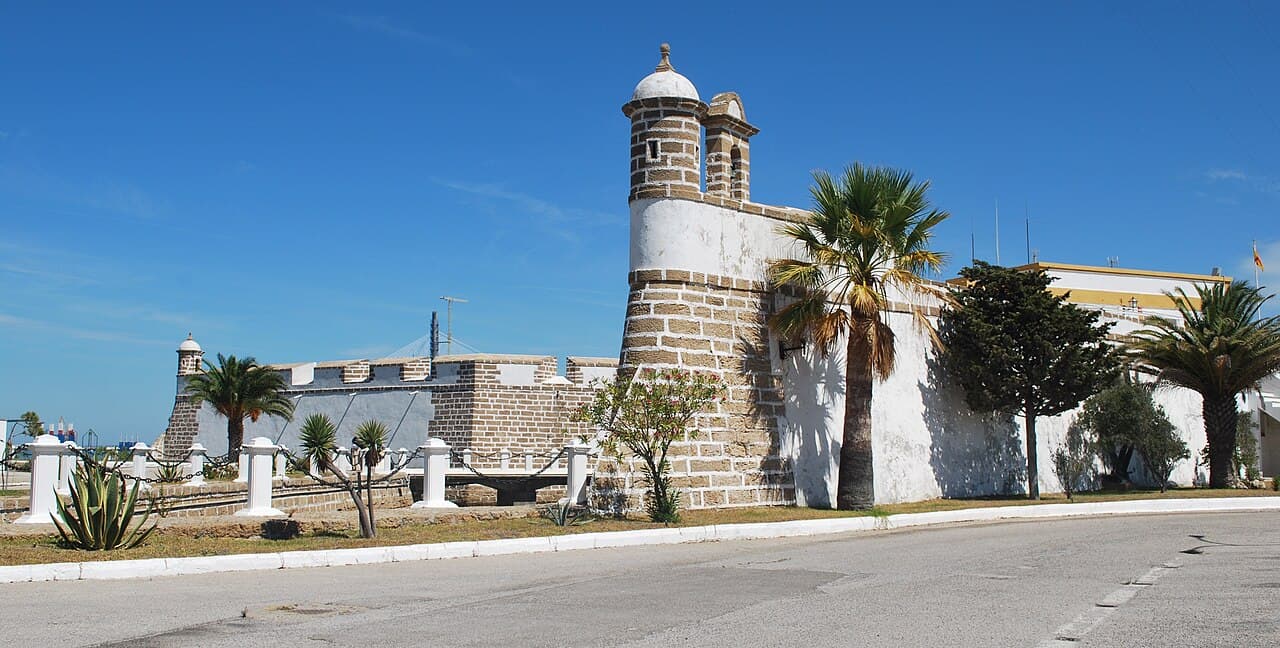
The fortress features an oval layout with two semi-bastions having angled flanks, designed to maximize defensive coverage and reduce blind spots. It is surrounded by water-filled moats and imposing curtain walls, with access controlled by a drawbridge that could isolate the castle from attackers.
Facing the bay, the Barleta battery was a crucial artillery position originally mounting up to fourteen cannons and several mortars. This battery worked in coordination with the Castillo de Matagorda across the bay to guard the entrance to the inner harbor and the naval arsenal at Carraca.
Inside the fortress, functional buildings supported the garrison's needs, including powder magazines, storage rooms, barracks, a chapel, a guardhouse, workshops, and kitchens. These structures were utilitarian, emphasizing practicality over decoration.
Later history and preservation
The fortress suffered damage during the Peninsular War in the early 19th century but was rebuilt in 1863, which shaped much of its current appearance. Since then, it has remained largely intact, preserving its 19th-century restored form.
Today, San Lorenzo del Puntal fortress is owned by the Spanish Ministry of Defense and continues to serve as a naval facility, limiting public access. Despite modern intrusions such as the high-voltage electricity towers installed in the mid-20th century, the castle retains its historical character and military significance.
Recognized for its cultural value, the fortress has been protected under Spanish heritage laws and was declared a culturally significant site by the Junta de Andalucía in 1993.
Significance in military architecture
The castle represents an important example of Renaissance military engineering in Spain, showcasing the transition from medieval fortifications to modern bastioned forts designed to withstand artillery warfare. The innovative use of concrete and the strategic design of bastions and artillery batteries reflect changing military tactics and technology in the late 16th and early 17th centuries.
Its coordinated defense with other fortifications around Cádiz harbor illustrates the integrated approach to coastal defense during Spain's imperial period, emphasizing control over key maritime routes and naval assets.
Frequently asked questions (FAQ)
- What is the historical significance of San Lorenzo del Puntal Fortress?
- San Lorenzo del Puntal Fortress, built in the 18th century, played a crucial role in the coastal defense of Cádiz against naval attacks. Its strategic location allowed it to monitor and protect the entrance to the bay, making it an essential part of the city's military history.
- When was San Lorenzo del Puntal Fortress constructed?
- The fortress was constructed between 1741 and 1748, during a period when Spain was focusing on strengthening its coastal defenses. The design reflects the military architecture of the time, emphasizing functionality and protection.
- Is it possible to visit San Lorenzo del Puntal Fortress?
- Yes, visitors can explore the fortress, which offers guided tours that delve into its rich history and architectural features. It's advisable to check the official website for the latest visiting guidelines and availability.
- What are the opening hours for San Lorenzo del Puntal Fortress?
- The fortress is typically open to visitors from 10 AM to 6 PM, but hours may vary seasonally or due to special events. It's recommended to verify the current hours before planning your visit.
- Can I access San Lorenzo del Puntal Fortress by public transportation?
- Yes, public transportation options are available to reach San Lorenzo del Puntal Fortress. Buses frequently run from central Cádiz to nearby locations, making it convenient for visitors to access this historical site.
- What is the best time to visit San Lorenzo del Puntal Fortress?
- The best time to visit is during the spring and fall months when the weather is mild and pleasant for outdoor exploration. Summer can be hot, while winter may have occasional rain, so plan accordingly for your visit.
- Are there any nearby attractions to visit while at San Lorenzo del Puntal Fortress?
- Yes, nearby attractions include the beautiful beaches of Cádiz and the historic city center, which is rich in culture and architecture. Visitors can also explore other fortifications and museums in the area to enhance their historical experience.
- What are the ticket prices for visiting San Lorenzo del Puntal Fortress?
- Ticket prices for San Lorenzo del Puntal Fortress are generally affordable, with discounts available for students and seniors. It's advisable to check the fortress's official website for the latest pricing information and any special offers.
Photo gallery

Information
Website
Visit websiteSources & official resources
Verify the information above using these authoritative references.
Loading map...
Visitor reviews
No reviews yet. Been here? Write the first review and help other travelers!
Write the first reviewVisited this castle? Share your experience
Your review helps other travelers and adds first-hand knowledge to our encyclopedia.