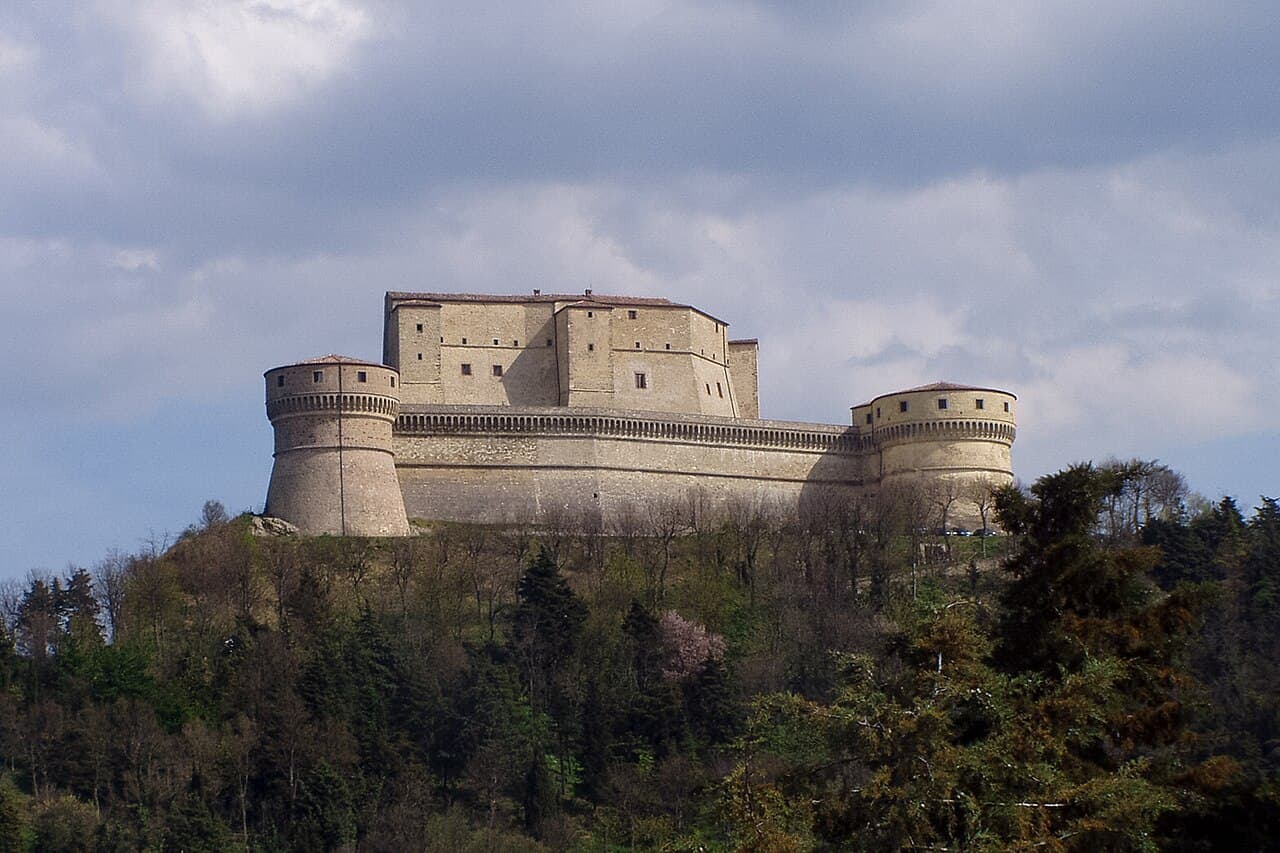
San Leo Fortress
San Leo Fortress stands majestically atop a rocky summit overlooking the town of San Leo in Italy, commanding sweeping views of the surrounding Valmarecchia valley. This hill castle is a remarkable example of military architecture that evolved from Roman times through the medieval and Renaissance periods. Its strategic position made it a coveted stronghold for centuries, shaping the political and military history of the region.
Early history and strategic importance
The origins of San Leo Fortress trace back to a fortified site established during Roman times. Its location atop a nearly vertical rocky slope provided natural defenses that were enhanced over the centuries. The fortress's commanding vantage point allowed control over the Valmarecchia valley, a vital corridor in northern Italy.
Throughout the early Middle Ages, the fortress was a contested prize among various powers, including the Byzantines, Goths, Franks, and Lombards. One of the most notable events was the siege by Otto I the Great from 961 to 963, which ended with the fortress's capture from Berengar II, the last Lombard king of Italy. This siege was a pivotal moment that shifted control in the region and underscored the fortress's military significance.
Medieval and renaissance transformations
Control by noble families
By the mid-11th century, the fortress became part of the dominion of the Counts of Montecopiolo, who adopted the name and title of Montefeltro. The fortress's control oscillated over the centuries, particularly between the Malatesta family, renowned condottieri of the late 14th century, and the Montefeltro lineage. This rivalry reflected the broader regional conflicts of the time.
Federico da montefeltro's reconstruction
A transformative phase occurred in 1441 when the young Federico da Montefeltro seized the fortress by a daring assault. Recognizing the need to adapt to the evolving nature of warfare, especially the increasing use of artillery, he commissioned the esteemed engineer Francesco di Giorgio Martini from Siena to oversee extensive rebuilding efforts. Martini's work modernized the fortress with Renaissance military architecture innovations, including reinforced walls and artillery platforms, making San Leo a formidable defensive installation.
16th-century conflicts and ownership changes
In the early 1500s, the fortress's control shifted multiple times. In 1502, Cesare Borgia, backed by Pope Alexander VI, captured San Leo. After the Pope's death in 1503, Guidobaldo da Montefeltro reclaimed it. Later, in 1516, the fortress was taken by Florentine troops allied with Pope Leo X, led by Antonio Ricasoli. From 1527, it was part of the Della Rovere family's holdings until the Duchy of Urbino was absorbed into the Papal States in 1631.
Use as a prison and later history
Starting in the 17th century, the fortress's role shifted from a military stronghold to a prison. It housed notable inmates such as the mystic and adventurer Alessandro Cagliostro and revolutionary Felice Orsini. The fortress remained an active penitentiary until 1906, with a limited military disciplinary function continuing until 1914.
Administratively, San Leo was part of the Marche region until 2009, when it was transferred to Emilia-Romagna following a referendum. Since 2014, the fortress has been managed by the Italian Ministry of Culture and integrated into the regional museum network, officially designated as a museum directorate from 2019 onward.
Architectural features and layout
The upper citadel and mastio
The fortress consists of two main sections: an upper citadel and a lower complex. The upper citadel is the oldest part and features a square keep known as the mastio. This section includes a Gothic-style entrance, providing access to the citadel. The mastio and its towers are key medieval defensive elements, constructed predominantly from stone, showcasing the robust and solid form typical of the era.
Lower fortress and defensive structures
The lower part of the fortress includes large round towers connected by thick stone walls and residential buildings. These are unified by an extensive curtain wall supported by corbels, which originally helped support battlements. The two prominent round towers, curtain wall, and upper keep enclose the Piazza d’Armi, a central open area that served as a parade ground and assembly space for military forces.
Strategic location and defenses
Perched on a steep, nearly vertical rocky slope facing east towards the Romagna plain, the fortress's position makes direct assault from this side nearly impossible. The approach to the fortress follows a winding path crossing rocky outcrops, some historically fortified with smaller positions. These sites are now often marked by chapels and churches, indicating a blend of defensive and religious functions over time.
The fortress's design incorporates strategically placed artillery positions on its sides, enabling defenders to unleash crossfire against attackers. Entry routes were guarded by military outposts deliberately positioned to prevent enemies from gaining advantageous firing positions. This combination of natural and man-made defenses made San Leo a formidable stronghold.
Preservation and current status
Constructed primarily from durable stone, San Leo Fortress retains well-preserved elements from its medieval and Renaissance phases. Despite the compactness of its fortifications, the interior spaces maintain a relatively open aspect, reflecting adaptations made during its later use as a prison. The arrangement of rooms and courtyards balances security with internal organization.
Today, the fortress is a popular tourist destination and museum, offering visitors insight into its rich history, architectural evolution, and strategic importance. Its integration into the regional museum network ensures ongoing preservation and educational outreach, highlighting its significance as a cultural and historical landmark in Italy.
Frequently asked questions (FAQ)
- How do I get to San Leo Fortress?
- San Leo Fortress is located in the town of San Leo in Emilia-Romagna, Italy. It is accessible by car and public transport, with parking available nearby and local bus services connecting to surrounding areas.
- What is the best time to visit San Leo Fortress?
- The best time to visit San Leo Fortress is during the spring and autumn months when the weather is mild and the crowds are smaller. Summer offers longer opening hours but can be busier, while winter visits may be limited due to weather.
- Can I tour the interior of the fortress?
- Yes, visitors can explore the interior of San Leo Fortress, including the upper citadel, lower fortress, and the Piazza d’Armi. Guided tours are available to provide historical context and architectural insights.
- Is San Leo Fortress wheelchair accessible?
- Due to its hilltop location and historic structure, San Leo Fortress has limited wheelchair accessibility. Some areas may be difficult to access, but the main courtyard and certain sections are reachable with assistance.
- Are there any notable events or exhibitions at San Leo Fortress?
- San Leo Fortress hosts various cultural events and temporary exhibitions throughout the year, focusing on its history, military architecture, and local heritage. Visitors can check the official website or local tourist information for current programming.
Photo gallery

Photo by No machine-readable author provided. Vvirgola assumed (based on copyright claims).•Public domain
Information
Sources & official resources
Verify the information above using these authoritative references.
Loading map...
Visitor reviews
No reviews yet. Been here? Write the first review and help other travelers!
Write the first reviewVisited this castle? Share your experience
Your review helps other travelers and adds first-hand knowledge to our encyclopedia.



