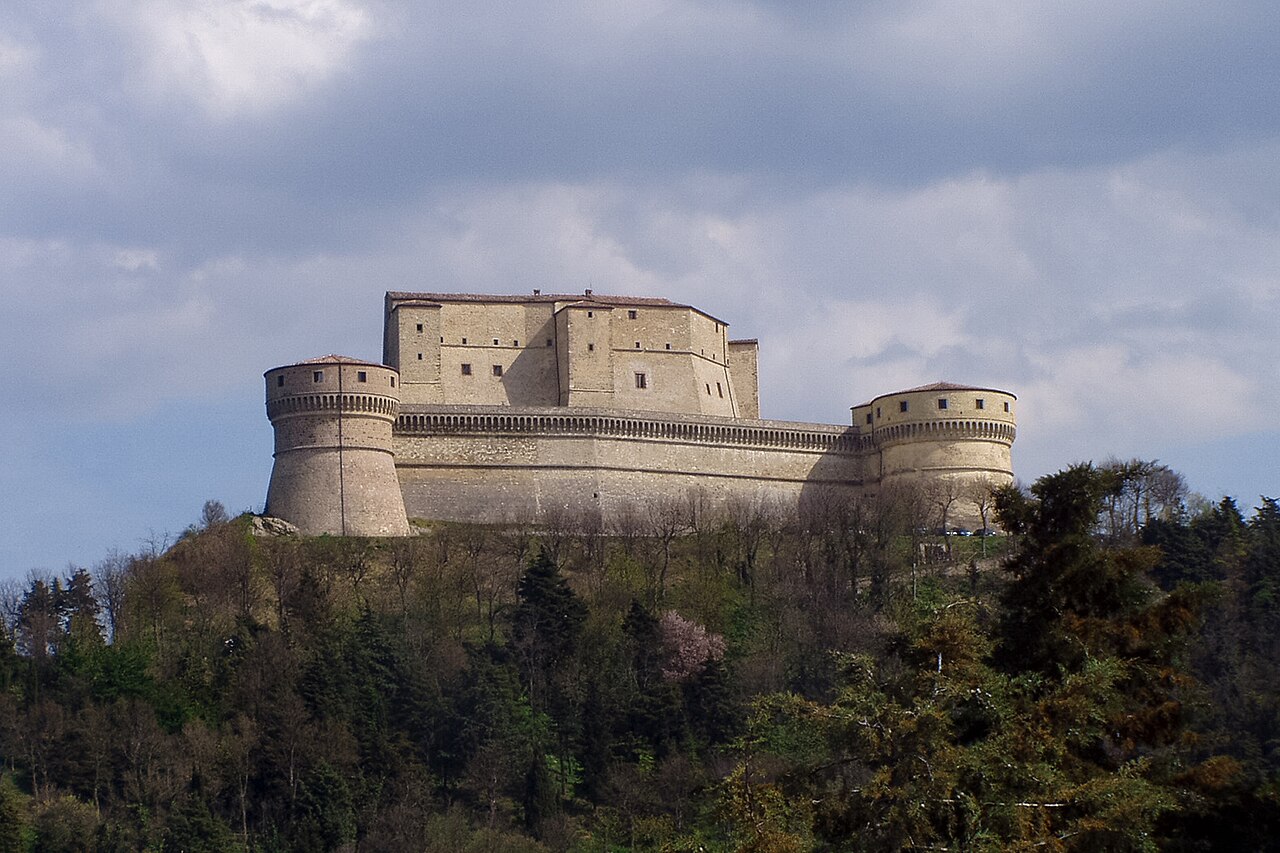
Castello di Montecopiolo
The Castello di Montecopiolo stands as a remarkable example of medieval hill fortifications in Italy, deeply rooted in the history of the Apennine Mountains. Established in the 10th century by the bishops of Montefeltro or their vassals, the Counts of Carpegna, this castle occupies a strategic position on a high ridge overlooking the valleys of the Conca and Marecchia rivers. These rivers mark a significant natural watershed that historically defined territorial boundaries during the medieval period.
Human presence in the area surrounding Montecopiolo predates the castle by tens of thousands of years. Archaeological evidence, including Mousterian flint tools, indicates Neanderthal habitation, highlighting the long-standing importance of this location. During the Roman era, from the 2nd century BCE to the 4th century CE, the site was occupied by agricultural settlements, with remains of farmsteads revealing a continuity of human activity prior to the castle's construction.
Medieval origins and strategic significance
The fortress as it is known today originated in the early medieval era, becoming a central stronghold for the influential Montefeltro family. The castle served as the foundation of their regional lordship and later became a core fortress within the Duchy of Urbino. Its location on a mountain terrace at an altitude exceeding 1,000 meters provided a commanding view of the surrounding landscape, making it a vital defensive and administrative center.
Throughout the Middle Ages and into the Renaissance, the castle underwent numerous expansions and fortifications. The 12th and 13th centuries saw the construction of extensive stone curtain walls protecting a settlement on a lower terrace, while the original summit tower was eventually replaced by a church and a palatial residence for the Montefeltro rulers. By the 14th century, the complex featured three concentric defensive walls with at least eight large towers, reinforcing its military strength.
Siege and military adaptations
The castle's military importance was demonstrated during the 1522 siege led by the forces of Giovanni dalle Bande Nere. Despite the fierce attack, the fortress remained under Montefeltro control and was never conquered. This resilience underscored the effectiveness of its fortifications and strategic design.
The introduction of gunpowder weaponry in the 15th century prompted significant architectural modifications. Rectangular towers were replaced by rounded ones better suited to withstand cannon fire. Walls were raised, and some summit buildings were removed to accommodate artillery movement, reflecting the castle's adaptation to evolving military technology.
Architectural features and layout
The castle's original medieval core included a large stone defensive tower approximately 12 by 12 meters, positioned on the highest rock outcrop. This tower was surrounded by a robust stone wall, enclosing various functional and residential buildings such as storerooms that supported the castle's daily activities.
The lower settlement, protected by its own walls, was overseen by the dominant summit fortress, creating a layered defense system. The three concentric walls and multiple towers provided formidable protection, characteristic of high medieval fortifications.
Quarries and building materials
Notably, the castle includes large limestone quarries carved between the 10th and 12th centuries. These quarries supplied the stone necessary for the castle's construction and are of geological interest due to their extensive man-made and natural rock formations.
Decline and archaeological preservation
Following the death of the last duke of Urbino in 1631, the castle gradually lost its population as inhabitants moved to nearby villages such as Villagrande and Monte Rotto. Over the centuries, the fortress fell into ruin and was partially dismantled.
Since 2002, archaeological investigations have uncovered much of the castle's historical fabric, revealing details of its construction phases, military adaptations, and daily life. Conservation efforts have preserved important elements of the walls, towers, and former buildings, allowing visitors to appreciate the castle's architectural evolution and historical significance.
Today, the ruins of Castello di Montecopiolo stand as a testament to its enduring legacy as a medieval hill castle with a rich history intertwined with the Montefeltro family and the broader history of the Duchy of Urbino. Its strategic location, architectural adaptations to changing military technologies, and archaeological significance make it an important site for understanding medieval fortifications in Italy.
Frequently asked questions (FAQ)
- When was Castello di Montecopiolo originally built?
- Castello di Montecopiolo was originally built in the 10th century by the bishops of Montefeltro or their vassals, the Counts of Carpegna.
- What is the historical significance of Castello di Montecopiolo?
- The castle served as a central stronghold for the Montefeltro family and was a key fortress within the Duchy of Urbino, playing a significant role in regional defense and administration.
- Can visitors see the remains of the castle today?
- Yes, visitors can explore the ruins of the castle's walls, towers, and former buildings, which have been preserved and uncovered through archaeological efforts since 2002.
- How did the castle adapt to changes in military technology?
- In the 15th century, the castle's rectangular towers were replaced by round ones to better resist cannon fire, walls were raised, and some buildings were removed to allow artillery movement.
- Why did the castle fall into ruin?
- After the death of the last duke in 1631, the population moved to nearby villages, leading to abandonment and gradual dismantling of the fortress over the centuries.
Information
Website
Visit websiteSources & official resources
Verify the information above using these authoritative references.
Loading map...
Visitor reviews
No reviews yet. Been here? Write the first review and help other travelers!
Write the first reviewVisited this castle? Share your experience
Your review helps other travelers and adds first-hand knowledge to our encyclopedia.