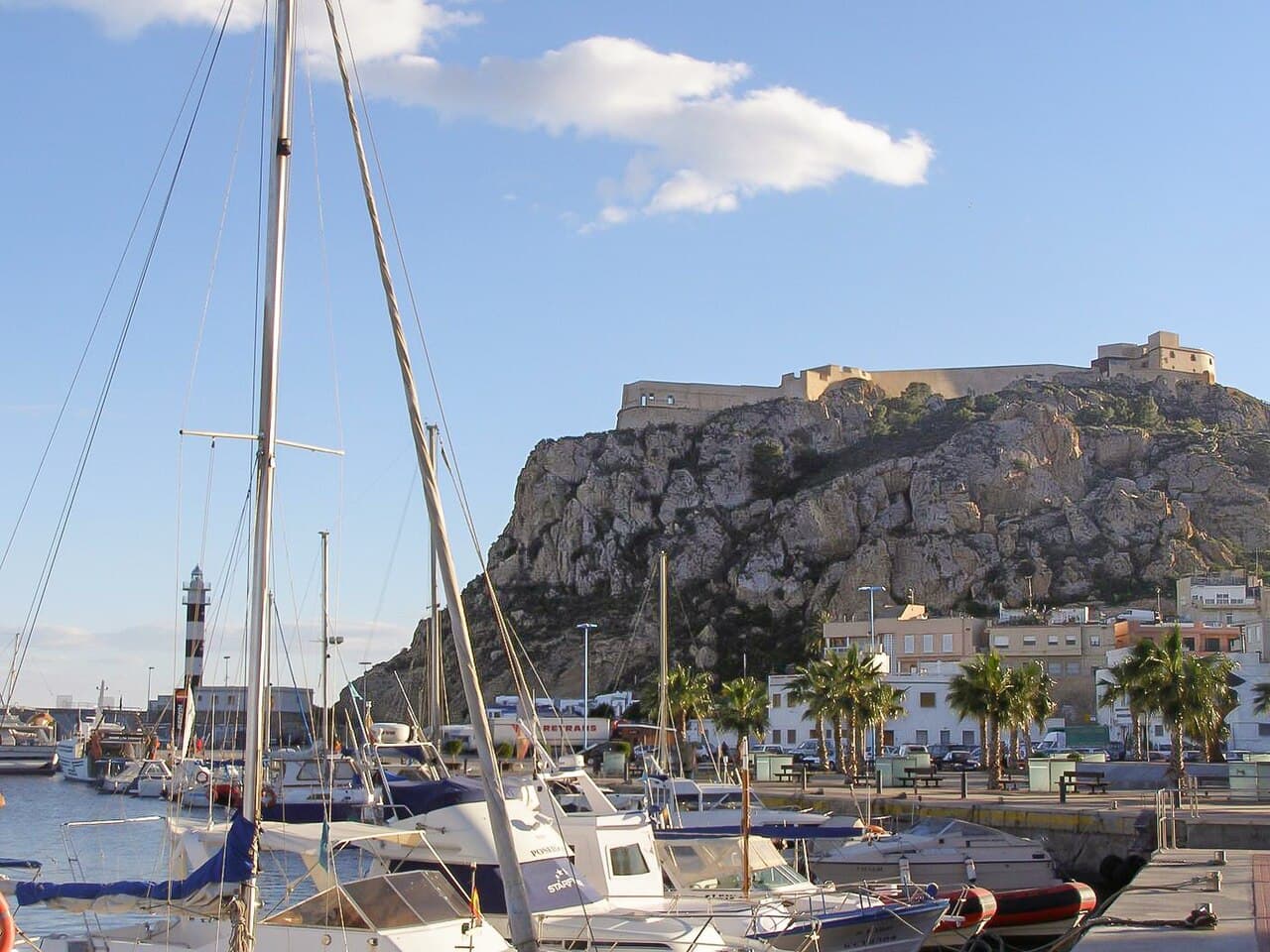
San Juan de las Águilas Castle
San Juan de las Águilas Castle is a prominent 18th-century hill castle located in Águilas, Spain, strategically perched on a promontory approximately 45 meters above sea level. This fortress played a crucial role in the coastal defense of southeastern Spain, particularly against the persistent threat of Barbary pirate raids during the Post-Renaissance period. Its history reflects a complex evolution from an earlier watchtower to a robust fortress designed to protect the growing town and its port.
Historical origins and early fortifications
The site of San Juan de las Águilas Castle has a history extending back to the Carthaginian period, though the earliest surviving military structures date to the late 16th century. Initially, a watchtower named San Juan was constructed in 1579 under the reign of Philip II of Castile. This tower was part of a broader network of coastal defenses designed to guard the vulnerable shoreline between Vera and Mazarrón from Turkish and Algerian maritime incursions.
The tower's design was influenced by contemporary military architecture, resembling the nearby Torre de Cope, and served primarily as a lookout point to alert inland garrisons, particularly in Lorca, of approaching threats. Despite its strategic importance, the tower suffered damage from a significant earthquake in 1596 and was later destroyed in 1643 during a successful pirate assault.
Reconstruction and transformation into a fortress
Following the destruction, the Spanish Crown took measures to restore the tower's defensive capabilities. In 1652, under the directive of King Philip IV, reconstruction efforts were ordered to repair and reinforce the coastal defenses. However, by the mid-18th century, the fortification had again fallen into disrepair.
In response to ongoing threats and the town's expanding population, Sebastián Feringán, an engineer from the Cartagena Arsenal, proposed a comprehensive replacement of the deteriorated tower with a more substantial fortress. Construction of the current castle began in 1759 during the reign of Charles III and was completed around 1766. This new structure incorporated advances in military engineering of the era, making it one of the most formidable coastal fortresses of its time.
Architectural features and strategic importance
The castle occupies a commanding position on a hill overlooking the Mediterranean Sea, providing extensive visibility over the coastline and surrounding terrain. Its design reflects typical 18th-century military architecture with robust walls, defensive battlements, and provisions for artillery to repel seaborne attacks.
One notable feature from earlier periods is the Torre de las Águilas (The Eagles Tower), constructed during the reign of Philip II. This tower was integrated into the later fortress complex, symbolizing the continuity of defensive efforts at the site.
Despite the castle's robust construction, few ornamental details survive today. However, a preserved façade displays a coat of arms that likely represents the lions of Castile, emphasizing the castle's royal patronage and symbolic authority.
Later history and cultural significance
Throughout its history, the castle was a frontline defense against frequent Berber attacks that threatened the safety of the port and its inhabitants. Its repeated reconstructions and enhancements underscore the strategic importance of the site in securing the southeastern Spanish coast.
In modern times, the fortress fell into ruin but was restored in 2007 to preserve its historical legacy. It was subsequently opened as a museum in 2009, allowing visitors to explore its storied past and enjoy panoramic views of Águilas and the Mediterranean coastline.
Recent archaeological excavations in the surrounding area have uncovered underground passages believed to connect San Juan de las Águilas Castle with the nearby Castle of Tébar, adding to the site's historical intrigue and suggesting a complex defensive network.
Visiting the castle today
Today, San Juan de las Águilas Castle stands as a well-preserved monument to Spain's coastal defense heritage. Visitors can appreciate its commanding location, architectural features, and the rich history encapsulated within its walls. The castle's museum offers insights into the military, cultural, and social history of the region, making it a valuable destination for history enthusiasts and tourists alike.
Frequently asked questions (FAQ)
- When was San Juan de las Águilas Castle originally built?
- The original watchtower at the site was constructed in 1579 during the reign of Philip II of Castile as part of coastal defenses against pirate raids.
- What is the architectural style of the castle?
- The castle exhibits 18th-century military architecture typical of coastal fortresses built during the Post-Renaissance period, featuring robust walls and defensive battlements.
- Can visitors explore underground passages at the castle?
- Recent excavations have revealed underground passages around the castle, believed to connect it with the nearby Castle of Tébar, though access may be limited for safety reasons.
- What is the best time to visit San Juan de las Águilas Castle?
- The castle is open to visitors year-round, with spring and autumn offering pleasant weather and fewer crowds for an optimal experience.
- Is there an entrance fee to visit the castle?
- Entrance fees may apply as the castle operates as a museum; visitors should check the latest information from the Municipality of Águilas before planning their visit.
Photo gallery

Information
Sources & official resources
Verify the information above using these authoritative references.
Loading map...
Visitor reviews
No reviews yet. Been here? Write the first review and help other travelers!
Write the first reviewVisited this castle? Share your experience
Your review helps other travelers and adds first-hand knowledge to our encyclopedia.



