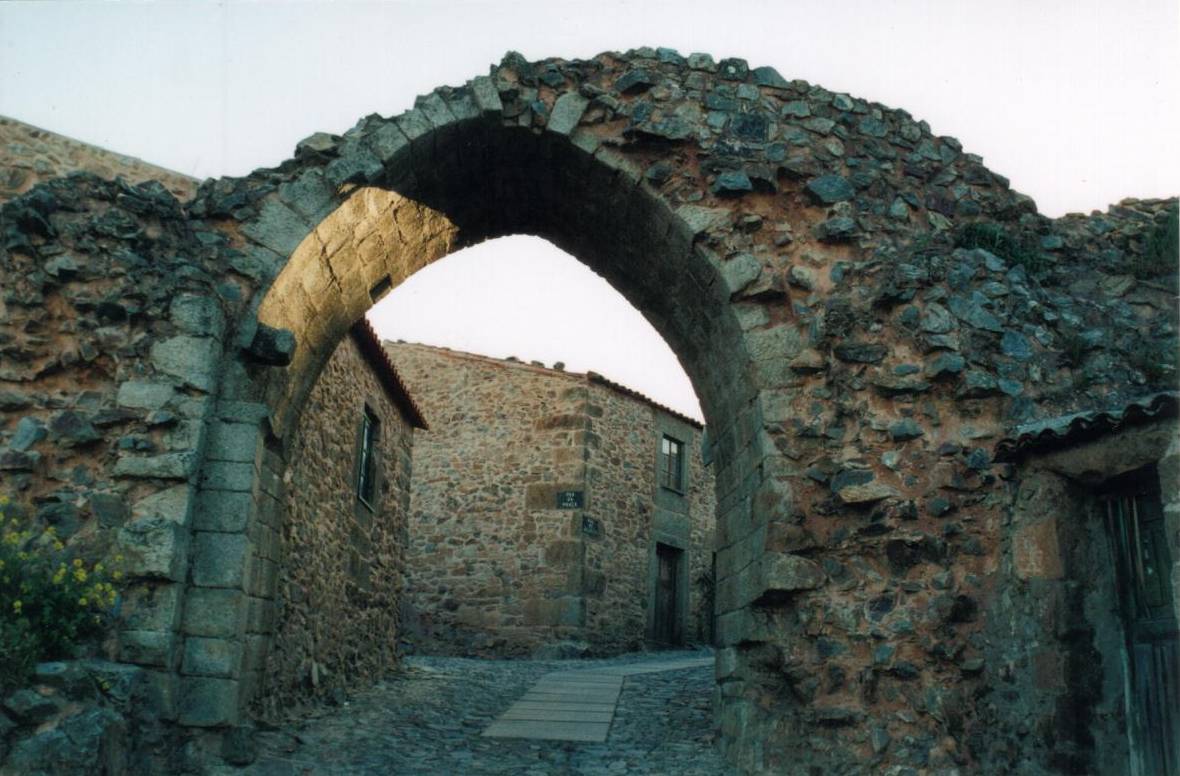
San Felices de los Gallegos Castle
San Felices de los Gallegos Castle is a significant medieval hill castle located in the town of San Felices de los Gallegos, Spain. Its strategic position on the historical border between Portugal and Castile shaped its development as a crucial frontier fortress. Originally constructed in the 13th century under Portuguese rule, the castle and its surrounding defensive walls were built to secure the contested territory and control the passage between the two kingdoms.
Medieval origins and architectural evolution
The castle's initial construction dates to the High Medieval period, attributed to King Don Dinis of Portugal. The fortification was part of a comprehensive defensive system that included enclosing walls with adjoining square towers, built from robust stone blocks. These walls encircle a spacious bailey, providing a protected courtyard within the fortress. The castle’s irregular layout follows the contours of the hill, optimizing natural defenses.
During the 15th century, the castle underwent significant remodeling, including the construction of the imposing keep tower, known as the Torre de Homenaje. This keep, initially called the Tower of Don Dionis, was rebuilt in 1476 to enhance its defensive capabilities and served as the fortress's central stronghold. Its preservation today allows visitors to explore the military architecture of the late medieval period.
In the 17th century, the castle's defenses were further strengthened with the addition of a third fortified enclosure featuring bastioned walls. These bastions reflect the evolution of military architecture in response to the increasing use of artillery. Two artillery batteries were incorporated: one within the original walls (intramuros) and another outside (extramuros), demonstrating adaptations to new forms of warfare.
Historical significance and political role
The castle's location on the border between Portugal and Castile made it a focal point of territorial disputes. Throughout the 14th century, control over San Felices de los Gallegos shifted amid dynastic conflicts and alliances, such as the marriage of María de Portugal to Alfonso XI of Castile, which helped return the castle to Castilian hands.
Notably, the castle served as a residence for prominent figures linked to both kingdoms. In 1374, Beatriz de Portugal, widow of Sancho of Castile, and her daughter Leonor maintained their court here, underscoring the fortress's role as a noble residence as well as a military stronghold.
The fortress continued to play a military role in subsequent centuries, hosting troops during the Portuguese uprising against King Philip IV of Spain in the 17th century and during the War of Spanish Succession in the early 18th century. Its bastioned defenses constructed in the 18th century during the War of Independence further illustrate its ongoing strategic importance.
Civil architecture within the walls
Inside the castle walls, the town contains notable civil and religious buildings that reflect its historical development. The parish church, dating from the 12th to 13th centuries, showcases the transitional Romanesque style in its façade and belltower, later modified during the Gothic-Renaissance period in the 16th century. The church features three naves and a main chapel, illustrating the architectural evolution over centuries.
Other prominent structures include the Town Hall from the 16th century and the Alhóndiga, a historic granary. The former hospitals of Rocamador and La Misericordia are also within the enclosure, alongside various noble mansions dating from the 16th to 18th centuries. These mansions, such as the houses known as Los Mayorazgos, El Corregidor, and Los señores de Ron, are distinguished by their carved coats of arms, reflecting the social status of their owners.
Architectural features and defensive elements
The castle complex integrates multiple layers of fortifications from different periods. The original medieval walls with square towers provide a strong defensive perimeter around the bailey. The moat surrounding the castle, though partially surviving, was an important element for defense, deterring siege engines and infantry assaults.
The 17th-century bastioned walls introduced angled bastions designed to deflect artillery fire, a hallmark of early modern military architecture. The presence of both intramuros and extramuros artillery batteries indicates the castle's adaptation to gunpowder weaponry, marking a transition from medieval to modern fortification techniques.
The keep tower remains the dominant architectural feature, serving both as a last refuge during sieges and as a symbol of feudal authority. Its robust construction and elevated position allowed for surveillance over the surrounding landscape and control of access routes.
Preservation and current use
After centuries of military use, the castle fell into decline during the 19th century. Restoration efforts in the 20th century have stabilized the structure and preserved key elements of the fortress. Today, the castle is well preserved and functions as a museum, offering visitors insight into its architectural development and historical role on the Iberian frontier.
The museum housed within the keep tower provides detailed exhibits on construction techniques, defensive strategies, and the castle's significance during various historical periods. The site is accessible to visitors interested in medieval and early modern military architecture, as well as the complex history of the Portugal-Castile borderlands.
Visitor information and cultural importance
San Felices de los Gallegos Castle remains a cultural landmark, representing the layered history of border conflicts, noble residence, and architectural evolution. Its combination of medieval walls, Renaissance civil buildings, and early modern bastions offers a comprehensive view of fortress design adapting through centuries.
Visitors can explore the castle's multiple defensive enclosures, the parish church, and the historic town center, gaining a deeper understanding of how military and civil life intertwined in a frontier town. The castle's preservation contributes to regional heritage tourism and educational programs focused on medieval Iberian history.
Frequently asked questions (FAQ)
- How do I get to San Felices de los Gallegos Castle?
- San Felices de los Gallegos Castle is located in the town of San Felices de los Gallegos in Castile and León, Spain. It is accessible by car via regional roads connecting to nearby cities, and local signage guides visitors to the site.
- What are the opening hours for visiting the castle?
- The castle is typically open to visitors during daytime hours, often from 10:00 to 18:00, but it is advisable to check current schedules before planning a visit as hours may vary seasonally.
- Is there a ticket fee to enter the castle museum?
- There is usually a modest entrance fee to visit the castle museum, which helps support maintenance and preservation efforts. Discounts may be available for children, seniors, and groups.
- What architectural styles are visible at the castle?
- San Felices de los Gallegos Castle exhibits a mix of architectural styles, including <strong>High Medieval stone fortifications</strong>, <strong>transitional Romanesque</strong> elements in the parish church, and <strong>Gothic-Renaissance</strong> modifications, alongside <strong>17th-century bastioned walls</strong> reflecting early modern military architecture.
- Can I explore the interior of the keep tower?
- Yes, the keep tower, known as Torre de Homenaje, is open to visitors as a museum. It provides detailed information about the castle's history and construction, and offers panoramic views of the surrounding landscape.
Information
Website
Visit websiteSources & official resources
Verify the information above using these authoritative references.
Loading map...
Visitor reviews
No reviews yet. Been here? Write the first review and help other travelers!
Write the first reviewVisited this castle? Share your experience
Your review helps other travelers and adds first-hand knowledge to our encyclopedia.