The Castle of Castelo Rodrigo stands as a significant medieval fortress located in the municipality of Figueira de Castelo Rodrigo, Portugal. Perched at an altitude of 810 meters on rocky schist outcrops, this hill castle commands a strategic vantage point over the surrounding Ribacôa region. Its origins trace back to the turbulent era of the Christian Reconquest of the Iberian Peninsula, when the Kingdom of León constructed it to fortify its borderlands.
While earlier traditions suggested that the site might have been occupied by the ancient Turduli people around 500 BCE or served as a Roman fortified settlement, modern archaeological research has found no definitive evidence supporting these claims. Similarly, there is no confirmed occupation by the Sueves or Visigoths. The only surviving element from the period of Muslim control is a cistern featuring a horseshoe-arched doorway, a hallmark of Islamic architectural influence.
Medieval origins and leonese construction
The castle's initial medieval construction began under the reign of Alfonso IX of León (1188–1230). It was part of an extensive defensive line protecting the border between León and the territories that would become Portugal. This line included several fortresses strategically placed to guard against incursions. The settlement around the castle was granted its first formal foral (charter) in 1209, marking its importance as a populated and defended locale. The castle's name honors Count Rodrigo Gonçalves Girão, who played a pivotal role in repopulating and defending the area during this foundational period.
Border disputes and portuguese sovereignty
For many decades, the territory around Castelo Rodrigo was a contested borderland between the Kingdom of León and Portugal. This dispute was resolved by the Treaty of Alcañices in 1297, which affirmed Portuguese sovereignty over the region. Following this, King Dinis of Portugal (1279–1325) undertook significant enhancements to the castle's defenses. These improvements included strengthening the keep tower, constructing a moat and barbican, and reinforcing the curtain walls. The main gate, flanked by two square towers bearing the king's royal coat of arms, was also built during this period, showcasing the castle's elevated status and defensive capabilities.
14th-century developments and political turmoil
In 1373, under King Fernando, the settlement received a market charter, which likely contributed to its economic growth and further fortification. During the Portuguese crisis of succession (1383–1385), Castelo Rodrigo played a critical defensive role, successfully resisting an assault by forces loyal to the Master of Avis. However, the castle's governor remained loyal to Beatriz and her husband, King John I of Castile. As a consequence, the village's coat of arms was displayed inverted as a mark of punishment, and administratively, the castle was subordinated to the nearby town of Pinhel.
Early modern period and the philippine dynasty
At the dawn of the 16th century, King Manuel I issued a new foral in 1508 and initiated a review of the castle's fortifications. The castle appears in the Livro das Fortalezas (Book of Fortresses) by Duarte de Armas, a detailed reconnaissance manuscript that illustrates its crenellated walls, towers, main gate, and keep tower, providing invaluable insight into its structure at the time.
During the Philippine Dynasty in the late 16th century, when Portugal was under Spanish rule, Philip II elevated Castelo Rodrigo to a county and appointed Cristóvão de Moura as its first count. Moura constructed a palace within the castle grounds on the site of the former alcáçova (central fortress), surrounded by walls and turrets. This palace featured a distinctive Gothic-style entrance. However, after Portugal regained independence in the 17th century, local inhabitants set fire to the palace, leaving it in ruins.
Military engagements and decline
The castle remained militarily significant during the Restoration War (1640–1668), enduring a siege by 3,000 Spanish troops defended by only 150 men. Local tradition recounts that Spanish commanders escaped disguised as monks, adding a colorful chapter to the castle's history. It faced occupation again during the Seven Years' War in 1762.
By the 19th century, Castelo Rodrigo had lost its strategic importance, and in 1836 the municipal seat was transferred to Figueira de Castelo Rodrigo by royal decree. Recognizing its cultural and historical value, the castle was declared a National Monument in 1922. It underwent partial restoration in the 1940s and has seen further conservation efforts in recent decades.
Architectural features and surviving structures
The castle's layout follows an irregular oval shape adapted to the rocky terrain. Its surviving architecture reflects two main phases: the Romanesque constructions from the late 12th and early 13th centuries under León, and the extensive 14th-century modifications commissioned by King Dinis.
Leonese phase elements
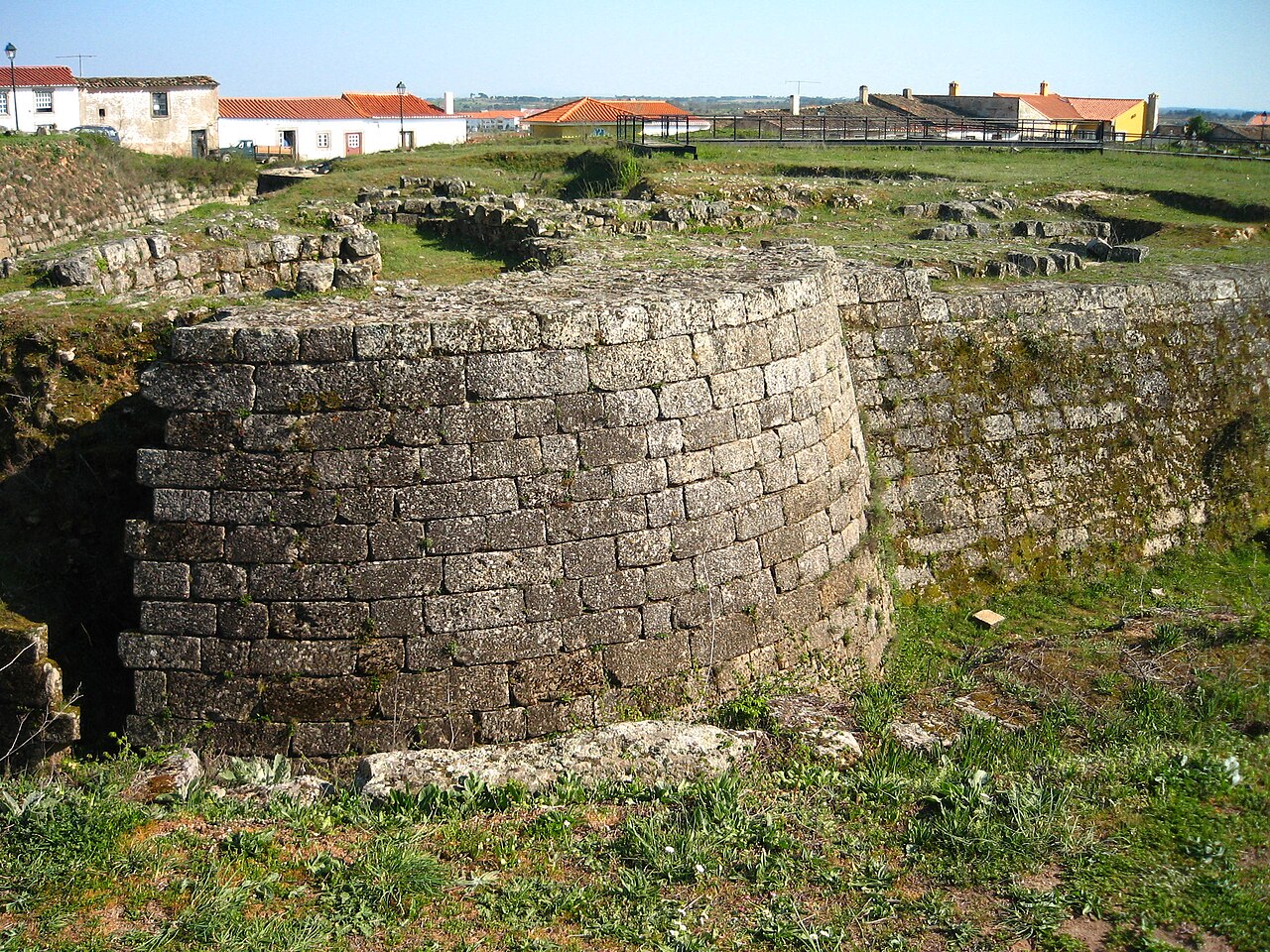
Circular towers from the initial Leonese phase remain standing, contrasting with the square towers typical of contemporary Portuguese castles. Among the lost features was an albarrã tower, a detached defensive tower located farther north than similar examples in Portugal; it was documented by Duarte de Armas in the early 1500s but no longer exists.
King dinis's enhancements
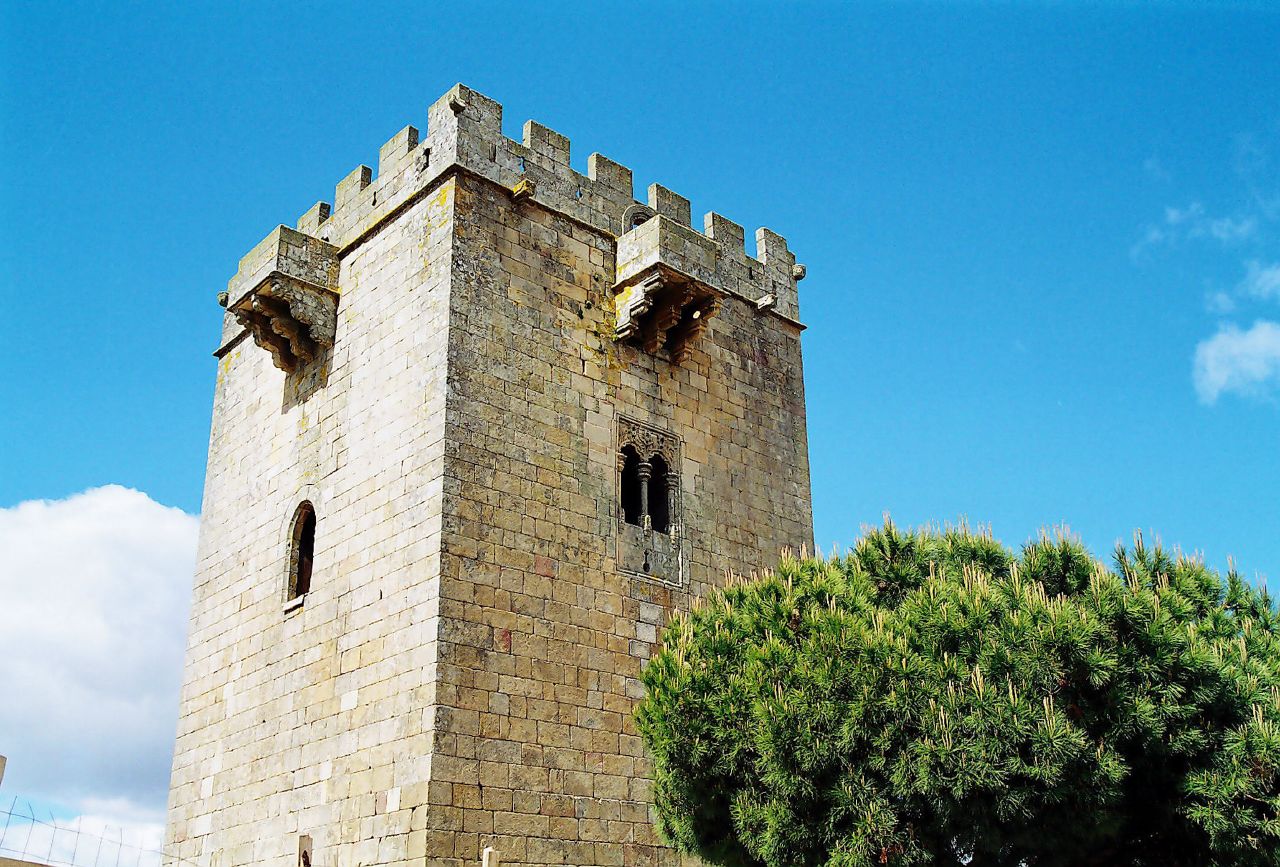
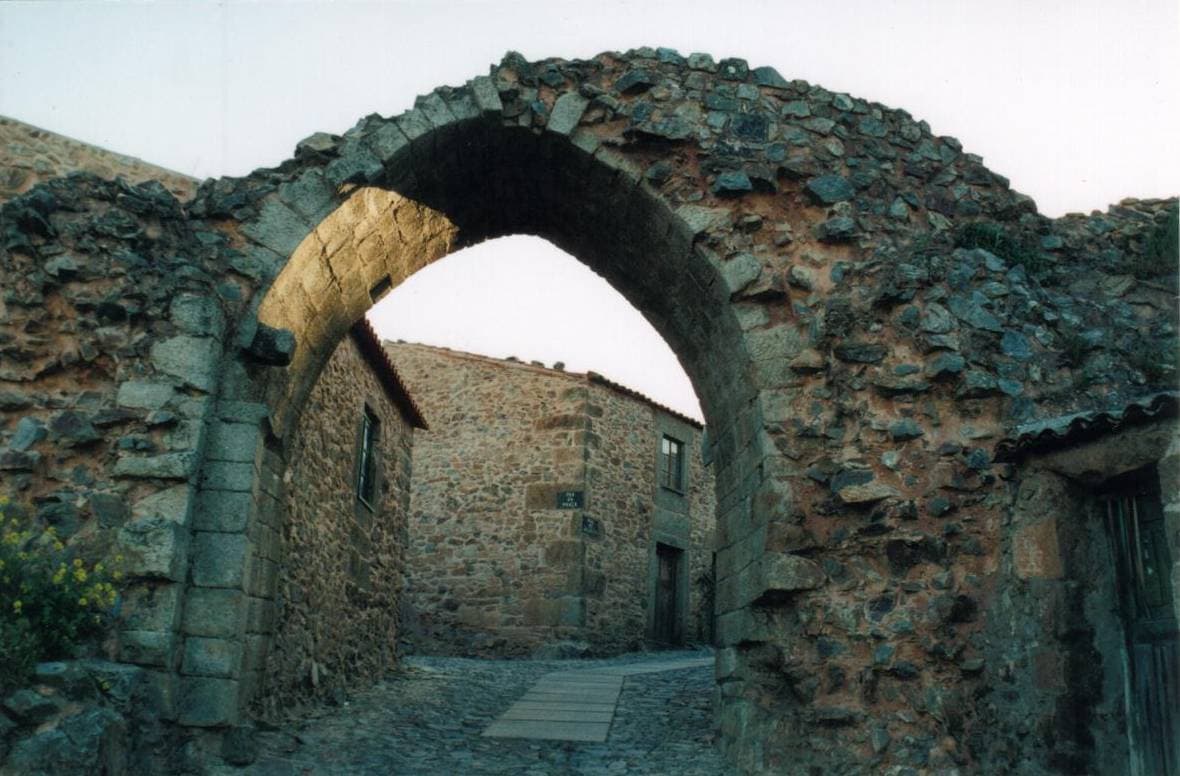
The 14th-century phase introduced significant defensive improvements, including the main gate characterized by a pointed arch and a machicolation balcony designed for dropping projectiles on attackers. Although only the balcony's supporting elements survive, the gate remains flanked by two quadrangular towers bearing the royal coat of arms. The square-plan keep tower prominently projects from the castle wall facing the village and features six windows with balconies, emphasizing both defense and residential comfort.
Other features from this period include crenellated outer walls, parts of which remain visible, as well as the moat and barbican that provided additional layers of defense. The castle's enclosure integrates with the village's fortified walls, which are crenellated and reinforced with semicircular towers. Three gates into the village survive: Porta do Sol (east), Porta da Alverca (north), and Porta da Traição.
Philippine dynasty palace remains
The entrance to Cristóvão de Moura's palace still stands, approached by a staircase and set within thick, uneven schist masonry walls. The doorway is a dressed-stone portal framed by pilasters with voussoirs and topped by a triangular pediment featuring a coat of arms, exemplifying the Gothic architectural style of the late 16th century.
Cistern and cultural fusion
Near the palace entrance lies an ancient cistern used for water storage, constructed with finely worked ashlar blocks. This deep well extends about 13 meters below ground and is accessed via a granite staircase worn smooth by centuries of use. The cistern has two doors: one with a horseshoe arch in the Mudéjar style, reflecting a fusion of Islamic and Christian artistic influences, and the other with a Gothic-style doorway, illustrating the cultural blending characteristic of the castle's long history.
Frequently asked questions (FAQ)
- What is the historical significance of the Castle of Castelo Rodrigo?
- The Castle of Castelo Rodrigo is a prominent historical site in Portugal, dating back to the 12th century. It played a crucial role during the Reconquista and served as a strategic military stronghold. Today, it stands as a testament to the region's rich history and architectural heritage.
- When is the best time to visit the Castle of Castelo Rodrigo?
- The best time to visit the Castle of Castelo Rodrigo is during the spring and fall months, when the weather is mild and pleasant. These seasons also offer fewer crowds, allowing for a more enjoyable exploration of the castle and its surroundings. Additionally, local festivals often take place during these times, adding to the cultural experience.
- Can I access the Castle of Castelo Rodrigo with a wheelchair?
- While the Castle of Castelo Rodrigo has some accessible areas, the historic nature of the site means that certain sections may be challenging for wheelchair users. It is advisable to contact the castle's administration ahead of your visit to inquire about specific accessibility options and available facilities.
- What are the opening hours for the Castle of Castelo Rodrigo?
- The Castle of Castelo Rodrigo is typically open to visitors from 9 AM to 7 PM during the summer months, and from 9 AM to 5 PM in the winter. However, these hours may vary, so it is recommended to check the official website or contact the site directly for the most current information before planning your visit.
- Is there an entrance fee to visit the Castle of Castelo Rodrigo?
- Yes, there is a nominal entrance fee to visit the Castle of Castelo Rodrigo, which helps maintain the site and its facilities. Ticket prices are generally affordable, with discounts available for children, students, and seniors. Be sure to check the castle's official website for the latest pricing and any special offers.
- What nearby attractions should I visit while at Castelo Rodrigo?
- While visiting Castelo Rodrigo, you can explore the charming village of the same name, which features traditional architecture and local shops. Additionally, the nearby historical town of Almeida offers its own fortifications to discover. The beautiful natural landscapes surrounding the castle also provide opportunities for hiking and photography.
- How do I get to the Castle of Castelo Rodrigo?
- The Castle of Castelo Rodrigo is accessible by car, located approximately 30 km from the city of Guarda. Public transportation options may be limited, so driving or arranging a tour might be the most convenient ways to reach this historical landmark. Ensure to follow local signage for the best routes to the castle.
- What architectural features can I expect to see at the Castle of Castelo Rodrigo?
- The Castle of Castelo Rodrigo showcases a mix of Romanesque and Gothic architectural styles, evident in its sturdy stone walls and towers. Visitors can admire the impressive battlements and the remnants of the castle's original structures, which reflect the defensive strategies of the time. The panoramic views from the castle's heights are also a significant highlight.

Information
Website
Visit websiteSources & official resources
Verify the information above using these authoritative references.
Loading map...
Visitor reviews
No reviews yet. Been here? Write the first review and help other travelers!
Write the first reviewVisited this castle? Share your experience
Your review helps other travelers and adds first-hand knowledge to our encyclopedia.