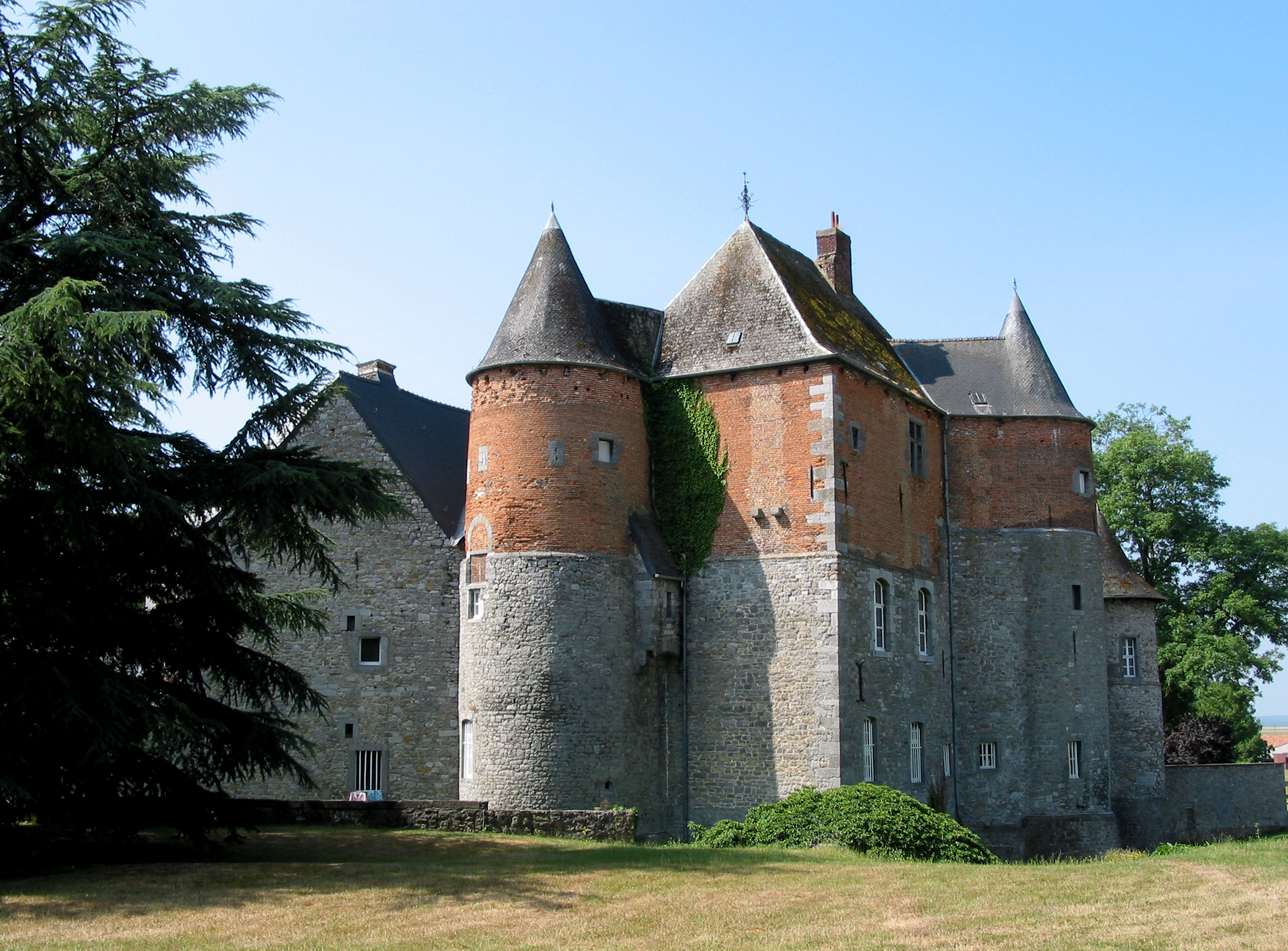
Salamander Tower
Salamander Tower, locally known as Tour Salamandre, is a prominent medieval defensive structure located in the town of Beaumont, within the province of Hainaut in the Wallonia region of Belgium. This tower forms a significant part of the town's historical fortifications and reflects the military architecture and turbulent history of the region from the High Medieval period onward.
Early origins and strategic importance
Constructed around 1050, the Salamander Tower was originally part of a small castle commissioned by Richilde, Countess of Hainaut. Situated on the edge of a plateau, the tower was strategically placed to oversee and defend the town of Beaumont. Its position allowed surveillance over the surrounding landscape, which was critical for early warning against invaders or hostile forces.
The initial castle complex was modest but played a crucial role in the defense system of the town. Over time, successive Counts of Hainaut, notably Baldwin IV and Baldwin V, expanded and fortified the town, transforming it into a more formidable fortress. The Salamander Tower was integral to these defensive enhancements, serving both as a watchtower and a stronghold within the town's walls.
Medieval conflicts and architectural evolution
Throughout the 14th and 15th centuries, the Salamander Tower and the surrounding fortifications witnessed several conflicts and sieges. In 1340, during the tenure of Jean de Beaumont, the castle suffered damage from a significant fire, which likely necessitated repairs and modifications to the tower and adjacent structures.
The region's instability continued into the early 15th century, particularly in 1408 when the war between the citizens of Liège and the Prince-bishop ravaged much of the area. However, Beaumont's modernized walls and defenses, including the Salamander Tower, enabled the town to avoid the widespread destruction that befell neighboring settlements. Similarly, in 1477, after the death of Charles the Bold, Duke of Burgundy, Beaumont escaped devastation during the ensuing conflicts.
By the mid-15th century, under the rule of Philip the Good, Duke of Burgundy, the castle and town entered a period of transformation. In 1453, Philip entrusted Beaumont to the influential De Croÿ family, who governed Hainaut on his behalf. The De Croÿ family undertook significant renovations, turning the fortress into a more luxurious palace complex. They beautified the castle, town, and ramparts, reflecting Renaissance tastes and the increased importance of residential comfort alongside military function.
The de croÿ era and renaissance influence
Charles de Croÿ-Aarschot, Duke of Aarschot and Croÿ, and Prince of Porceau and Chimay, was born in Beaumont in 1560. He made the castle his preferred residence, further enhancing its status and architectural refinement. His residency until his death in 1612 marked a high point in the castle's history as a noble residence.
Decline, destruction, and survival
The 17th century brought hardship to Beaumont and the Salamander Tower. In 1632, a devastating plague struck the region, killing half of the town's population and weakening its defenses. In 1637, Beaumont faced a siege, underscoring its continued strategic importance despite earlier transformations into a palace.
In 1655, the town defied a requisition order during the reign of Louis XIV, King of France. As a consequence, Henri de la Tour d'Auvergne, Vicomte de Turenne, acting on the king's orders, captured and burned Beaumont to the ground. Only about 30 houses remained standing after this destruction. The Salamander Tower, along with much of the town's fortifications, fell into ruin during this period.
Architectural features and current condition
The Salamander Tower is a typical example of a High Medieval defensive tower built for surveillance and protection. Its robust stone construction, strategic location on a plateau edge, and integration into the town's walls highlight its military purpose. Over the centuries, the tower's architecture evolved with additions and renovations reflecting changing defensive needs and residential uses, especially during the De Croÿ family's tenure.
Today, the tower remains a well-preserved historical monument, although it experienced periods of ruin and neglect after the 17th-century destruction. It has been restored sufficiently to house a small museum that welcomes visitors interested in the history of Beaumont and its medieval fortifications.
Visiting salamander tower
The Salamander Tower is open to the public for a modest entrance fee, offering a glimpse into the medieval past of Beaumont. Visitors can explore the tower's interior, learn about its role in regional conflicts, and appreciate its architectural features firsthand. The tower's location in a charming town adds to the visitor experience, combining cultural heritage with the ambiance of Wallonia's historic landscapes.
The museum within the tower provides educational exhibits about the castle's history, the De Croÿ family, and the military architecture of the period. The site is an important cultural asset for the region and serves as a tangible link to the complex history of the Hainaut province.
Frequently asked questions (FAQ)
- How do I get to Salamander Tower in Beaumont?
- Salamander Tower is located on Rue de la Poterne in Beaumont, Belgium. It is accessible by car and public transport, with parking available nearby and local bus connections to the town center.
- What is the historical significance of Salamander Tower?
- Salamander Tower was built around 1050 as part of Beaumont's defenses and played a key role in regional conflicts during the Middle Ages, including sieges and fires. It later became a noble residence under the De Croÿ family.
- Can I visit the museum inside Salamander Tower?
- Yes, the tower houses a small museum open daily from 10:00 to 17:00. Visitors can learn about the castle's history, medieval fortifications, and the local nobility for a small admission fee.
- Is Salamander Tower wheelchair accessible?
- Due to its medieval architecture and tower structure, Salamander Tower has limited wheelchair accessibility. Visitors with mobility concerns should check with the local tourist office for assistance and available accommodations.
- When is the best time to visit Salamander Tower?
- The tower is open year-round, but the best time to visit is during the warmer months from spring to early autumn when the weather is pleasant and the town hosts cultural events.
Information
Opening hours
10:00-17:00, daily
Ticket prices
€3 adult, €1.50 child
Current owner
Municipality
Address
Rue de la Poterne, Belgium
Loading map...
Visitor reviews
No reviews yet. Been here? Write the first review and help other travelers!
Write the first reviewVisited this castle? Share your experience
Your review helps other travelers and adds first-hand knowledge to our encyclopedia.