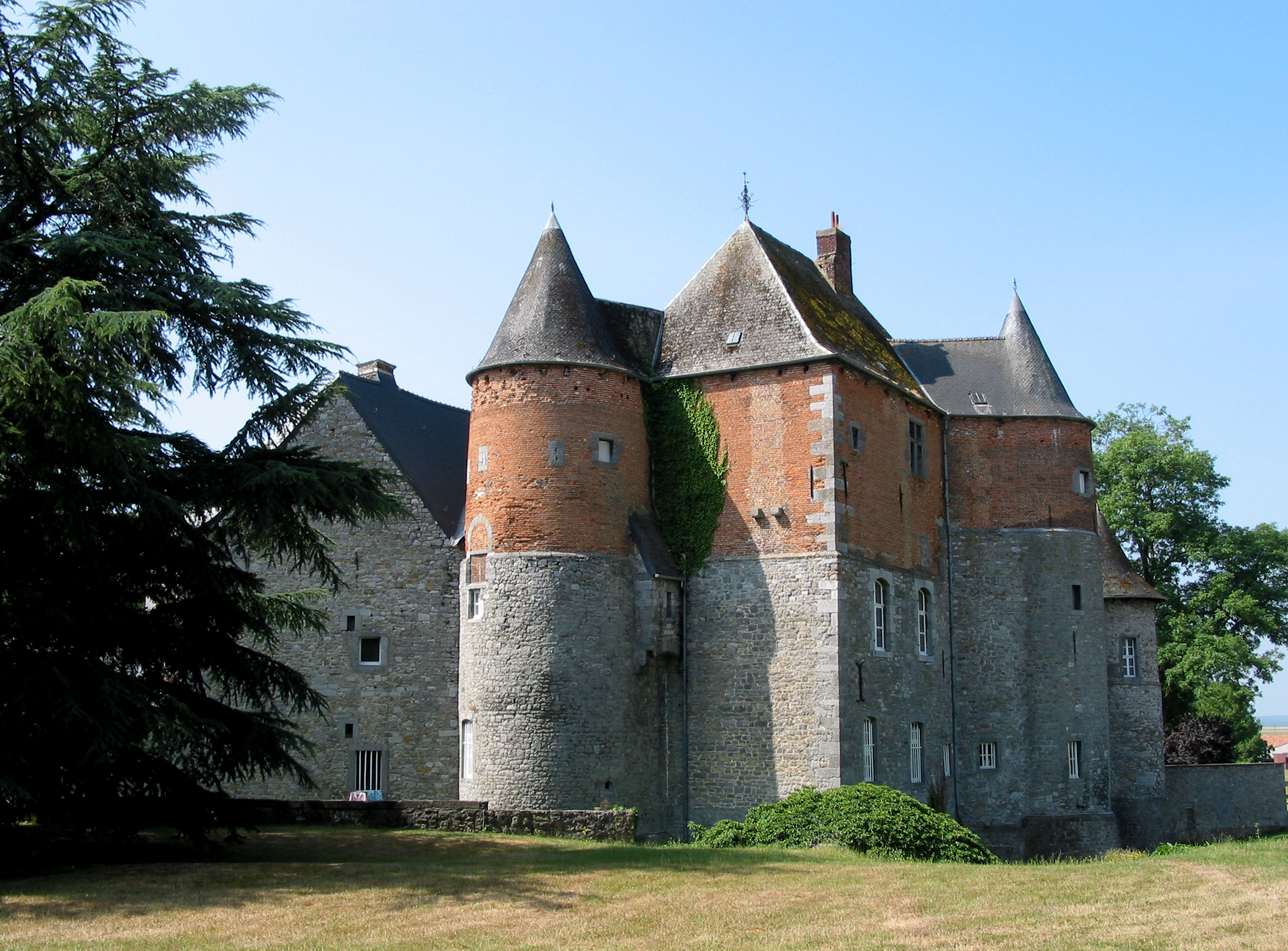
Solre-sur-Sambre Castle
Solre-sur-Sambre Castle, also known as Château de Solre-sur-Sambre, is a remarkable example of a high medieval hill castle located in the village of Solre-sur-Sambre in the province of Hainaut, within the Wallonia region of Belgium. This castle stands at the confluence of the Sambre and Thure rivers, a strategic position that historically offered both natural defense and control over important waterways.
The castle's origins trace back to the late 13th century, when it was constructed by the Lords of Barbençon. Initially, the fortress was centered around a rectangular, massive keep, a typical feature of medieval military architecture designed for defense and residence. This keep formed the core of the castle and was likely intended to serve as a last refuge during sieges.
Architectural evolution and design
During the 14th or 15th century, the original keep underwent significant modifications. It was incorporated into a larger square castle complex, which was fortified with circular towers at each of its four corners. This design enhanced the castle's defensive capabilities by allowing defenders to cover all approaches with crossfire. The transformation of the keep into a gate tower was a notable architectural adaptation, serving both as a strong defensive entry point and as a symbol of lordly power.
The castle's layout reflects typical medieval military architecture, combining robust stone walls with towers that provided vantage points for surveillance and defense. The use of circular towers was an advancement over earlier square towers, as they better deflected projectiles and reduced blind spots.
Historical ownership and significance
In around 1480, Solre-sur-Sambre Castle was acquired by the family of Jean Carondelet Mortagne, who was the Lord Chancellor of Archduke Maximilian of Austria. The Carondelet family held the castle for nearly 150 years, until 1628. This period likely saw the castle function both as a noble residence and a local administrative center.
Following the Carondelet tenure, ownership passed to the De Merode family through marriage, a prominent noble house with significant influence in the region. The castle remained associated with the De Merode lineage for centuries, underscoring its importance as a noble estate.
In 1843, the castle changed hands again through marriage to the Wignacourt family. This lineage maintained the property until the late 20th century.
In 1989, Prince Alexandre de Merode repurchased Solre-sur-Sambre Castle from the Wignacourt family, and it remains in the possession of his descendants to this day. This continuity of noble ownership highlights the castle's enduring legacy and cultural significance.
Current condition and accessibility
Today, Solre-sur-Sambre Castle is classified as ruins, retaining much of its medieval stone structure despite the passage of centuries. The castle's preservation state offers valuable insights into medieval fortification techniques and noble residence architecture.
As the castle is private property, it is not open to public tours or interior visits. However, its exterior can be admired from the adjacent public road and a nearby walking path, which provide excellent vantage points for viewing the castle's imposing remains and appreciating its historical ambiance.
The castle's setting near the rivers and within the scenic landscape of Hainaut makes it a noteworthy landmark for visitors interested in medieval history and architecture, even from a distance.
Architectural features and medieval military design
Solre-sur-Sambre Castle exemplifies the evolution of medieval fortifications from simple keeps to more complex castle structures. The original rectangular keep was a common defensive feature in the high medieval period, designed to be both a residence and a stronghold. Its later integration into a square curtain wall with circular corner towers reflects advances in military architecture aimed at improving defense against siege weaponry.
The gate tower, formed from the original keep, was a critical defensive element. It controlled access to the castle and was likely equipped with defensive mechanisms such as a portcullis and murder holes to repel attackers. The circular towers not only strengthened the walls but also provided platforms for archers and artillery.
Strategic location
The castle's position at the confluence of two rivers was a deliberate choice, enhancing its defensive capabilities and control over local trade routes. The surrounding watercourses could have been integrated into the castle's defenses, possibly forming natural moats or obstacles to attackers.
Legacy and cultural importance
Solre-sur-Sambre Castle stands as a testament to the medieval noble families who shaped the region's history. Its architectural features provide a window into the military and residential needs of the time. The castle's continuous ownership by prominent families such as the Carondelets, De Merodes, and Wignacourts reflects its status as a symbol of aristocratic power and heritage.
Despite its current status as ruins, the castle remains an important cultural landmark in Hainaut. It attracts historians, architects, and visitors who appreciate medieval fortifications and the stories embedded in stone walls and towers.
Frequently asked questions (FAQ)
- Can I visit Solre-sur-Sambre Castle?
- Solre-sur-Sambre Castle is private property and not open to the public. However, visitors can view the castle's exterior from the nearby public road and walking paths.
- When was Solre-sur-Sambre Castle built?
- The castle was originally built in the late 13th century by the Lords of Barbençon, with significant expansions in the 14th or 15th century.
- What are the main architectural features of Solre-sur-Sambre Castle?
- The castle features a rectangular keep that was later incorporated into a square castle with circular corner towers. The keep was transformed into a gate tower.
- Who were the notable owners of Solre-sur-Sambre Castle?
- Notable owners include the Lords of Barbençon, the Carondelet family, the De Merode family, and the Wignacourt family. It was repurchased by Prince Alexandre de Merode in 1989.
- Why is Solre-sur-Sambre Castle historically significant?
- The castle illustrates medieval military architecture evolution and reflects the history of noble families influential in the Hainaut region over several centuries.
Information
Sources & official resources
Verify the information above using these authoritative references.
Loading map...
Visitor reviews
No reviews yet. Been here? Write the first review and help other travelers!
Write the first reviewVisited this castle? Share your experience
Your review helps other travelers and adds first-hand knowledge to our encyclopedia.