Saint-Pierre Castle
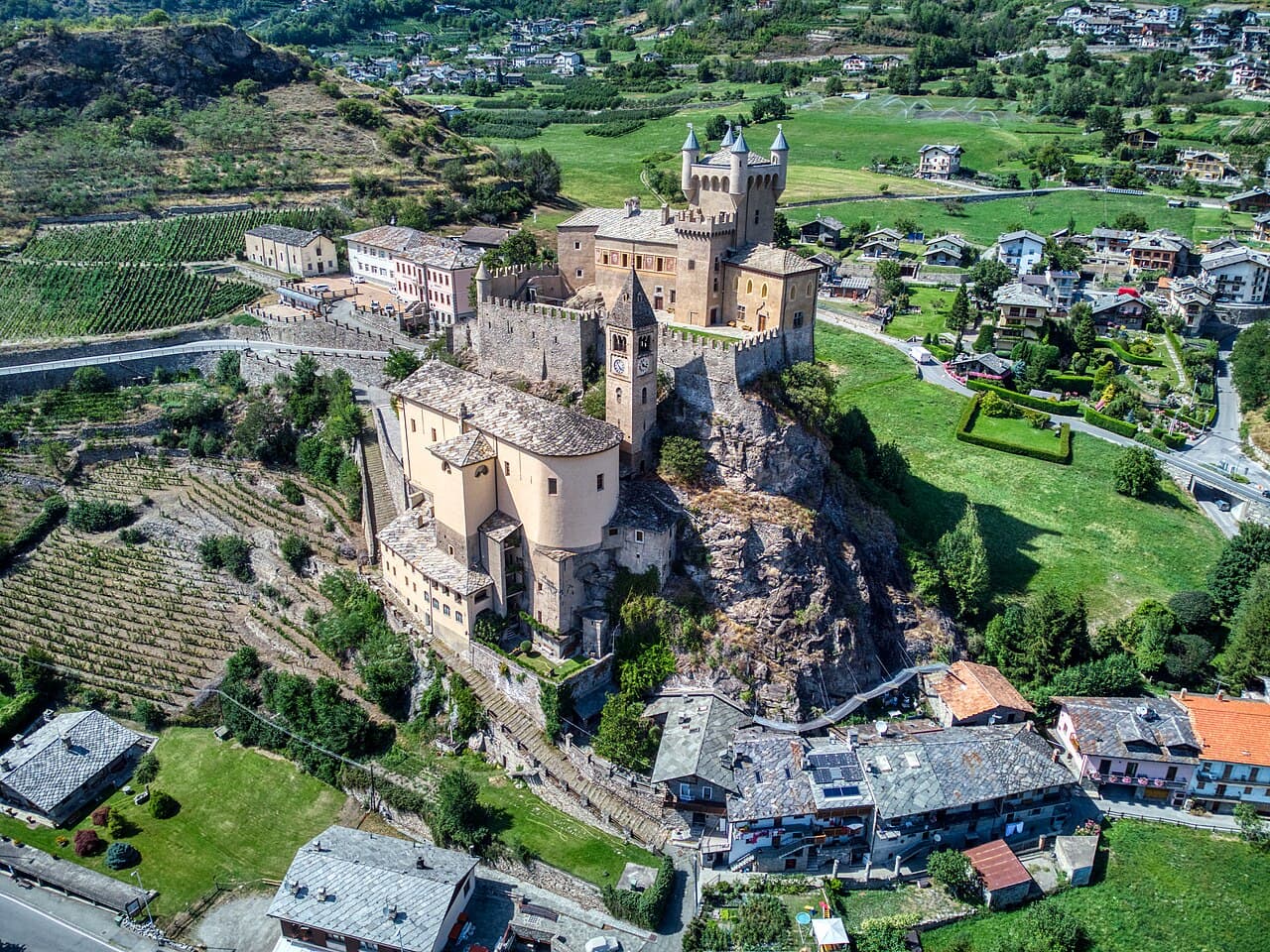
Saint-Pierre Castle stands majestically on a rocky promontory in the village of Tache, approximately 8 km from the city of Aosta in the Aosta Valley region of Italy. As one of the oldest castles in the region, its strategic position overlooking the valley has made it a significant landmark throughout its long history. The castle’s origins trace back to around the 12th century, with the first documented mention appearing in a 1191 document, firmly situating it within the high medieval period.
The castle owes its name to the noble De Sancto Petro family, its original owners who established the earliest fortifications, including two towers that are still visible today. Over the centuries, Saint-Pierre Castle underwent numerous transformations reflecting the tastes and requirements of its successive owners, including the Quarti family, the powerful House of Savoy, and the Challant family. Each lineage contributed architectural additions and modifications, evolving the castle from a defensive fortress into a more complex and comfortable residence.
Medieval origins and early history
The initial construction of Saint-Pierre Castle was typical of hill castles of the medieval period, designed primarily for defense and control over the surrounding territory. Its location on a rocky marble spur provided natural fortification, with steep drops on the northern side and commanding views of the SS26 road and valley below.
The original structure consisted of basic walls and two towers, which served both as lookout points and strongholds. The castle’s early owners, the De Sancto Petro family, established the site as a feudal seat, and the castle’s name directly reflects their lineage.
Succession of noble families
Following the De Sancto Petro family, the castle passed through the hands of several important noble families. The Quarti family, formerly known as de Porta Sancti Ursi, took control and made their own alterations to the estate. Subsequently, the castle became part of the extensive holdings of the House of Savoy, a dynasty that played a crucial role in the history of the region and later Italy as a whole. The Challant family, another influential noble house, also owned the castle, each contributing to its architectural evolution.
Renaissance transformation and residential expansion
In the early 17th century, the castle was acquired by the Roncas family. Pierre-Philibert de Roncas led significant renovations, transforming the medieval fortress into a grand residence that reflected the Renaissance and early Baroque tastes of the time. This shift marked a departure from purely military functions towards a more comfortable and stately home.
The castle's interiors were enhanced with period furniture, decorative ceilings, and a large stone fireplace surmounted by the Saint-Pierre coat of arms, found in what is known today as the "Throne Room". This room exemplifies the blending of medieval defensive architecture with the domestic luxury of the Renaissance period.
19th-century restoration and neo-gothic additions
By the 19th century, the castle had fallen into disrepair until it was purchased in 1873 by Baron Emanuele Bollati. He commissioned architect Camillo Boggio to undertake a comprehensive restoration that would give the castle its present-day fairy-tale appearance.
One of the most notable changes during this restoration was the addition of four circular decorative turrets at the corners of the central mastio (keep), which has a square floor plan. These turrets, connected by a walkway supported by small arches, impart a distinctive silhouette often likened to a Disney castle. The south side of the castle features a small courtyard enclosed by crenellated walls, emphasizing its medieval character while serving as an elegant outdoor space.
Architectural style and features
The restoration introduced elements of the romantic neo-gothic style, popular in the 19th century for reviving medieval architectural motifs with a picturesque flair. The castle’s exterior now combines its original high medieval defensive structures with these later ornamental additions, creating a unique blend of historical authenticity and romanticized medievalism.
The castle as a museum and cultural site
Since 1985, Saint-Pierre Castle has been owned by the Municipality of Saint-Pierre and repurposed as the Regional Museum of Natural Sciences (Museo Regionale di Scienze Naturali "Efisio Noussan"). The museum occupies nine rooms within the castle, each dedicated to various aspects of the natural environment of the Aosta Valley.
The museum’s collections include mineralogy and geology exhibits, climatic and glaciological displays, and extensive flora and fauna sections. Visitors can view stuffed specimens of regional wildlife such as the bear, wild cat, wolf, and bearded vulture. There is also an osteological collection from the Gran Paradiso National Park, featuring animals like chamois and ibex.
The former castle stable now houses the ticket office and mineralogical exhibits. The museum’s layout emphasizes interactive and technological displays, following a major redevelopment completed in 2022. This renovation aimed to enhance visitor engagement by combining historical architecture with modern museography techniques.
Interior highlights
Within the castle, the "Hall of Coats of Arms" is a notable interior space featuring an ornate fireplace and period furniture that reflect the castle’s layered history. The castle also contains a distinctive spiral staircase known locally as the viret, adorned with unique wall decorations that add artistic interest to the interior.
Surrounding structures and landscape
Adjacent to the castle is the parish church of Saint-Pierre, rebuilt in 1872 on the foundations of earlier religious buildings dating back before the year 1000. The church’s Romanesque bell tower, constructed in the 12th century, features a square stone plan with a pyramidal stone slab roof. Its walls are pierced by bifora and trifora windows, which illuminate the bell chamber and contribute to the architectural harmony of the site.
The castle’s position on a steep rocky outcrop allows it to dominate the surrounding landscape and provides panoramic views of the valley below. The combination of natural and man-made defenses made it a formidable stronghold in its time.
Conservation and cultural significance
Saint-Pierre Castle has undergone continuous conservation efforts, particularly since the late 19th century and more recently from 2008 to 2022. These works have ensured the preservation of both its medieval origins and later architectural interventions. The castle stands today as a well-preserved example of a high medieval hill castle that has adapted over centuries to changing functions and tastes.
The castle’s inclusion on a 1980 Italian postage stamp underscores its cultural and historical importance. It remains a key heritage site in the Aosta Valley, attracting visitors interested in medieval architecture, regional history, and natural sciences.
Frequently asked questions (FAQ)
- What is the historical significance of Saint-Pierre Castle?
- Saint-Pierre Castle is one of the oldest castles in the Aosta Valley, originally built in the 12th century and owned by several noble families including the De Sancto Petro, Quarti, Savoy, and Challant. It reflects the region's medieval history and later Renaissance and 19th-century restorations.
- Can I visit the Regional Museum of Natural Sciences inside Saint-Pierre Castle?
- Yes, the castle houses the Regional Museum of Natural Sciences since 1985. The museum features exhibits on geology, climate, flora, and fauna of the Aosta Valley, with interactive displays following recent renovations.
- What are the notable architectural features of Saint-Pierre Castle?
- The castle features a central square keep with four circular decorative turrets added in the 19th century, crenellated walls surrounding a courtyard, and a Romanesque bell tower nearby. The restoration blends high medieval defensive elements with romantic neo-gothic style.
- Who was responsible for the 19th-century restoration of Saint-Pierre Castle?
- Baron Emanuele Bollati commissioned architect Camillo Boggio in 1873 to restore and renovate the castle, adding the distinctive four circular turrets and other neo-gothic features.
- Is Saint-Pierre Castle accessible for visitors year-round?
- Visiting hours may vary seasonally. It is recommended to check with the Municipality of Saint-Pierre or the museum directly for current opening times before planning your visit.
Photo gallery

Information
Architect
Camillo Boggio
Current owner
Municipality of Saint-Pierre
Website
Visit websiteAddress
Tache
Sources & official resources
Verify the information above using these authoritative references.
Loading map...
Visitor reviews
No reviews yet. Been here? Write the first review and help other travelers!
Write the first reviewVisited this castle? Share your experience
Your review helps other travelers and adds first-hand knowledge to our encyclopedia.