Châtel-Argent Castle
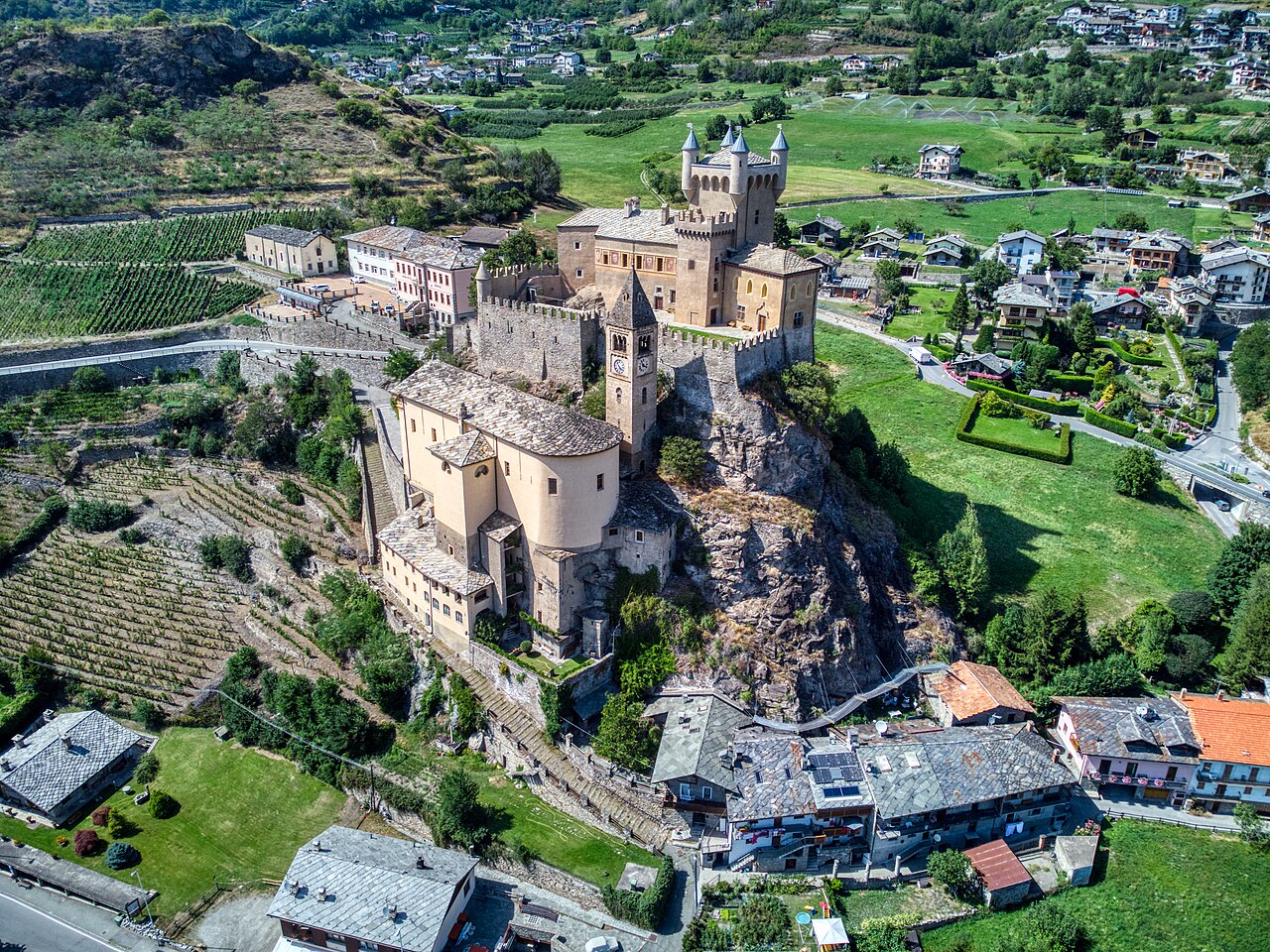
Châtel-Argent castle stands as a remarkable example of medieval military architecture nestled on a commanding hilltop in Villeneuve, within the Aosta Valley region of Italy. This high medieval hill castle has origins that trace back to prehistoric times, with archaeological evidence revealing continuous human presence through the Roman era, underscoring the site's long-standing strategic importance. The castle's name, translating to "Silver Castle," is believed to derive from a historic mint that once operated nearby, highlighting its economic as well as military significance.
The castle's earliest documented mention dates to 1176 under the Latin name Castrum Argenteum. Its development into the formidable fortress visible today largely occurred during the late 13th century, around 1275, under the direction of James of Saint Georges, the renowned architect serving Count Peter II of Savoy. Unlike many contemporaneous fortifications, Châtel-Argent remained continuously under the control of the House of Savoy, despite changes in local lordship among families such as the Bards, Challants, and Roncas.
Historical significance and early use
The site of Châtel-Argent was initially used by the Salassi tribe, a mountain people who fortified the location to control the critical Dora Baltea valley. Roman influence further cemented its strategic value, with fortifications likely enhanced during that period. The castle's primary role throughout the medieval era was as a defensive refuge rather than a permanent residence, providing shelter for feudal lords and their retainers during times of conflict.
Adjacent to the fortress is a Romanesque chapel dedicated to Saint Columba of Sens, constructed between 1050 and 1070. This chapel, located just outside the castle's defensive walls, reflects the site's religious importance and the integration of spiritual and military functions within the complex.
Architectural features and fortifications
The castle occupies a roughly rectangular area measuring approximately 90 by 70 meters, enclosed by a sophisticated triple series of defensive walls. These fortifications were designed to protect a sizable population, estimated to be up to 2,000 people in times of danger, indicating the castle's role as a major stronghold in the valley.
The cylindrical donjon
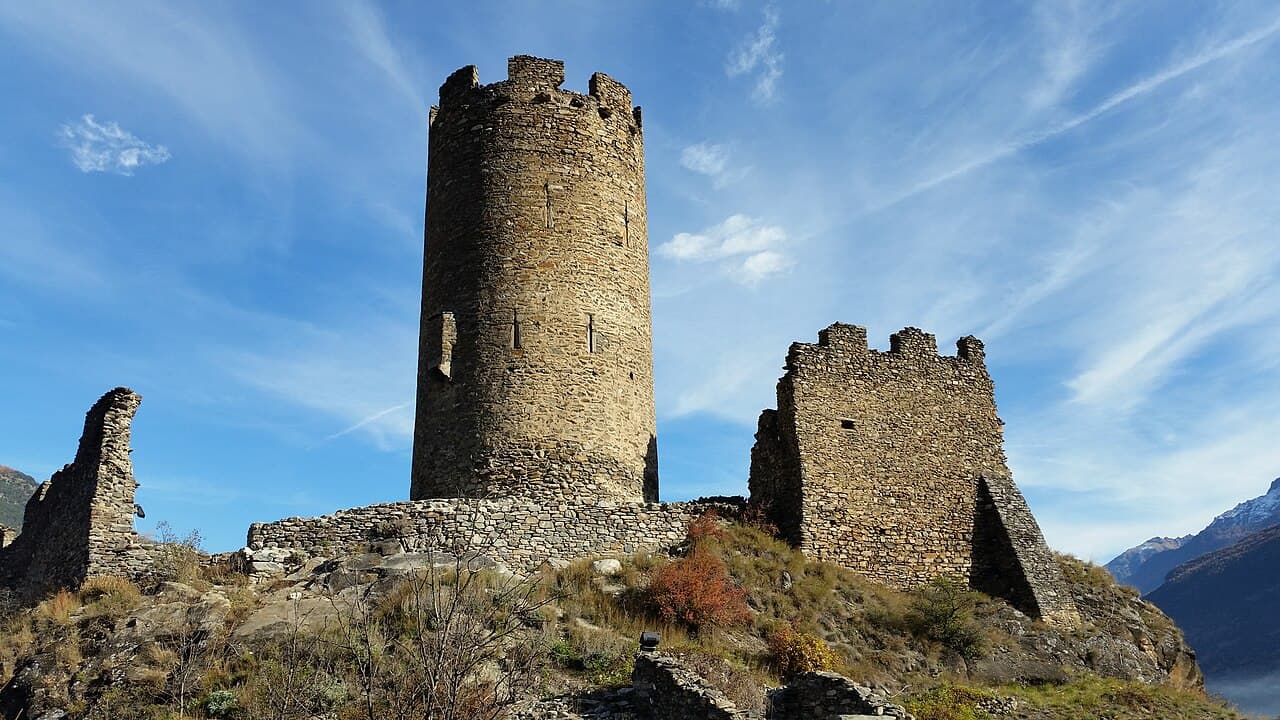
The most prominent surviving feature is the cylindrical donjon or keep, rising about 16 meters tall with an external diameter close to 9.5 meters. This tower exemplifies 12th-century military architectural innovation, with its circular form reducing vulnerable wall lengths and enhancing defense. The donjon's entrance is uniquely positioned approximately 8 meters above ground level, allowing defenders to retract ladders and prevent enemy access during sieges.
Other structures and water cistern
Within the enclosure, remnants of various buildings survive, including a water cistern that would have been crucial for sustaining the castle's occupants during prolonged sieges. These structures hint at the complex internal organization necessary to support a large garrison and population.
Material and local economic connections
The castle is built on a rocky outcrop of bardiglio, a distinctive grayish-green silicate marble quarried extensively in the area. These quarries, active since Roman times and intermittently used into the 19th and 20th centuries, link the castle not only to military history but also to local economic activities, including stone extraction and trade.
Access and preservation
Access to the castle ruins is via La Rampa, a steep, paved staircase carved directly into the valley rock face in 1817. This path connects the village of Villeneuve with the castle and the nearby Marian church, illustrating the site's continued cultural relevance well beyond its military use.
Today, the ruins of Châtel-Argent cover approximately 6,300 square meters, offering visitors a glimpse into its former grandeur. The castle's ability to shelter up to 700 people during times of danger reflects its strategic importance and the scale of its fortifications. The site remains a significant cultural and historical landmark within the Aosta Valley, attracting interest for its architectural features, historical depth, and scenic location overlooking the Dora Baltea valley.
Frequently asked questions (FAQ)
- How do I reach Châtel-Argent castle from Villeneuve?
- You can reach Châtel-Argent castle by walking up La Rampa, a steep staircase carved into the rock face of the valley wall, starting from Villeneuve village. The path is paved and well-marked, making the ascent feasible for most visitors with reasonable fitness.
- What is the historical significance of Châtel-Argent castle?
- Châtel-Argent castle served as a strategic defensive refuge for the House of Savoy and local feudal lords from the 13th century onward. Its location controlled the important Dora Baltea valley, and its name reflects a historical mint nearby, linking it to economic as well as military history.
- Can I visit the Romanesque chapel dedicated to Saint Columba?
- Yes, the Romanesque chapel dedicated to Saint Columba of Sens is located just outside the castle walls and can be visited. It dates from the mid-11th century and features distinctive architectural elements such as a three-panel façade and decorative arches.
- Is the castle suitable for families and children to visit?
- The castle ruins involve some walking on uneven terrain and climbing stairs, including La Rampa. Families with children can visit, but should be prepared for a moderately challenging hike and take care on the rocky paths.
- When is the best time to visit Châtel-Argent castle?
- The best time to visit is during the late spring through early autumn months when weather conditions are favorable for hiking and exploring the ruins. Winter visits are less advisable due to snow and ice on the access paths.
Photo gallery

Information
Sources & official resources
Verify the information above using these authoritative references.
Loading map...
Visitor reviews
No reviews yet. Been here? Write the first review and help other travelers!
Write the first reviewVisited this castle? Share your experience
Your review helps other travelers and adds first-hand knowledge to our encyclopedia.