Aymavilles Castle
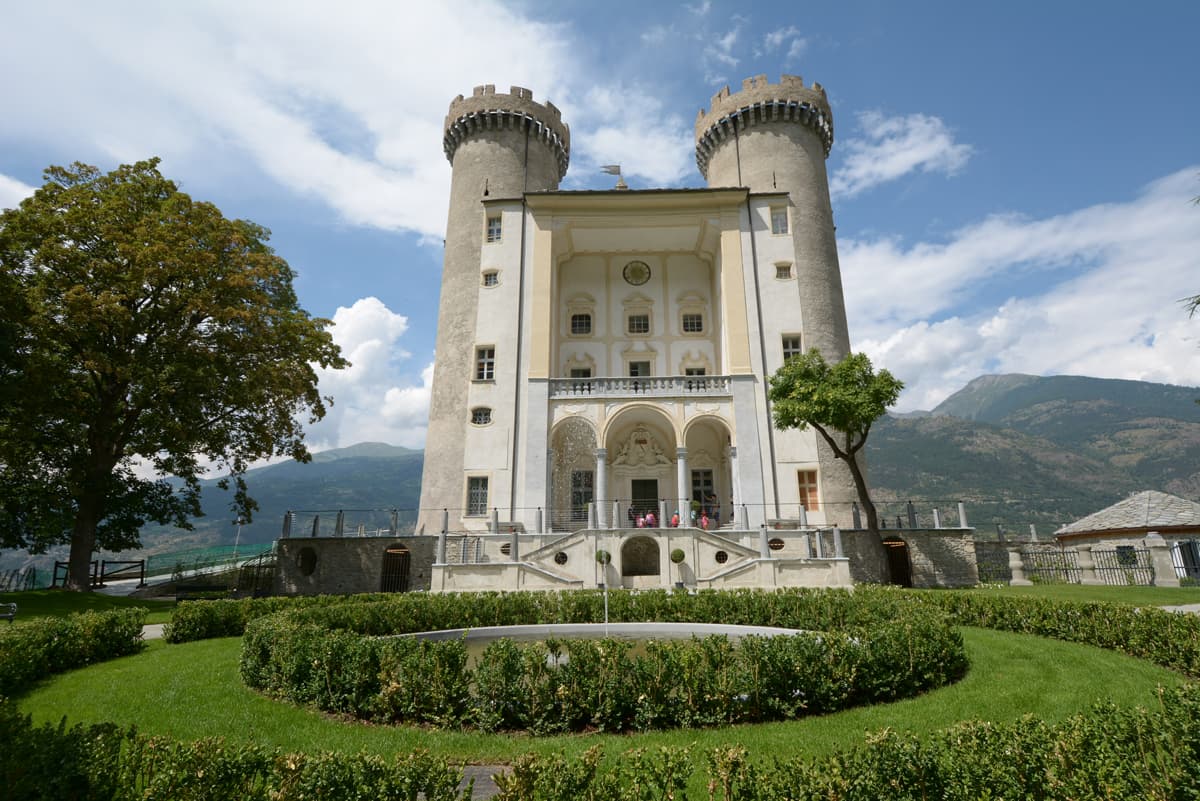
Aymavilles Castle stands prominently on a morainic hill at the entrance of the Cogne valley in the Aosta Valley, Italy. This hill castle is renowned for its distinctive quadrangular plan crowned by four imposing cylindrical towers at each corner, each topped with battlements and murder holes designed for defense. The castle's strategic location oversees the confluence of the Dora Baltea and Grand Eyvia rivers, controlling a vital route along the ancient Roman consular road connecting Milan to Lyon. Its position also provided access to nearby marble quarries in the Val di Cogne, underscoring its military and economic significance.
Originally constructed in the 12th century, the castle's earliest form was a fortified residence or casaforte, surrounded by a protective wall that safeguarded the local population. Early records dating back to 1207 describe the castle as a simple four-sided tower enclosed within walls, following the architectural typology common among Valdostan castles such as those at Écours and La Mothe. Over time, the castle underwent extensive modifications reflecting changing defensive needs and residential tastes.
Medieval architecture and defensive features
During the 13th and 14th centuries, the castle's fortifications were significantly enhanced. The original tower was expanded, and a secondary defensive wall with a moat and drawbridge was added to reinforce its protection. In 1357, the castle came under the control of Aimone de Challant, who implemented major improvements including the construction of the four distinctive cylindrical corner towers. These towers vary in diameter and height and feature battlements supported by corbels (beccatelli). Notably, two towers bear Guelph emblems while the other two display Ghibelline motifs, symbolizing the medieval political factions that shaped Italian history.
The towers are interconnected by galleries and loggias, covered walkways that allowed defenders to move swiftly along the walls. Additional defensive turrets punctuate the curtain walls, enhancing the castle's ability to repel attackers. The use of local materials such as tuff and bardiglio marble from the Val di Cogne quarries adds both strength and regional character to the structure.
Transformation into an elegant rococo residence
By the 18th century, the castle's military role diminished, and it was transformed into a refined noble residence by Baron Joseph-Félix de Challant. This transformation involved the demolition of the outer fortifications, including the moat and second defensive wall, replaced by terraced gardens and a large park. The castle's entrance was enhanced with a grand double-ramp staircase, and the gardens featured an ornate baroque fountain and elegant baroque loggias linking the towers.
The interior decoration reflects the tastes of the 19th century, showcasing a rich array of motifs from neo-Gothic and chinoiserie to mythological, naturalistic, and neo-Egyptian themes. These decorative elements were carefully restored during recent conservation efforts, highlighting the castle's layered history and artistic significance.
Historical ownership and restoration efforts
The castle remained in the hands of the Challant family until 1857, after which it passed through various private owners including Count Clemente Asinai Verasis di Castiglione and Senator Giovanni Bombrini. Bombrini's ownership was notable for the discovery of medieval paintings in the attic, enriching the understanding of the castle's artistic heritage.
In 1970, the property was acquired by the Italian state and transferred to the regional government of Aosta Valley. A comprehensive restoration program began in 2013 and concluded in 2021, focusing on preserving the castle's architectural integrity and preparing it for public access as a museum. Today, visitors can explore a four-level museum route that includes exhibitions on the castle's noble families, 19th-century collections, and medieval art from the Académie Saint-Anselme. The exposed 15th-century wooden roof trusses and multimedia displays offer insight into the castle's construction and evolution.
Castle grounds and auxiliary buildings
Adjacent to the main structure is a restored stable building with a traditional stone roof, as well as the "grandze," a Valdostan farm building now used for temporary exhibitions and cultural events. The terraced park surrounding the castle descends toward the village and features a lined avenue of horse chestnut, cypress, and linden trees, reflecting the 18th-century landscape design by Baron Joseph-Félix de Challant.
The castle and the nearby Pompiod mines are recognized as a Site of Community Interest, emphasizing their cultural and environmental importance within the region.
Frequently asked questions (FAQ)
- How do I get to Aymavilles Castle?
- Aymavilles Castle is conveniently located in Aymavilles, Italy, approximately 7 km from the city of Aosta. You can reach the castle by car, taking the SS26 road, or by public transport, with local buses connecting Aymavilles to Aosta. Parking is available near the castle for visitors.
- What is the historical significance of Aymavilles Castle?
- Aymavilles Castle dates back to the 14th century and was built as a defensive structure for the region. It is an excellent example of medieval architecture and reflects the feudal history of the Aosta Valley. The castle offers insights into the life and times of its former inhabitants, the Counts of Aymavilles.
- When was Aymavilles Castle built?
- The construction of Aymavilles Castle began in the late 14th century, specifically around 1300. It was completed in the following decades, serving as a residence and a stronghold for the local nobility. The castle has undergone various restorations to preserve its historical integrity over the centuries.
- Can I enter Aymavilles Castle?
- Yes, visitors can enter Aymavilles Castle to explore its fascinating history and architecture. Guided tours are often available, providing insights into the castle's past and its significance in the region. It's advisable to check the current visiting guidelines and tour availability before your visit.
- Why is Aymavilles Castle a popular tourist attraction?
- Aymavilles Castle attracts tourists due to its stunning architecture, rich history, and picturesque location. The castle offers beautiful views of the surrounding mountains and valleys, making it a perfect spot for photography. Additionally, its proximity to Aosta and other historical sites enhances its appeal to travelers.
- Is it possible to visit Aymavilles Castle year-round?
- Aymavilles Castle is typically open to visitors from spring through autumn, with limited hours in the winter months. It is advisable to check the official website or contact local tourism offices for the exact opening hours and any seasonal events. Visiting during the warmer months allows you to enjoy the beautiful gardens and surrounding landscape.
- What are the ticket prices for Aymavilles Castle?
- Ticket prices for Aymavilles Castle vary depending on the season and whether guided tours are included. Generally, entrance fees are affordable, with discounts available for children, students, and seniors. It's best to verify the latest pricing information before your visit to plan accordingly.
- What are the best times to visit Aymavilles Castle?
- The best times to visit Aymavilles Castle are during the spring and early autumn months when the weather is pleasant, and the gardens are in full bloom. Visiting during these seasons allows you to enjoy the natural beauty surrounding the castle. Additionally, weekdays tend to be less crowded than weekends.
- Are there any nearby attractions to visit after Aymavilles Castle?
- Yes, there are several nearby attractions to explore after visiting Aymavilles Castle. The historic city of Aosta is just a short drive away, featuring Roman ruins and charming streets. Additionally, the beautiful Gran Paradiso National Park offers stunning hiking trails and breathtaking scenery for nature enthusiasts.
Photo gallery

Information
Website
Visit websiteSources & official resources
Verify the information above using these authoritative references.
Loading map...
Visitor reviews
No reviews yet. Been here? Write the first review and help other travelers!
Write the first reviewVisited this castle? Share your experience
Your review helps other travelers and adds first-hand knowledge to our encyclopedia.