Saint Maire Castle
Saint Maire Castle in Lausanne, Switzerland, stands as a remarkable example of late medieval fortified architecture. Constructed between 1397 and 1425, this castle was originally built to serve as the fortified residence of the Bishops of Lausanne. It remains a prominent symbol of the city's historical and political heritage, currently housing the Council of State of Vaud, the cantonal government. Recognized as a Swiss heritage site of national significance, the castle encapsulates centuries of religious, military, and administrative history.
Historical background and significance
The construction of Saint Maire Castle was initiated under Bishop Guillaume of Menthonay and completed by his successor, Guillaume of Challant. The castle was named after Saint Marius, the first bishop of Lausanne, reflecting its ecclesiastical origins. Serving as the bishop's residence until 1536, the castle witnessed a pivotal moment when Bernese forces captured Lausanne during the Reformation period. This event led to the secularization of the bishopric, and the bishop at the time, Sébastien of Montfalcon, famously escaped through a hidden stairwell within the castle.
Following the Bernese conquest, the castle's function shifted from a religious residence to a military and administrative center. The Bernese installed a bailiff and repurposed the castle as an armory. This transition marked a significant change in the castle's role within the region, reflecting the broader political and religious upheavals of the 16th century.
With the establishment of the canton of Vaud in 1803, Saint Maire Castle was designated as the seat of the cantonal government, a role it continues to fulfill. This continuity underscores the castle's enduring importance in the political life of the region.
Architectural features and style
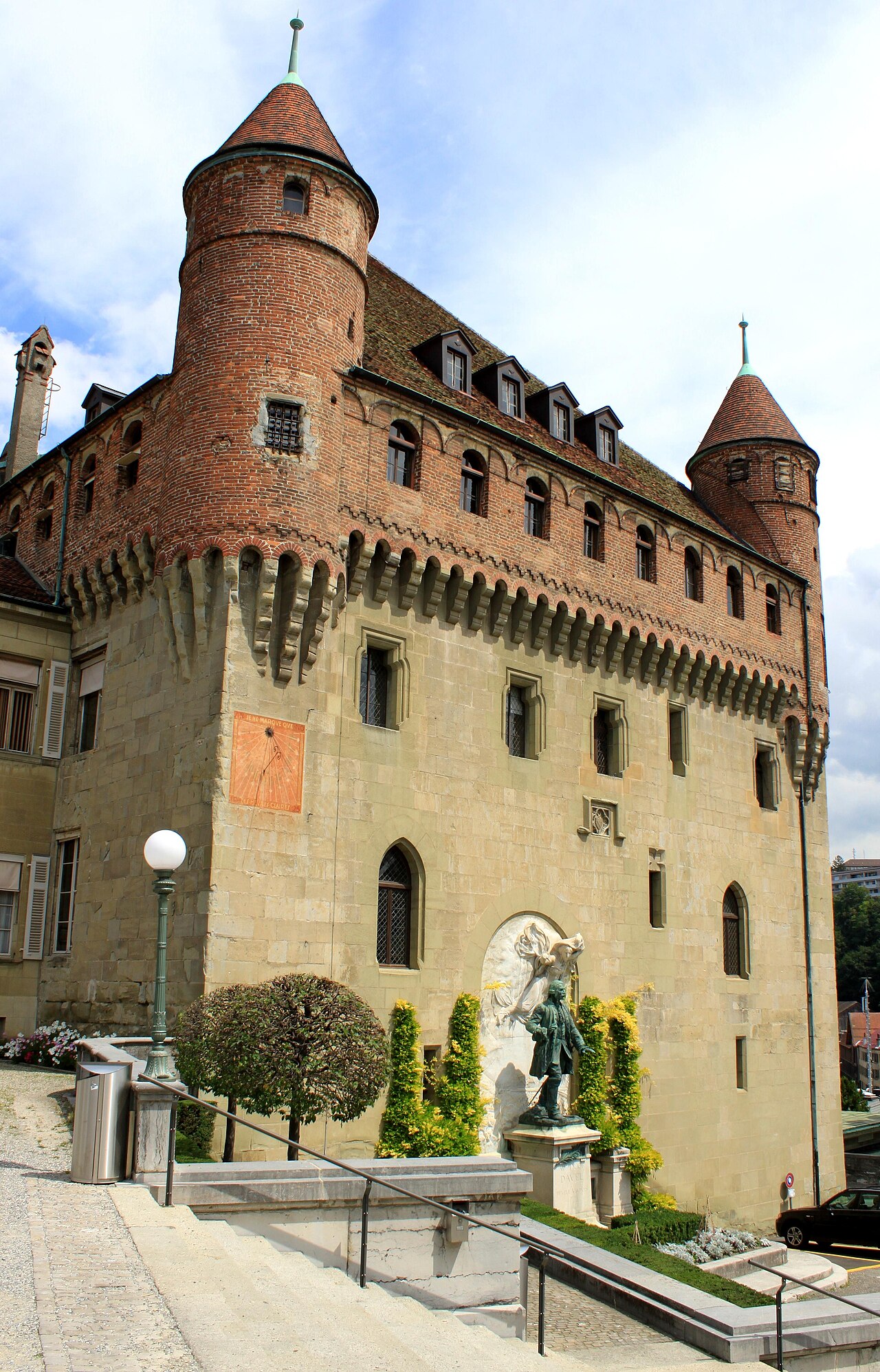
Saint Maire Castle was constructed as a single massive rectangular block, a common design for fortified residences of its time. The lower portion of the castle is built from sandstone, providing a sturdy foundation, while the upper portion is constructed of brick. This combination of materials was typical in the region and period, balancing durability with aesthetic considerations.
One of the castle's distinctive features was its original Ghibelline merlons, a style of battlement characterized by swallowtail-shaped crenellations, which imparted an Italianate appearance to the fortress. However, due to the wet climate of Lausanne, these merlons were later filled in and the roof extended, likely during the 16th century to improve weather protection. The windows located just below the eaves fill the gaps between the merlons, with arches above them echoing the v-shaped openings typical of Ghibelline design.
In 1789, the Bernese authorities added an annex on the west side of the castle, which now serves as the main entrance. This addition reflects the evolving use and adaptation of the castle over time. A tower that once stood adjacent to the castle was demolished in 1890, and around the same period, a statue of Abraham Davel, a local historical figure, was installed against the front wall, adding a commemorative element to the site.
Cultural and political role through the centuries
Throughout its history, Saint Maire Castle has played a multifaceted role, transitioning from a religious fortress to a military stronghold and finally to a center of civil administration. Its survival and continuous use highlight its architectural resilience and adaptability.
As the seat of the Council of State of Vaud, the castle remains a vital institution in the governance of the canton. Its historical significance is celebrated locally and nationally, contributing to the cultural identity of Lausanne and the wider region.
Preservation and current status
Today, Saint Maire Castle is well preserved, maintaining much of its original late medieval character despite modifications over the centuries. Its designation as a Swiss heritage site of national significance ensures ongoing protection and conservation efforts.
The castle is accessible to the public during certain events and offers visitors a glimpse into the rich history and architectural heritage of Lausanne. Its imposing structure and historical ambiance make it a notable landmark for tourists and scholars alike.
Notable architectural elements
- Rectangular block structure: The castle's massive rectangular form exemplifies medieval fortress design.
- Ghibelline merlons: Originally featured distinctive swallowtail battlements typical of Italian medieval architecture.
- Material composition: Sandstone lower walls with brick upper sections, balancing strength and style.
- Annex addition: The 18th-century annex on the west side serves as the current entrance.
- Hidden stairwell: Historical escape route used by Bishop Sébastien of Montfalcon during the Bernese conquest.
- Statue of Abraham Davel: Installed in the late 19th century, commemorating a local hero.
Frequently asked questions (FAQ)
- How do I get to Saint Maire Castle?
- Saint Maire Castle is easily accessible by public transport from Lausanne city center. You can take a local bus or tram to the nearest stop, followed by a short walk to the castle entrance.
- What is the historical significance of Saint Maire Castle?
- Saint Maire Castle dates back to the 14th century and served as a residence for the Counts of Lausanne. It played a crucial role in the region's political and military history, making it a significant landmark in Switzerland.
- When was Saint Maire Castle built?
- Construction of Saint Maire Castle began in the late 13th century and was completed in the early 14th century. Over the years, it has undergone various renovations, preserving its historical architecture while adapting to modern needs.
- Can I take guided tours of Saint Maire Castle?
- Yes, guided tours are available at Saint Maire Castle, offering visitors insight into its rich history and stunning architecture. Tours are conducted in multiple languages, and it's advisable to book in advance for a better experience.
- Why is Saint Maire Castle a popular tourist attraction?
- Saint Maire Castle is popular due to its impressive architecture, historical significance, and stunning views of Lake Geneva. Visitors are drawn to its beautiful grounds and the opportunity to learn about the castle's storied past.
- Is it possible to host events at Saint Maire Castle?
- Yes, Saint Maire Castle offers facilities for hosting various events, including weddings and corporate meetings. The picturesque setting and historical ambiance make it a unique venue for special occasions.
- What are the opening hours for Saint Maire Castle?
- Saint Maire Castle is open to visitors from 10 AM to 6 PM, with extended hours during the summer months. It is advisable to check the official website for any seasonal changes or special closures.
- What are the ticket prices for visiting Saint Maire Castle?
- Ticket prices for Saint Maire Castle are reasonably priced, with discounts available for students and seniors. Children under a certain age may enter for free, making it an affordable destination for families.
- When is the best time to visit Saint Maire Castle?
- The best time to visit Saint Maire Castle is during the spring and early fall when the weather is mild and the gardens are in full bloom. Summer can be busy with tourists, while winter may limit access to some outdoor areas.
- Are there any nearby attractions to visit along with Saint Maire Castle?
- Yes, nearby attractions include the beautiful parks along Lake Geneva, the Olympic Museum, and the historic Old Town of Lausanne. These sites offer a rich cultural experience and complement your visit to the castle.
Information
Website
Visit websiteSources & official resources
Verify the information above using these authoritative references.
Loading map...
Visitor reviews
No reviews yet. Been here? Write the first review and help other travelers!
Write the first reviewVisited this castle? Share your experience
Your review helps other travelers and adds first-hand knowledge to our encyclopedia.