Grandson Castle
Grandson Castle, perched on the shores of Lake Neuchâtel in Switzerland, stands as a remarkable example of a high medieval hill castle with a rich history spanning nearly a millennium. Constructed originally in the 11th century by the Lords of Grandson, the castle was strategically positioned to control the vital coastal road along the lake, serving as a formidable seat of power and defense in the region.
The castle’s early history is closely tied to the rise of the House of Grandson, a noble family first mentioned in records from the latter half of the 11th century. This family produced influential figures, including bishops in several important dioceses such as Basel, Lausanne, Toul, and Verdun. Their expanding influence often led to conflicts with nearby religious institutions, notably the monastery of Romainmôtier.
The lords of Grandson and their legacy
The most prominent figure associated with the castle is Otto I of Grandson, who undertook significant rebuilding efforts in the 13th century. Otto I was a notable military leader and diplomat, closely allied with Prince Edward of England. He accompanied Edward on the Eighth Crusade in 1271 and participated in the conquest of Wales in 1283. His military career extended to commanding crusader forces at the unsuccessful siege of Acre in 1291 and leading campaigns against rebellious cities such as Lausanne in 1313.
Otto I's diplomatic skills earned him the trust of powerful figures including the Pope, the Holy Roman Emperor, and the kings of France and England. After his death in 1328, his brother William moved to England and established the line of the Lords of Grandisson, while the main branch of the family remained influential in the region, closely allied with the House of Savoy.
Decline and political turmoil in the late medieval period
The family's fortunes declined towards the end of the 14th century. Members of the Grandson family faced serious accusations including forgery and involvement in the death of Amadeus VII, Count of Savoy. Notably, Otto III was defeated in a judicial duel in 1397, and John II was executed for sedition against the Duke of Burgundy. These events marked the end of the Grandson family's dominance, with their estates confiscated and transferred to other noble hands.
Grandson Castle in the Burgundian Wars
In the 15th century, Grandson Castle changed ownership several times, eventually belonging to Jacques de Savoie, an ally of Charles the Bold, Duke of Burgundy. The castle became a focal point during the Burgundian Wars when the Swiss Confederation captured it in 1475. The following year, Charles the Bold laid siege to the castle with a large mercenary army and heavy artillery. After the garrison surrendered, Charles ordered the execution of the defenders by hanging or drowning.
Unaware of this atrocity, the Swiss army advanced to relieve the siege, culminating in the Battle of Grandson on 2 March 1476 near the town of Concise. The Swiss forces achieved a decisive victory, routing Charles’s army and capturing a substantial treasure, parts of which are displayed in Swiss museums today. This battle was a significant humiliation for one of Europe's most powerful dukes and a pivotal moment in Swiss military history.
Architectural features and preservation
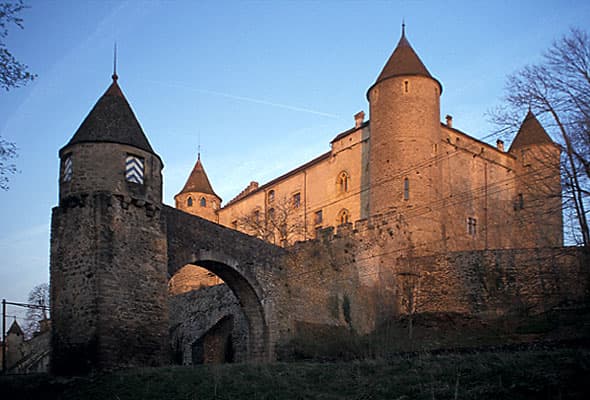
Grandson Castle is recognized as one of Switzerland's best-preserved medieval fortresses. Its complex layout includes multiple towers and fortified walls that reflect construction phases from the 11th to the 15th centuries. The original early 11th-century donjon, a square main tower, no longer stands but its remnants can be discerned on the northern wall facing the Jura Mountains. This donjon was likely dismantled during the construction of the castle's western section.
The castle features five tall round towers without battlements or machicolations, an unusual defensive design choice. One external tower, the Burgunder Tower, has a distinctive square base with a round upper third. Three fortified towers were added during Otto I’s reign in the late 13th century, as confirmed by dendrochronological dating. Later, around 1450, three additional towers were constructed near the lakeshore and within the town to bolster defenses against lake-based attacks.
Originally, the castle was directly adjacent to Lake Neuchâtel, using the water as a natural defense on its southeast side. However, in 1875, the lake's water level was lowered as part of flood control measures, leaving the castle some distance from the water and removing this natural protection.
Interior and museum collections
The castle's interior includes a Renaissance-era knights’ hall furnished with period seating, a torture chamber displaying instruments from the era, and a weapons hall exhibiting arms and armor from the Burgundian Wars. The weapons collection features crossbows, artillery pieces, and experimental combat devices, offering insight into medieval warfare technology.
Several museums operate within the castle complex. One museum is dedicated to the Battle of Grandson, featuring a detailed model with 2,200 lead soldiers. Another displays models of the castle and battle plans, while a regional history museum highlights the significance of Lake Neuchâtel in local culture and economy. The castle's cellar once served as a prison for the feudal court.
Later history and current status
After serving as the seat of bailiffs from Freiburg and Bern alternating every five years until 1798, the castle passed into private ownership. In 1875, it was acquired by Baron Gustave de Blonay and later inherited by his son Godefroy de Blonay. Today, the castle and its collections are managed by a foundation established by Bruno Stefanini, a notable Swiss patron of art and culture.
The castle grounds include two hectares of vineyards on the lakeside territory of the municipality of Concise, enhancing the site's cultural landscape. Grandson Castle remains a significant heritage site, attracting visitors interested in medieval architecture, Swiss history, and the dramatic events of the Burgundian Wars.
Frequently asked questions (FAQ)
- How do I visit Grandson Castle and what are the opening hours?
- Grandson Castle is open to visitors with guided tours available during the warmer months. Opening hours typically run from 10:00 to 17:00 daily in summer, but it is best to check the official website for seasonal variations and special events.
- What is the historical significance of Grandson Castle?
- Grandson Castle played a key role in controlling the Lake Neuchâtel coastal road and was central to regional power struggles during the High and Late Middle Ages. It is famous for its association with Otto I of Grandson and the pivotal Battle of Grandson during the Burgundian Wars.
- Can I see medieval weapons and artifacts at Grandson Castle?
- Yes, the castle houses a weapons hall with arms and armor from the Burgundian Wars, including crossbows and artillery pieces. Visitors can explore exhibits showcasing medieval military technology and the castle's role in historic battles.
- Is Grandson Castle accessible for visitors with mobility issues?
- While the castle has some uneven surfaces and stairs typical of medieval fortresses, efforts have been made to improve accessibility. Visitors with mobility concerns should contact the castle in advance to plan their visit accordingly.
- When was Grandson Castle built and who built it?
- Grandson Castle was originally built in the 11th century by the Lords of Grandson, a noble family who established their power in the Lake Neuchâtel region during the High Medieval period.

Information
Sources & official resources
Verify the information above using these authoritative references.
Loading map...
Visitor reviews
No reviews yet. Been here? Write the first review and help other travelers!
Write the first reviewVisited this castle? Share your experience
Your review helps other travelers and adds first-hand knowledge to our encyclopedia.