Saint Maire Castle, Lausanne
Saint Maire Castle, located in Lausanne, in the canton of Vaud, Switzerland, is a prominent example of a medieval hill castle that has evolved significantly through the centuries. Constructed between 1397 and 1431 by the bishops of Lausanne, it replaced an earlier episcopal residence that no longer fulfilled their needs. This castle stands as a testament to the religious and political authority wielded by the bishops during the Late Medieval period.
The castle is named in honor of Saint Marius (Saint Maire), a 6th-century bishop who relocated the episcopal seat from Avenches to Lausanne around the year 581, a strategic move prompted by the threat of Germanic invasions. This relocation marked a significant shift in the ecclesiastical center of the region and laid the foundation for Lausanne's later prominence.
Architectural features and defensive design
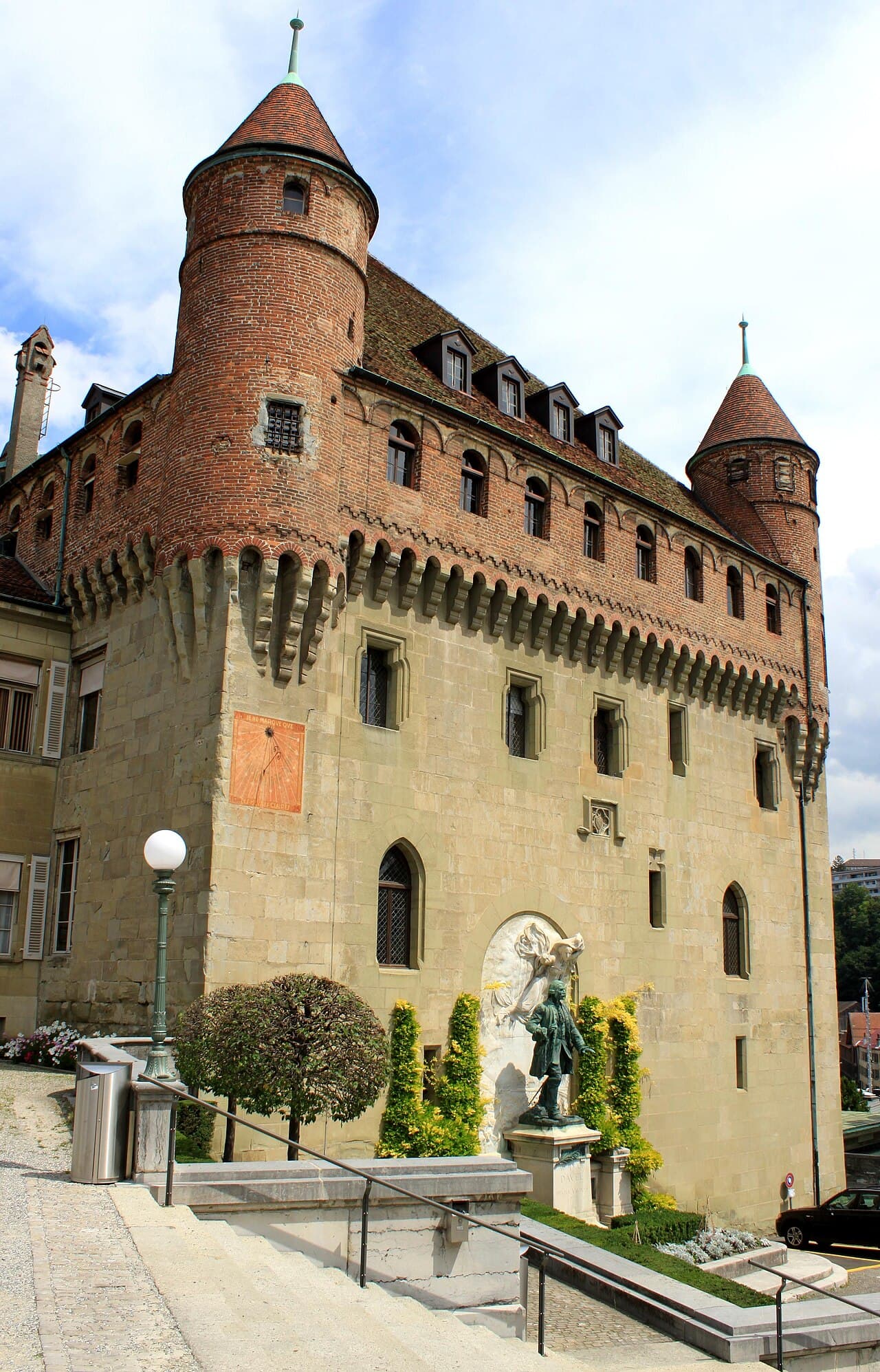
Saint Maire Castle is a large cubic structure measuring approximately 25 by 23 meters, with formidable walls 2.8 meters thick designed for defense and durability. The castle’s south façade rises to a height of 25 meters, emphasizing its imposing presence overlooking the city. The lower sections of the walls are constructed from gray molasse sandstone, a common regional building material, while the upper story features red brick, a distinctive contrast that highlights the castle's architectural phases.
One of the castle’s most notable defensive features is its machicolations—openings in the parapet used to drop projectiles or boiling liquids on attackers—which adorn the upper sections. Small corner turrets shaped like pepper pots provide additional vantage points for surveillance and defense. The roof is a four-sided pitched design standing 13.5 meters tall, with a distinctive ridge featuring two peaks.
Originally, the roof was crowned with Ghibelline merlons, a battlement style characterized by swallowtail-shaped notches that were popular in northern Italy. These merlons were later filled in during the 16th century, and windows were inserted just below the eaves, filling the spaces between the original battlements. The arches of these windows echo the shape of the former merlons, preserving the castle’s medieval silhouette while adapting it for new uses.
The castle was historically separated from the city by defensive walls and a dry moat on its western side. Access was controlled via a drawbridge, which has since been filled in as the castle transitioned away from military functions. In 1789, a two-story annex was added to the west side, now serving as the main entrance. A nearby tower was demolished around 1890, reflecting changes in urban development and defensive needs.
Historical context and episcopal residence
Saint Maire Castle served as the fortified residence of the bishops of Lausanne until 1536. This period was marked by the castle's dual role as a religious seat and a symbol of episcopal power. The bishops undertook significant renovations between 1476 and 1517 under the leadership of Benoît de Montferrand and Aymon de Montfalcon. These renovations included the addition of murals decorating the interior walls and the installation of prison cells in the lower parts of the castle, reflecting its judicial and administrative functions.
The bishop’s chamber, renovated in the early 16th century, features the Montfalcon family coat of arms and motto, symbolizing the familial and political ties of the episcopal occupants. The chamber also contains 16th-century murals that some attribute to the artist Pierre Spicre, although this attribution remains a subject of scholarly debate.
The castle’s religious function ended abruptly in 1536 when Bernese forces conquered the Vaud region. The last bishop, Sébastien de Montfalcon, escaped through a secret stairwell within the castle during this conquest. Following this event, the castle ceased to be a religious residence and was repurposed under Bernese rule.
Bernese administration and later civic use
From 1536 to 1798, under Bernese control, Saint Maire Castle served as the administrative center for the Bernese bailiff. During this time, the castle’s defensive features were modified to suit its new role. The crenellations were filled in, and the roof was extended to improve insulation, signaling a shift from military defense to administrative functionality.
After the liberation of Vaud in 1798 and its establishment as a canton in 1803, the castle was adapted to serve as the seat of the cantonal government. It housed the Council of State and other executive offices, a role it continues to fulfill today. This transformation highlights the castle’s enduring importance as a center of regional governance.
Throughout the 19th and 20th centuries, the castle underwent various adaptations to accommodate administrative needs. The courtyard was reconfigured, facades were repaired, and 16th-century paintings were uncovered, adding to the castle’s historical and cultural value. A monument to Major Abraham Davel, a local hero executed nearby in 1723 for his resistance against Bernese rule, stands against the castle’s southern facade, linking the site to regional history and identity.
Restoration and preservation efforts
Recognized as a Swiss heritage site of national importance since 1920, Saint Maire Castle has been the focus of ongoing preservation efforts. A major restoration project from 2015 to 2018 modernized the castle’s facilities while carefully preserving its historical character. This included repairing facades, replacing stonework, and installing modern amenities such as an elevator to improve accessibility.
The restoration balanced the need for contemporary functionality with respect for the castle’s architectural heritage, ensuring that the structure remains a vital part of Lausanne’s civic landscape. Although the castle is generally closed to the public due to its role as the seat of the cantonal executive, its historical and architectural significance continues to attract scholarly interest and cultural appreciation.
Interior features and courtyard design
Inside, the castle retains elements from its medieval past alongside later modifications. The bishop’s chamber, with its heraldic decorations and murals, offers a glimpse into the castle’s ecclesiastical history. The prison cells in the lower levels reflect its judicial functions during the late 15th and early 16th centuries.
The courtyard was redesigned in the mid-19th century to include a raised esplanade with a balustrade and stairs, which reveals the base of the main tower, or donjon. This redesign enhanced the castle’s appearance and functionality as a government building while preserving key architectural features.
Frequently asked questions (FAQ)
- When was Saint Maire Castle built and by whom?
- Saint Maire Castle was built between 1397 and 1431 by the medieval bishops of Lausanne to serve as their fortified residence.
- What architectural styles are evident in Saint Maire Castle?
- The castle features a mix of architectural styles, including elements from the Late Medieval period such as machicolations and Ghibelline merlons, as well as later modifications reflecting its administrative use.
- Can the public visit Saint Maire Castle?
- The castle is generally closed to the public as it currently serves as the seat of the cantonal executive of Vaud.
- What significant historical events affected Saint Maire Castle?
- The castle was the episcopal residence until 1536 when Bernese forces conquered the Vaud region, leading to the bishop's escape and the castle's conversion to an administrative center.
- What restoration efforts have been undertaken at the castle?
- A major restoration from 2015 to 2018 modernized facilities, repaired facades, replaced stonework, and installed an elevator while preserving the castle's historical character.
Photo gallery

Information
Sources & official resources
Verify the information above using these authoritative references.
Loading map...
Visitor reviews
No reviews yet. Been here? Write the first review and help other travelers!
Write the first reviewVisited this castle? Share your experience
Your review helps other travelers and adds first-hand knowledge to our encyclopedia.