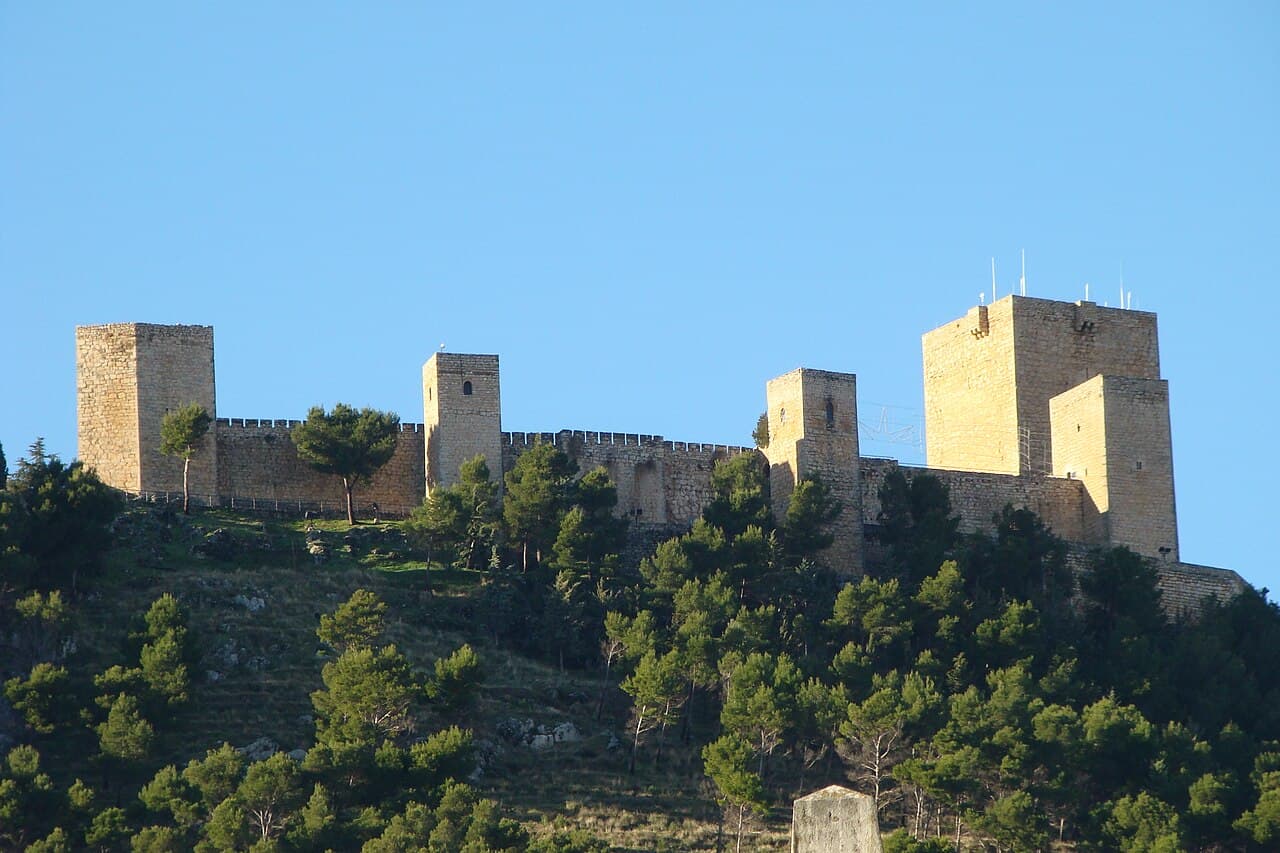
Saint Catherine's Castle
Saint Catherine's Castle (Castillo de Santa Catalina) dominates the Cerro de Santa Catalina, a strategic hill overlooking the historic city of Jaén, Spain. Its commanding position offers sweeping views over the Guadalquivir valley and the distant Sierra Morena mountain range, underscoring its military and strategic importance throughout centuries. Today, the castle is home to a parador, a state-run luxury hotel, blending historical preservation with modern hospitality.
The castle's origins trace back to the 8th century AD during the Early Medieval period when it was initially constructed as a Moorish fortress. This early fortress formed part of the Islamic defensive network during the time of Al-Andalus. The fortress was later enhanced by the Nasrid ruler Abdallah ibn al-Ahmar, the founder of the Emirate of Granada and the architect behind the renowned Alhambra. His improvements reinforced the castle's fortifications, adapting it to the evolving military technologies and political realities of the late medieval period.
Historical evolution and architectural development
Moorish origins and early fortifications
The earliest known structure on the site was a tower known as Hannibal's Tower, remnants of which survive near the current parador. The fortress was originally designed to control the surrounding territory and protect the city of Jaén from Christian reconquest efforts. Its hill castle classification reflects its elevated position, a common defensive strategy in medieval military architecture.
Christian conquest and transformation
In 1246, King Ferdinand III of Castile successfully captured Jaén after a prolonged siege. Following this victory, he initiated a significant transformation of the castle. This included the construction of the so-called New Castle on the eastern end of the hill, expanding the fortress to accommodate the changing needs of the Castilian crown. The bulk of the reconstruction and expansion occurred under the reigns of Alfonso X and Ferdinand IV, who reinforced the castle's defenses and adapted its structures to the military strategies of the time.
Structural components and notable features
The castle complex comprises five towers and a prominent donjon or keep. One of these towers houses the Chapel of Saint Catherine, reflecting the castle's dual role as both a military fortress and a place of worship. The donjon, a late addition to the castle, was commissioned by Miguel Lucas de Iranzo, the Constable of Castile, and represents the pinnacle of medieval military architecture at the site.
The builders of the new castle incorporated some of the original Moorish towers and ramparts, while others were demolished or replaced to suit the new defensive requirements. Unfortunately, the construction of the parador in 1965 led to the destruction of many elements of the Old Castle, leaving only a few remnants of the original fortress on the western side of the hill.
Later modifications and military use
17th-century remodeling
During the 17th century, the castle underwent interior remodeling, adapting some of its spaces for updated residential or administrative uses. These changes reflect the castle's evolving function from a purely military fortress to a more complex site with civil and ceremonial roles.
Napoleonic era military installations
In the early 19th century, during the Peninsular War, Napoleonic forces occupied the castle and added several military structures, including a gunpowder store, stables, a hospital, offices, a kitchen, and an artillery platform. Most of these additions have not survived beyond their foundations, but they illustrate the castle's continued strategic importance well into the modern era.
Symbolic elements and cultural significance
At the summit of the hill stands a monumental cross commemorating the one erected by Ferdinand III after his conquest of Jaén. This cross is a powerful symbol of Christian reconquest and the transformation of the castle's identity from Islamic to Christian rule. Engraved in the rock at the foot of the cross is the 'Sonnet to the Cross' by the poet Almendros Aguilar, adding a layer of cultural and literary significance to the site.
The castle's panoramic views and historical layers make it a key monument in Jaén's heritage. Its location overlooking the Guadalquivir valley connects it visually and historically to the broader landscape of Andalusia.
Modern use and visitor experience
Today, the castle houses a parador designed by the architect José Luis Picardo, which integrates modern hospitality facilities within the historic fabric of the site. This adaptation allows visitors to experience the castle's history firsthand while enjoying contemporary comforts.
Notably, General Charles de Gaulle stayed at the parador during the period he was writing his memoirs, linking the site to 20th-century historical figures as well.
Visitors to Saint Catherine's Castle can explore the remaining medieval fortifications, enjoy the views over Jaén and the surrounding countryside, and appreciate the blend of architectural styles and historical periods represented in the castle's fabric.
Architectural style and classification
The castle is primarily classified as a hill castle with architectural elements spanning from Early Medieval Moorish fortifications to later Christian medieval military architecture. The layering of Islamic and Christian construction phases is typical of Andalusian fortresses that changed hands during the Reconquista.
Preservation and condition
While the castle is largely well preserved due to ongoing maintenance and its adaptation as a parador, some original elements from the Moorish period survive only as ruins or archaeological remains, especially on the western side of the hill. The 20th-century interventions, including the parador construction, altered parts of the historic fabric but also ensured the site's continued use and conservation.
Frequently asked questions (FAQ)
- What is the best time to visit Saint Catherine's Castle?
- The best time to visit Saint Catherine's Castle is during spring and autumn when the weather is mild, making it ideal for exploring the hilltop fortress and enjoying panoramic views.
- How do I get to Saint Catherine's Castle from Jaén city center?
- Saint Catherine's Castle is located on Cerro de Santa Catalina, a short drive or a steep walk from Jaén city center. Local taxis and buses can provide access, but be prepared for an uphill climb if walking.
- Is it possible to stay overnight at Saint Catherine's Castle?
- Yes, the castle houses a parador, a luxury hotel, where visitors can stay overnight and experience the historic ambiance combined with modern comforts.
- What architectural styles are visible at Saint Catherine's Castle?
- The castle features a blend of Early Medieval Moorish fortifications and later Christian medieval military architecture, reflecting its history of changing rulers and adaptations.
- Are there guided tours available at Saint Catherine's Castle?
- Guided tours are often available through the parador or local tourist offices, offering detailed historical and architectural insights about the castle and its surroundings.
Photo gallery

Photo by Pepepitos•Public domain
Information
Architect
José Luis Picardo
Current owner
State museum
Loading map...
Visitor reviews
No reviews yet. Been here? Write the first review and help other travelers!
Write the first reviewVisited this castle? Share your experience
Your review helps other travelers and adds first-hand knowledge to our encyclopedia.


